Showing posts with label missionary work. Show all posts

Monday, October 12, 2015

And Let One Interpret

I am so excited about something that won't be in my life anymore. Not because I don't like it, but because I've finished it! Last week I finished translating the last lesson of our Sunday School curriculum into Xitsonga. I started this project over six years ago and finally have finished 212 lessons from A Beka Book's elementary Bible curriculum. Earlier I had translated 32 lessons with Firm Foundations, a chronological approach from New Tribes Mission.

I usually spent three to four hours per week in translating a lesson plus review questions, then another hour or so picking out a memory verse for the week, making memory verse visuals, and practicing teaching the lesson. I am very excited to have some more time in my week now that this lengthy project is finished! I am also happy when I think about national teachers being able to use these materials in the future when we have hopefully moved on to another church plant.

Once at a college graduation I attended, a man was awarded an honorary doctorate for having written curriculum for eight semesters of a one-day-per-week seminar. I tickled my fancy, awarding myself with an honorary doctorate for finally finishing this accomplishment. :) Not tooting my own horn, just enjoying finishing this "chapter." Oh, the work missionary women do that will go unheard of, unsung, or unnoticed. (By the way, much of what I write could apply to pastor's wives as well.) So share with me, are you working on any projects on your field right now? Have you finished any projects that excited you? I'd love to hear about it!
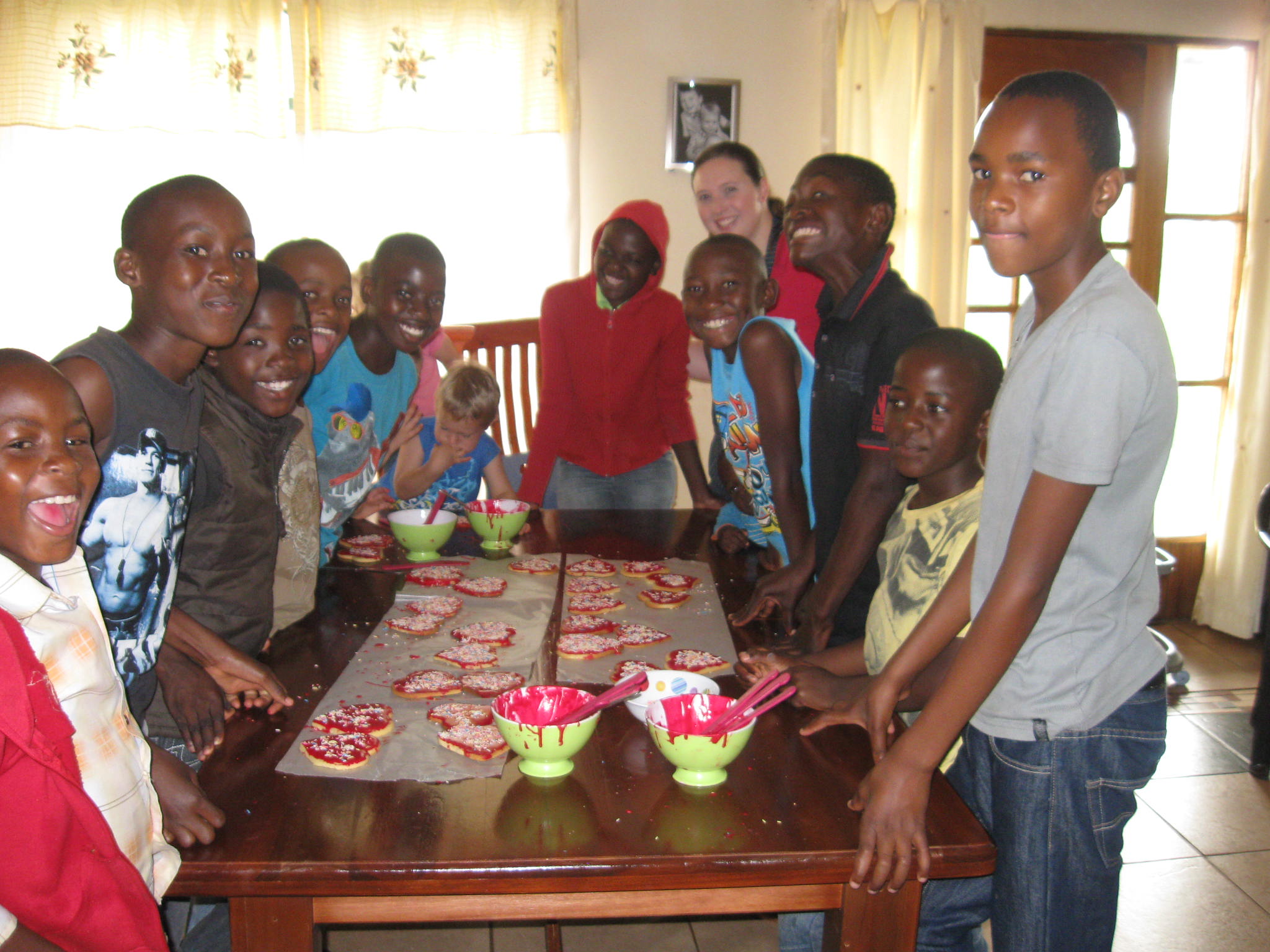
Decorating Valentine's cookies at a Sunday School party


Monday, September 15, 2014

That's Life in Africa!

A while ago, I shared a list of questions to ask missionaries; and in fact, I've even made up a questionnaire to ask other missionary women here at Baptist Missionary Women, but then I realized that I've never taken the time to answer them myself. So here are my answers to that questionnaire.

I am Amy Meyers, and I blog at Ita Vita African, which is Latin for "That's life in Africa!" I try to write on missions, whether generally or more specific to our field here in the rural villages of South Africa (like prayer letters or what a typical Sunday looks like for us) on Mondays, which I call Missional Monday. (I explain why I used the term "missional" here.)   I have a not-so-updated categorized list of my favorite posts on missions called Missions Musings.
  1. Children (how many? Ages?): We have four children, all born in April: Caleb (7), Colin (5), Callie (3), and Carson (2)
  2. Do you homeschool? Name your favorite curriculum that you use (whether just one subject, or an all-in-one): I use a mix of curriculum and lean classical in my philosophy of education, but probably my favorite curriculum specifically is The Story of the World (a 4-volume set on world history written in an engaging manner for grades 1-8), and more generally My Father’s World (more of an all-in-one scheduling history, science, Bible, art, and music), which utilizes Story of the World for some of its history assignments. I have researched quite a bit on homeschooling philosophies as well as reviewed several different curricula choices and am sharing that on my blog as well. Here is what we are using this year.
  3. Country of service: South Africa
  4. How long have you been there? My husband came single in June 2004, and I joined him after our marriage in 2005; I arrived in September.
  5. What do you do there? We are pioneering ministry amongst the Tsonga people, so after getting our feet wet and deciding where to live, we started a church called Elim Baptist Church. We also started a little Bible college called Limpopo Bible Institute and have graduated nine men, many of whom are pastoring in Zimbabwe currently. At this point, we have no students, however.
  6. Are you learning a language? How is it going? Are you discouraged? Yes, we minister in Xitsonga. We are not yet fluent, but other people consider us so. We can speak fairly well conversationally and translate lessons and sermons into Tsonga. Seth’s accent is much better than mine. In the beginning it was highly discouraging to learn Tsonga, but now we are encouraged. We actually began learning another tribal language at first, Xivenda, which I have lost quite a bit of, but Seth still uses at times.
  7. Success: Have you had any encouragement in ministry recently? Can you tell me two or three things that have encouraged you? Today, a young man in our church chose to follow Christ instead of living in immorality. This is a huge struggle for our young people, and therefore, a wonderful victory for his faith. Another encouragement is that our teammates (who do the same work as us in another village down the road) are having their opening service for their new church building this coming Sunday. We are also in a building project, and so it is encouraging to see their work come to completion!
  8. Challenges: What is your greatest challenge in ministry? What other difficulties wear you down? Probably the greatest challenge here is the African traditional worldview, which is so opposed to Christianity in general, and specifically to propositional thinking. It takes a long time to teach how to follow the logical steps of Biblical teachings, and further to integrate those truths into their lives and thoughts. Sometimes it seems that everything else (but specifically, their culture) trumps Christianity—and that that is how it will always be. The blindness and darkness of the culture is a drain that sucks our energy and will. The prosperity gospel and charismatic theology is also a huge challenge here.
  9. How is your life similar to life in America? South Africa is the richest African country, so there are several cities around the country that would look fairly American to an American visitor. In the cities you can go to grocery stores and buy products to cook almost all of the American recipes you desire (although you will have to cook more from scratch :)), and you can get technological items such as cameras or iPads (though they will be more expensive here). So we eat American foods most of the time, and although our data is limited, we now can even get wifi through cell phone technology. You might be really surprised to find not one, but two!, KFC’s in our own little village! (Since we moved here in 2006, they have built two strip malls in our village, which has become a hub for most of the villages around.)
  10. What are some special benefits you or your family experience from where you’re ministering? (or from being missionaries) We pay less for electricity because we live in the village, and until we had to purchase our well, our water was free from the municipality. (Of course, that’s also why we eventually had to buy the well, because the municipal water was highly undependable.) My point is that it’s cheaper to live in the village than to live in a city.  In general missionary children, in spite of the many difficulties they face, grow up with a broader view and knowledge of the world than if they’d stayed in America. We have all learned so much about the world and people, about the Gospel, and our own sinfulness, from being missionaries.
  11. What are some positives and negatives of your culture (that you’re ministering to)? Positives: freedom of religion, a general respect for whites (they view us as more educated and able in general), an enjoyment of children, generally friendly and hospitable; they know how to survive on little. Negatives: We have learned that culture is rooted in religion. African traditional religion has nothing to offer a culture. It is permeated with lying, fear and superstition, jealousy, immorality, drunkenness, greed, and laziness of body and mind. Christianity has had almost 2,000 years to change Western culture, but only 100-200 years or even fewer to affect sub-Saharan Africa. It will take much time and prayer to change their culture and worldviews to reflect Christianity instead of a stronghold of Satan.
  12. What sins might a missionary be especially tempted with that another Christian in the U.S. might not? This is actually a theme I’d like to cover in more depth soon, but here is a list of sins that missionaries are tempted with especially that my husband and I have come up with: laziness, bitterness, pride, discouragement, foolish planning, inconsideration, and being doctrinally superficial. And the longer I am here, I feel I must add cynicism to the list as well. Being here has brought to light so many personal secret sins that I didn’t fully realize before: anger and selfishness are two examples.
  13. What books have you been reading? Do you have any book recommendations? I would like to review more of my favorites on my blog, but haven’t found the time. I’ve got about 6 books reviews over there, including a couple of children’s books. This year I read a novel that was really a biography of John Calvin (Betrayal), which was interesting and spiritually helpful. (I did review that one.) My best book from this year is The Quest for Meekness and Quietness of Spirit by Matthew Henry. I'm blogging my way through that on Thursdays. For homeschooling, the most helpful books I’ve read thus far, which I recommend to all newbies, are The Well-Trained Mind by Susan Wise Bauer and 101 Top Picks for Homeschool Curriculum by Cathy Duffy (which walks you through the different educational philosophies, and then helps you match up your personal philosophy with great curricula that share that philosophy.) My favorite missionary biography so far (so moving!) is The Apostle by John Pollock (on Paul). If you like Christian fantasy such as The Chronicles of Narnia (which is incredible, unbeatable, by the way), I’d recommend a kinda new series for you called The Binding of the Blade by L.B. Graham. There are 5 books in the series, and they are hard to put down once you hit book 3.
  14. How can we pray for your people or culture in a general way? Pray that they would be willing and enabled by Christ to stand alone against their culture when needed and to persevere in the faith.
  15. How can we pray for your family specifically? That we also would persevere in our love and service to the people here. That Seth and I would be encouraged in our work and in the Lord. That our children would be converted and would find joy and friendship in one another, since they have no close Christian possibilities for friendship here. That we would know how to help our missionary kids handle the pressures of their lives in another culture—when to push them to reach out of themselves more, and when to understand and be gentle with them.

Monday, September 1, 2014

I Know What to Do! (I Think...)

Last week and the week before, I've been sharing three of our prayer letters from the past, which discuss ethical "dilemmas" missionaries sometimes face. I thought I'd share one last letter from two years ago. To be honest, it's my least favorite. But I hope you enjoy it, and perhaps you will recognize some items on the list that you've experienced yourself. I am interested to know if other missionaries have faced these same issues in their countries of service.
________________________________________________________________________


Last year about this time, I sent a list of ethical dilemmas that missionaries might face. Here’s a new slate of challenges. Of course, some of you will think the answers are obvious: last year two different people responded saying that one of the ethical tensions was obvious—unfortunately, they both gave the opposite answer. So, I’d like to ask again that you pray for us to be filled with the skill of thinking correctly in each situation.

1.     Should Christians tithe regardless of their financial circumstances?
If one of your church members lived in a one-room, corrugated iron shack away from his wife and child, and then one day got a $12 piece job, should he tithe on that amount? Give offerings? If he asked you what he should do, (remember he has a little girl and a wife to take care of as well), what Scripture would you counsel him with? Do you tell him to take care of his family because otherwise he has “denied the faith” according to 1 Timothy, or do you tell him to put money in the offering?

2.     Should you teach new converts how to vote?
There are more than a dozen political parties in this country, and very few of them (I know of only two) are pro-life. The most popular ones are socialistic or communistic. Should you spend valuable teaching and instructing time on politics, or stick with the Gospel and issues around sanctification?

3.     Should you pray for unconverted people in their presence?
We’re sitting at the Baloyi home for our weekly Bible study, and it is especially nice to have the father of the home there with us since he was back from work. What prayer requests do the believers have? The 16-year old daughter asks for public prayer for her father’s conversion. Is that unduly embarrassing or is that a good demonstration of evangelistic love?

4.     Should you church discipline or otherwise dismiss church members who are nearly permanently absent because of work?
We haven’t seen the four men on our membership role in months. One of them hasn’t been to a service in two years. They are all away because of work, but they tell me on the phone that there are no churches near them that teach the Gospel. How can I watch for their souls and keep them accountable; and if we can’t do that, in what sense are they members of this body?

5.     Should you give Bibles to people who can’t afford them?
Can’t afford them? What does that mean? It seems like everyone has money for satellite TV and cold drink (Coke). Should I just charge the list price, discount it, or give it free? And if you say, “Discount it. That’s the best of all options.” Then, how much?

6.     Should you use slang in formal settings if that is what communicates?
We’re trying to add enduring traditions to the worldview of those to whom we minister. Sunday afternoons, I am teaching about character, and the women’s Bible study is doing something similar. So, shouldn’t we use the strongest, purest Tsonga rather than the blend of English, Zulu slang that all the young kids are using from TV. But if they don’t know the old, classic Tsonga words should we just use the slang since they understand it? Knowat I’m sayin?

7.     Should you sing nominally Christian songs at a funeral?
Though a majority of people in my village claim to be Christian, I have learned that forms of syncretism are equally prevalent. So when at a funeral I hear the familiar song about Jesus which has as its complete lyrics “There is no one like you; we support ourselves by you,” should I join in to show solidarity or should I remain quiet because even Muslims could sing that song?

8.     Should I take parental oversight of believers who do not have parents or at least do not have Christian parents?
Most of the young people in our church do not have dads at home or have never known their fathers. Should I take the initiative to insert myself into their lives to guide them in ways that a father would? Or, should I teach father-like counsel from the pulpit? Does a dad’s counsel always have to a Scripture verse, or can I sometimes just give good advice about life? For example, “You should work really hard to learn English now, so that you will be able to get a job in the future.”

9.     Should you give new Christians jobs in church right away or wait until they prove faithful?
They’ve given their testimony and are prepared to be baptized. Now, should I find a place for them to serve, or is that being foolishly hasty?

10.  Should missionaries restrain the size of their family so that missions dollars can be used to send more families with less children?
This is probably the most controversial issue, and most people would probably leave it to the missionary. Maybe they’re right. But maybe not. Furlough, saving for college, insurance, and the rest can be very expensive. Should the churches just offer a fixed amount, or may the missionary raise more support if he can’t keep the same standard of living with 4 (or 6 or 8) that he had with 2? And what about all the missionaries running on the treadmill of deputation?

Having worked through these issues, I have a position on most of them. But it’s profitable for God’s people to think clearly in applying Scripture to life, so I hope this letter will serve to that end. Your comments and advice are always welcome. Please continue to pray for us and our church. 
_________________________________________________________________________

Some of these are personal and perhaps a bit touchy. I'm not trying to start debates or endless questions. Instead I hoped to foster a familial spirit as you perhaps will recognize questions that you and your families have mulled over during a meal and wondered if other people felt the same!

Monday, August 25, 2014

What to Do, What to Do?

Last week I showed you our recent prayer letter, which has become almost an annual edition, showing ethical "dilemmas" missionaries sometimes face. I thought I'd share a few more from our first letter. I am so interested to know if other missionaries have faced these same issues in their countries of service.
________________________________________________________________________


Since arriving in South Africa, I have been stretched in ways that I didn’t expect. Probably the most unexpected was the swirl of ethical decisions that I found confronting me at one time or another. So here is a top ten list of situations that I have had to face as a missionary. This list is calculated to motivate you to pray for us as well as other missionaries that we would be discerning, reflective, and Scriptural at all times for the sake of the Gospel.

1.     Should I give people a lift if I know they are going to a false church?
When driving the roads in SA, it is common to see people asking for a ride. We have a pickup truck that could easily take them. But many of the churches here love money and are therefore enemies of the gospel. They also encourage their members to wear uniforms so I can often tell which hitchhiker goes to which church. If I give them a lift, will they think I am endorsing their idolatrous religion, or will they see my love and know that my church is different?

2.     Should I evangelize a woman if she is the only adult home?
Now, rarely do I do Bible studies inside homes. Typically, we sit outside the home in the yard area. But my regular pattern of evangelism is 4-8 weeks of Bible studies in Romans. Does it send a bad message to people passing by if they see the pastor return multiple weeks to sit outside if there’s only a woman and her two children listening? Or, should I merely invite the woman to church if I see there is no one else there?

3.     Should I give a generous offering of my salary to our churchplant?
Like most churches we want to meet in a building with musical instruments and multiple rooms. If I tithed to our church with its present weekly offerings of about $3 would it create dependency and irresponsibility or would it be a tool for evangelism and churchplanting?

4.     Should I baptize a young person (child) who has given a testimony of salvation, but has not shown Christian maturity?
We often have youth with unsaved family members visit our church. Once they profess Christ, should they be immediately baptized in hopes that their baptism would encourage them to grow, or should they wait lest they quit their new church and give the name of Christ a bad testimony in the community?

5.     May I spend money on my family and personal standard of living even if it is above those in my village? What if it is very above? How much do I let them see?
When coming from America, it is difficult not to have more discretionary spending than the average person in our village. If I have a higher standard of living does that make them marvel at the power of the Christian worldview to create wealth or does that make them greedy of western money and afraid to approach me about the gospel? At what point, if ever, could my family’s western lifestyle hinder people from being converted?

6.     How harshly should I handle believers who fall into sin?
No one in our church has a heritage of Christianity. Everyone is a first generation Christian. None of them went to a Christian school or college. Should I be more patient with them than I would be with a US church member when they fall into sin, or should church discipline be equally strict in all cultures?

7.     Should I address cultural issues that are not clearly sin, but may not be consistent with a Christian worldview?
Littering. Receiving handouts from the government. Families not eating together. The Bible does not explicitly say these are sin, but a consistently Christian perspective will avoid them. If they are common in a culture should a pastor address them?

8.     Should I give jobs to church members?
In a country with 30%+ unemployment living in a village where nearly every adult would like a job, should “rich” missionaries employ church members? Will it communicate love or hamper the church’s ability to stand on its own? More importantly, will jobs attract unconverted people who would be glad to act Christian for a salary?

9.     Should I keep doing Bible studies at a person’s home if they have shown very little initiative?
Jesus told his disciples to shake the dust of their feet if the village would not hear them. If the family isn’t saved after my 4-8 weeks of Romans Bible studies should I leave and go somewhere else or should I stay if there’s even a little interest? How can you tell when to move on?

10.  Should I use expensive books, computers, and handouts to make my sermons as good as possible if I know that the next national pastor will not be able to keep the same standard?
Our people have greatly benefited from my library as it has wormed its way into my teaching and preaching. Will the people develop a taste for a style of preaching that the next pastor may not be able to give simply because he can’t afford Harold Hoehner on Ephesians?

________________________________________________________________________

Have you experienced similar quandaries, dear missionary friend? We'd love to hear your thoughts!


Monday, August 18, 2014

Ethics on the Mission Field

Being a missionary involves lots of little ethical choices that are not always easy to make.

I wanted to share with you our recent prayer letter in which we wrote down a recent scattershot "Top 10" ethical difficulties from the past year. This is actually our third "Ethical Dilemmas" prayer letter. These are always some of our most interesting and humorous prayer letters, because if people take the time to respond with their humble opinions, inevitably you'll get two people dogmatically on opposite sides of the coin regarding a certain ethical "dilemma"! This simply proves that these issues aren't as easy to decide as they might seem at the outset.

The point with these letters is not so much to ask advice, although we love to converse with people and get opinions! The point is to communicate that on the mission field, you may often find yourself in surprisingly sticky situations, trying to figure out what is expedient, what this or that communicates, and...what would Jesus do in this situation? We do have our own opinions on these situations, so some of them aren't exactly "dilemmas"; but some of them are tough!

Please feel free to leave your thoughts on our ethical "dilemmas" in the comments. Please also share if you have come across your own difficult ethical choices on your mission field! I'll try to unearth the first two letters with their ethical issues for future Missionary Mondays. By the way, I'd encourage you to share some of your own "ethical dilemmas" in a prayer letter to your supporters. It makes you seem more real and opens up some good conversations between you and your friends and supporters.

_________________________________________________________________

In July 2011, I sent out a list of difficult ethical situations our team has experienced. Another list came along in July 2012, but last year I took a break while we were in the US. The world has not gotten easier in the last two years so here are another ten conundrums that commonly confront us.

1.     Should I show frustration with incompetence?
If I’m purchasing at a shop and the employee is amazingly slow to help, is it justified to express that we are busy and would appreciate prompt service in exchange for our money? Would that communicate a Christian work ethic and personal responsibility or would it be one more example of American impatience?

2.     Should I sit with my wife and children in church even though many churches separate the men and women?
Traditionally, Africans do not mix the sexes at church and maybe at other public gatherings too. Should we be like them to win them, or is there some distinctly Christian virtue in a man sitting with his family? And this goes for dinner too. Most Africans do not eat their meals as a family: Must we teach them to do so?

3.     Should I spank village children?
On an average afternoon in the sunshine about 5-15 village children can be found playing in our yard. Once a 9-year old went home and brought a knife back because he and another boy had been fighting. He does not have a father living at home and probably will not get any discipline from the adults in his life. Should I discipline him so that he learns not to brandish weapons? What about the other little boy who stole our children’s toys (no dad there either)?

4.     Should I allow children to return to our yard if they have not been punished?
And when the children come to play on our grass, we have to decide whom to admit. Should we allow kids to return if they have done wrong but have not yet been punished? What about the younger brothers of our teenager neighbor who has repeatedly stolen from us? When he broke in he used some small boys to fit through our window. Was it them?

5.     Should I use loud speakers if that is what the culture wants?
Large speakers are used to amplify both speaking voices and music as a call to the village to signal that a social event is opened to the public. But they also are commonly found in parties where the purpose is entertainment or at churches where the purpose is to put on a show. Should we buy a set of 6-foot woofers to attract people to the church?

6.     Should I ever encourage someone to pay a bribe?
If a police officer pulls me over and asks, “Now what can we do because of your speed?” Is it always wrong to give him money so that you can go on your way? What about customs officials? And the situation is more complicated when we think of some of our Zimbabwean friends who have slender bank accounts. Could they pay an official to get through?

7.     Should I use a literal translation that is difficult to understand or a thought-for-thought translation that sometimes oversimplifies theological discourses?
Tsonga has two translations. The first from 1907, revised in 1929, is more literal than the recent 1989 Good News Bible. The modern is generally easier to understand, but is also looser than the earlier translation. The earlier translation has many words that no one knows; and just remember, the education level is low, and very few people have dictionaries. Both translation employ the same Greek text. Which one should I use? Or both?

8.     Should I rebuke unconverted people for sinful behavior?
I am returning from preaching at an evening Bible study as I walk on the road by my house. Two young people in the dark are preparing for sin near the corner as I near home. Should I rebuke them to have a moralizing effect on the community? Or should I ignore them because they are only doing what sinners do? After all, if they stopped that particular sin, it wouldn’t save them. Yet how can we be indifferent to blatant violations of God’s law?

9.     Should I open civil functions in prayer if the society is nominally Christian?
They don’t care about my gospel, but they are as one writer says, “incurably religious.” So they ask me to open their children’s graduation from kindergarten with prayer. Does that open a door for the gospel, or does it sanction their own baseless claims to being Christian?

10.  Should I feel obligated to stay in a place because of the investment of time and money?
Many villages need the gospel and ours has not been overwhelming in its response to our ministry. Should we stay here because we’ve put so much money into our house? Or because seeds take time to grow into trees with fruit? Or are we nearing the time to shake the dust off of our feet? It is difficult to know when we should endure all things for the elect’s sake and when we should preach the gospel where Christ has not yet been named.

Hopefully, these scenarios will inspire godly conversation and fervent prayer. Remember us with the words of Paul to the Philippians: “I pray that you would overflow with discerning love so that you will know what is right in any situation.” We would enjoy hearing from you if the mood betakes you to hit “reply.”

With Mind and Heart,

Seth and Amy Meyers


Monday, July 14, 2014

Lifting Christ Up--Down Under

I thought it would be so interesting for us to have some in-real-life missionaries answer those "Good Questions to Ask Missionaries" that I posted here a while ago. That way, you can compare fields a little bit and understand what missions ministry looks like all over the world. What difficulties are specific to a certain continent or culture? Perhaps you can apply this information to pray for other missionaries in a similar field to the lady being interviewed.


Today, meet Jennifer Bauer, the mastermind here at the BMW blog. She blogs about life in Australia at her personal blog Be Thou Exalted. If you haven't gotten enough of our awesome critter stories around here, you would be really interested in the kinds of critters a missionary to Australia has to deal with: The Critters and Creatures in My House.


  1. How many children do you have? What ages?
Autumn (11) and Cody (6) 
  1. Do you homeschool? Name your favorite curriculum that you use (whether just one subject, or an all-in-one):
We do homeschool.  Currently we use ACE. (Here is why I chose ACE for this school year.) But we have used Abeka, Apologia, Rod and Staff, and a mixture of others. 

  1. Country of service:  Australia
  1. How long have you been there?  2 years, 8 months
  1. What do you do there?
Currently my husband is interim pastor for a small church, but we were called here to work with the Indigenous People.  So when the new pastor arrives in two weeks, we will be going full-on with our new ministry with the Indigenous (Aboriginals). 

  1. Are you learning a language? How is it going? Are you discouraged?
We are planning to learn Kriol, which is the Indigenous language spoken in our area.  Most of the Indigenous speak English, but we feel it’s important and respectful to learn their language.

  1. Success: Have you had any encouragement in ministry recently? Can you tell me two or three things that have encouraged you?
We have had many open doors to go and have church services in the communities.  One cannot just walk onto a community, you must be invited.  My husband has had many invitations the past few weeks, and we can see the Lord making the way for us.  We’re so excited!  I also have my youngest brother visiting for 3 months.  This has been a huge encouragement for me.

  1. Challenges: What is your greatest challenge in ministry? What other difficulties wear you down?
Although we are quite remote, we still have a stocked grocery store, wifi, and even a small Target, so in regards to location we are blessed not to have too many challenges.  I think our greatest challenge in ministry will be reaching the Indigenous men.  Alcohol (grog as they call it here) is a major detriment and a common past time for the men. 

  1. How is your life similar to life in America?
There are many similarities to America.  Although we don’t have some of our favourites (Lucky Charms, Captain Crunch, Cracker Barrel, etc.) we do have the modern conveniences (indoor plumbing, wifi, McDonalds, Subway, grocery store 2 minutes away, etc.)

  1. What are some special benefits you or your family experience from where you’re ministering? (or from being missionaries)
To be able to share the Gospel with someone who has never heard of Christ is just an amazing privilege.

  1. What are some positives and negatives of your culture (that you’re ministering to)?
I’m speaking more of the Australian culture rather than Aboriginal culture here.  The positives is the freedom of religion, a very relaxed, laid back attitude among the people (no one is ever on time!), and the welcoming of Americans (for the most part, there are a few Aussies who prefer the Yanks stay home J ).  Negative – hmmm…it’s hard to think of any, but if I had to say one thing, I guess it would be the amount of alcohol that is consumed here by the Indigenous and the white fellow.

  1. What sins might a missionary be especially tempted with that another Christian in the U.S. might not?
Not sure how to answer this one.  The only thing I can think of is that nudity can be shown on tv here after a certain time.  As well as any kind of language.

  1. What books have you been reading? Do you have any book recommendations?
I am currently reading Growing Up Duggar.  I definitely recommend!  My favourite missionary books are Evidence Not Seen by Darlene Diebler Rose and Jungle Pilot by Russell Hitt.

  1. How can we pray for your people or culture in a general way?
Please pray for us as we begin this new phase in our ministry in working with the Indigenous People.  Please pray that we are sensitive to the Lord’s leading and to the people we are called to witness to. 

  1. How can we pray for your family specifically?
That we will continue to grow closer to the Lord, for His safety and protection while travelling to communities, and as a selfish request, that we will be able to take a short furlough home for 6 weeks to be with our family during Thanksgiving and Christmas.