Showing posts with label missionary job descriptions. Show all posts

Monday, June 2, 2014

The Many Jobs of a Missionary ~ Exterminator, Flying Creatures

These flying creatures I don't mind. Gold finches build hanging nests in the tree right outside of our study, and we feast our eyes on them every spring.
Now that you are fully creeped out by my former descriptions of Africa as THE home of all things crawly and fascinating, I thought I'd wrap it up with those nightmarish descriptions of things that can take wing and follow you or actually get-in-your-face:

Mosquitoes

Annoying, loud or silent, deadly at times, and incessant. Not so bad here in our home, but terrible--causing sleepless nights--if you cross the border to Zimbabwe or Mozambique. We can get malaria here, but it's uncommon. Just a little farther to the north, it is both common and deadly. I wrote a bit about my fears concerning malaria here. We've become experts at homemade window screens and all forms of insect repellant--electrical plug-ins, sprays, creams, roll-ons, burning smoke coils.

Wasps
We catch all of these insects and draw them for our nature journal.
We catch insects and draw them for our nature journal.

Interestingly, it took a nature reader from a Christian publishing company to figure out what kinds of wasps continually built under the eaves of our house. They are the paper wasp.

You know, I've noticed--get ready for something really profound here--that critter issues are worse the farther from city life you go. I know, that's a shocker. But on my one trip to very rural Mozambique, I noticed the bugs everywhere! You couldn't even enjoy a quiet time with the Lord without feeling like you'd sat in an ants' nest or should just start waving away mosquitoes full-time.

On one trip to Mozambique, our teammate left his truck's windows down overnight. The next morning, to all the guys' dismay (especially to another teammate, who is allergic), the truck was full of bees. The guy with an allergy got far away; and the other wrapped a tarp around himself showing only his eyes, eased himself into his truck, and drove full speed down the road with windows and doors open until the bees went somewhere else to make their nest.
He didn't get stung once!

Bats

Don't you just hate these guys? They fly in such an erratic pattern, looking like they'll zoom into your face on accident. Two bat memories--when my parents came to visit, we went to a game park to see the wild animals, and while making our dinner at an outdoor kitchen, the bats began to fly around for their nightly meal. It was a fright to my mom who grew up with bats in her attic and a brother who loved to take a bat upstairs and play a game of hit-as-many-as-I-can-while-they-fly-around-my-head. :)

When we built our house in the village, we had no ceiling for the first nine months. I remember when a bat got in and couldn't get back out. It was during our first two weeks living there in the house. It would fly around at night, and Seth would jump from roof truss to roof truss trying to scare it out of the cracks it had entered by. It was not easy to sleep wondering if a bat was over your head!

Others
These aren't the kind that eat flowers, but they're close.
We have pretty black and yellow beetles that fly into our yard whenever the flowers bloom. I hate them because they sound like bumblebees, and they gorge themselves eating all of our flowers. :(

When it rains hard, flying termites escape their flooded holes in the ground and flutter all over. At first I called them "throbby bottoms" because that's exactly what they looked like. I literally thought I would go mad during my first few encounters of them getting into our house. They crowd around the lighted windows seeking a way out of the rain. They have four cellophane wings which barely hold them up and which they easily lose. They don't fly very well, so they actually do fly right into your head. It is sooo unnerving. The Africans simply pluck of their wings and eat them (usually fried first!)
Look at that walkingstick!
We have some big, colorful grasshoppers and walking sticks, and mango flies, which I haven't seen but have heard of. They can lay eggs in your laundry drying on the line. Then they hatch inside your skin, and if you don't pinch them out while they're small, it gets very painful. I hope I never experience that! There are ticks that can cause nasty flu-like symptoms and need strong antibiotics to get rid of. I'll never forget when I got tick bite fever while pregnant! And fruit flies and normal flies are here as well of course.

I think that's it. See, that's all! haha. When are you coming for a visit??

IMG_1423

Monday, May 26, 2014

The Many Jobs of a Missionary ~ Exterminator, The Slithery Kind

A snake we killed for our neighbor.
Oh, the enmity between the slippery serpent and humans since the beginning of time. When you think of rural missionary work, snakes and critters definitely make up part of the picture. We've killed our share of snakes around here. I'd say we average one for every year and a half?

Our favorite snake-killing story happened before I was even in SA. When we first moved here, we rented a small house on a Boer's farm where my husband lived single for a year before I came. His neighbor, renting another house, called him over one night to help kill what he claimed was a Mozambican spitting cobra that had gotten under his sink. Seth will never forget this Afrikaner spewing out venom of his own, "I HATE snakes!" as he faced his sink with a 30-whatchamacallit shotgun.

"You're not going to shoot at your sink, are you?" Seth asked disbelievingly. His neighbor repeated his feelings about snakes and then BAM! shot under his own sink. He hit the snake but didn't completely kill it. They chopped off its head with a machete; but it's mouth still opened and closed, hissing, for several minutes. Isn't that creepy?

OLYMPUS DIGITAL CAMERA

One time in youth group in Mashamba (the village we first worked in with a national pastor), a young girl came up to me and whispered, "There's a snake in the roof." Sure enough over a row of girls' heads, a snake was resting in the rafters. I still remember Seth interrupting our teammate's sermon with a calm whisper, then turning around with an attempt at a calming announcement, "Girls over here, please quietly move over to the other side. We need to kill a snake."

Calm over! Pandemonium ensued. Screaming girls tripped over each other, rushing to the other side of the auditorium. It was funny in its unexpected disparity from my husband's calm announcement.

I have even killed my own snake. (Can you hear the self-satisfaction in that line?) It was four inches long and a millimeter wide. :) I could maybe make a toe ring out of it. I crushed it with my shoe and then a clothesline peg. (Maybe that gives a clue as to what I was doing when I found it!)

Snakes are an area for me to learn to increase my trust in the Lord for the safety of my children. It's something that does no good to worry or imagine the possibilities of.

Lizards
Here's a pretty one.
I admit to a kind of critical spirit towards the Africans about lizards. I remember driving to youth group when we used to rent on the farm, and seeing up to four lizards running on the outside wall of a one-room house in the village, and thinking, "I will not allow lizards to take over my house like that."

Since one of my two lone visits to the church outhouse in Mashamba involved a lizard dropping on my head (the other visit involved a spider), I have forever afterwards been slightly traumatized regarding outhouse usage (besides the usual stigma attached to outhouses!)

But now I don't mind them. When we built our house in the village and began seeing them take up residence with us, we asked pest control how to exterminate them. They said it was illegal to kill them. We were shocked!

Now I appreciate them. They stay mostly in the roof or garage, or near the ceilings, and don't usually come down to floor level, and certainly not in clothing or bedding or anything like that. And they eat other little bugs and critters. We've even gotten to see killings up close, as they sit on the outside of a window at night, creep up on a moth, and fast as lightning grab it in their mouths and gulp it down whole in a few convulsive swallows. Kinda gross, but I cheer them on. We even caught one to draw for nature study one day.

IMG_0715

One interesting fact about lizards (this linked picture shows Colin holding a lizard with a blue tail!)--if you scare them, they'll detach their tail and leave it slithering on by itself behind them as a defensive tactic while they run away. The predator goes for the tail, and the lizard gets away safe. But then they have no tail for a while until it grows back.

Slugs

IMG_0975These weren't so common until the recent rainy seasons we've had in which it rained so much that we had floods. I still remember our sole vacation to Durban, on the 14th floor of an apartment building, where slugs were on the toilets! I thought it was due to being right on the ocean, but it still surprises me that they were so high up in the building. We've also seen snails on our windows during really rainy times.

Slugs don't bother me too much unless I accidentally touch them on a shoe or book I'm picking up. That's a *gag* moment.
Miscellaneous Other Slitherers and Crawlers

IMG_0237

There are some really neat worms and caterpillars over here. Some the Africans eat-- "meat," they call them. The most famous is the "Mopane worm" which you can find fried up at street corners for a crunchy snack. I haven't convinced myself to try those yet. Shudder.

The Africans will jump a few feet high in the air to get away from fuzzy, hairy caterpillars, however, if they see them. They make you ITCH if you touch them.

IMG_1172

Millipedes and Centipedes

This final category is creepy as well. The centipedes are rare but scary, gyrating across your floor out of nowhere very fast. We kill them ASAP. We even heard of one that's dangerous, that hisses by clapping its antennae together. Very creepy. We've only seen two of those, and not for long, before they were no more.
The biggest millipede I've ever seen.
Millipedes are more common. They're slower, lumbering across the grass or floor. If you touch them, they curl up into balls, and if you scare them or try to smush them, they leave a brown liquid trail behind them. The Africans won't play with them either, and an Afrikaner (linked in the story at the top) told me that she'd heard they were poisonous. I'm not sure whether to believe that or not, but I don't let the kids touch them now.

I have become an amateur naturalist, trying to identify flora and fauna around here. But don't worry. I'm winding down on this topic--only one more week comin'. I can't speak for Charity over there in Asia, though. ;)

Monday, May 19, 2014

The Many Jobs of a Missionary ~ Exterminator, Crawly Creepies

I thought enough time had passed since I creeped everyone out with a few critter stories, so I thought I'd have a laugh sending some more shivers up your spines.

Spiders

IMG_0829
You've never seen spiders like these. As big as your hand, striped or hairy legs, noticeable pincers...definitely nightmare-inducing (especially if you just happened to watch a movie with a certain creature named Shelob...I still remember waking up while scooting my pregnant body out of bed at triple speed. I dreamed a huge spider was over my bed.) Thankfully, the big guys aren't around too often.
IMG_0776

Scorpions

Did you know scorpions are in the spider family? Oh, the things you learn from homeschooling! We actually haven't seen too many in our direct neighborhood, but our teammates once saw an interesting kind in theirs.

One time we were returning with baby Caleb from a few days away at a cheap self-catering hotel called "Bed in the Bush." It had a few bedrooms (one with an air conditioner unit!)...well, in the bush. As we drove up to the little camp, we saw baboons running away. I kept an eye on our little crawling tyke to make sure no crazy baboons would kidnap him. We found a scorpion or two in the bathtub there.

We couldn't stay long, because Seth need an MRI for his bad back. I still remember sitting in the back seat beside Caleb, feeding him cereal in the truck as we drove away early that morning, when suddenly a big black scorpion scuttled out from beneath a few books beside me on the seat, not a foot away!

"Augh! Augh! Stop! Pull over!" I screamed. Miraculously I held onto the cereal. Seth handles all critter murders in our family. I was sooo glad Caleb wasn't stung!
Here we are, safely leaving Bed in the Bush.
Here we are, safely leaving Bed in the Bush, unaware of our stowaway.
Cockroaches

These aren't the little ones I remember seeing at college in Florida (which were the first I'd ever seen). These are 3 inches long. If you've ever been woken up to a 3-inch cockroach crawling on your arm or head...let me rephrase that. If you've ever woken up to find yourself frantically snatching at something crawling on you only to fling it away, turn on the light, and see a big brown cockroach--then you might be a missionary.

We were doing pretty well with exterminating these guys, but then in 2010 our one adult male church member died. We stored his widow's belongings when they cleared her little shack for visitors for the funeral. A whole cockroach colony moved in with that storage. It took at least a year before things were under control again. And these guys leave little marks of their presence all over the kitchen cupboards.

Unfortunately, I read in a kids' book (good ol' homeschooling again!) that cockroaches can live for a long time without eating (2-3 months maybe?) and that they can live off of cardboard. Isn't that depressing? No wonder they never seem to die in the attic.

On that optimistic thought, I'll leave you to enjoy the thought of summer approaching (those of you in the northern hemisphere, that is). :)

If you're a missionary, share your critter stories here!

Monday, May 12, 2014

The Many Jobs of a Missionary ~ Exterminator (Creepy Crawlies)

Do you remember that old nursery rhyme?
Girls are made of sugar and spice
And everything nice,
And boys are made of snakes and snails
And puppy dog tails.
Or something like that.

Well, sometimes I think that's how missionaries compare America with their field of service. America has "everything nice" (including sugar!), whereas Africa (or ___ ) is made up of slimy, hairy critters. Some of us may serve in India or other spice-heavy countries; yet the creepy crawlies may overtake that benefit, invading our lives, bodies, and dreams.

I still remember one of my dad's points when reminding me of considerations before deciding to commit to a relationship with my future husband. "You don't like bugs! How will you do in Africa?"
I conveniently dismissed that point.

While I'm super glad, of course, to be married my awesome guy, and while I know that God has ordained me to be here in Africa, dealing with the bugs can be daunting at times.

Every missionary has to have some critter stories, right?

Here are some for fun:

Termites, oh the termites!

We had barely moved into our newly built, yet unfinished, house in the village. The most expensive part of the house was the kitchen cupboards. One night, my husband heard some chewing...yup, we'd apparently built our house right on top of a nest or two of the most turbo-charged, undefatigable, superhero-style termites in the world. They ate right through the back of two corner cupboards. Seth tried to clean them out, but after having some captains bite and draw blood on his arms and then seeing those trails right back the next morning, we told the lady who had made our cupboards.

"Oh!" she said. "If you have a breakout like that, you need to call pest control." So we did. We were told that that breakout probably meant that there was a nest the size of our kitchen underneath the floor, and that the queen lays 18,000 eggs per day. (I have also read the stat "30,000 per day" on the internet.) Isn't that horrifying?

You'll understand then, when I had nightmares of the floor under our bed breaking up at night and our bed falling into a swarming nest of termites!

For the last eight years, we have fought an ongoing war with termites. We've had pest control out here 10 times to pump poison under our house or into neighborhood nests. We've bought poison ourselves before to pour down holes that drink endlessly. And no matter how many people tell us that termites don't kill living plants, it isn't true! They've killed our grass, trees, and flowers before. It's unreal.
Caleb in a termite mound.
They also destroy the non-living things, even when it's treated--baked in oil--so that the termites won't eat it. Our entire fence fell over one day when certain treated poles had been eaten clean through. Same thing with laundry poles. We now have metal poles for both. Seth said never again would he use wooden poles for our laundry. Ridiculous!  And we used a beautiful wooden door with wood frame for our front door...

Then there was the time our teammate came over to pray with Seth and just as he bowed his head, he observed some movement on some books in the lower corner of the bookshelf. Termites! Their cruel intent was noticeable on many books, but they did the worst damage to three books in particular—Seth's favorite John’s: Holy War by John Bunyan, Charity and Its Fruits by Jon Edwards, and ironically, Taste and See by John Piper.
Opening up a termite mound.
Creeping right along in the crawly department, Ants:

Most of our ant pests have been the little ones, although we've also seen some bigger species around here. After the termite trails have been poisoned and lain dormant for a while, the ants crawl through. They come through the trails by our front door and feast on leftover toddler food under the table. They also like the kitchen counters.

They break out by our tub and lay thousands of eggs overnight. They crawl on my laundry lines, and more than once I have begun separating clean laundry into folding piles and found a bunch of ants with their eggs hidden in a towel or large T-shirt taken down from the line the night before. Not a nice surprise! They also break out on top of our grass after rains, which kills the grass.

It's no longer a big deal to find a small ant crawling up and tickling my arm while sitting at the computer or dinner table. Just brush it off, and move on.

I've just begun to share my stories, and you're probably already getting creeped out by this story crawling on, so I'll save more for next time. Until then...

May my friends living in spice
And the land of "everything nice"
Enjoy their termite-free lives!

Monday, March 31, 2014

WHAT Did You Say?! ~ The Many Jobs of a Missionary, Linguist, Part 3

IMG_1497Almost every missionary who has learned a new language has a hilarious story or two about his language bloopers.

Since I write out all my Bible lessons word-for-word, I don’t have too many funny mistakes to share, just average mistakes; but my husband has made some memorable gaffes that I hope will encourage all who attempt to learn a foreign language, that no matter how bad the mistake, just keep trying!

Besides innocuous one-liner funnies, like telling a line of 20 baptismal candidates to hold their sheep (tinyimpfu) instead of their noses (tinompfu), I’d like to share 2 of Seth’s worst, funniest mistakes that we still laugh about with tears and sides aching, and embarrassment!

But first as a warm-up, I’ll share a misunderstanding he had with a neighbor over terminology, which illustrates how the Tsongas will “tsongalize” an English word, and we don’t catch it; and then we laugh later at how they used or abused the English language.

Our neighbors came at 8 PM one night, upset--not at the man's immorality with a woman--but that the woman had stolen some of his paperwork, like his identity book, as well as his “tijokes.” (This guy is quite a character; he calls himself Walker Texas Ranger.) Our neighbor wanted Seth to drive him a couple villages away to retrieve these things, especially the “tijokes.”

Seth was wondering what those were—comic books? Seth tried to refuse, “It’s late!” but eventually, he drove them. Finally when they were almost back home, he discovered that “tijokes” are underwear! (We guessed it comes from the brand name Jockey.) We still tease Seth about his gallant nature in this misadventure of rescuing the man’s "tijokes."

Okay, first BIG blooper:

Upon preaching through Ephesians in youth group, Seth arrived at Ephesians 5:22. At the end of a sermon on Biblical femininity, Seth gave some practical applications to the teen girls. He was trying to translate “don’t initiate” (in the context of guys and girls), and this was yet another example of Tsonga’s limited vocabulary. He took the verb for “be first, or begin” (rhanga), and added the “-isa” ending to it (rhangisa), which changes it to “make first, or to lead.” Then he added the emphatic negative command (not just a simple negative command); like saying, “Don’t ever do this.”

It should have worked! The way he did it would have worked with most verbs; but not this one. The sermon was a total loss after that. The youth tried to control themselves; but I’ll never forget one adult woman who had attended that day, hiding her face in her arms, shoulders shaking from laughter for five full minutes!

One of them finally got up the nerve to explain after youth group. Unbeknownst to Seth, colloquially, the mothers tell their children this word to begin dressing. If there is no direct object after “rhangisa,” it colloquially means, “start dressing,” or more specifically, “Put on your underwear.”

Seth had just told the girls in a mixed youth group, in the context of what to do in relation to guys, “Don’t ever put on your underclothes!” AUGH!  The good thing about mistakes like that is that you never forget the language lesson!

Second mistake:

Seth was preaching a sermon on baptism, preparing some baptismal candidates for an upcoming baptismal service. He meant to be reassuring, “You will get in the water, you will get wet, and then you will come out…”

The word for get wet is “tsakama.” He mistakenly added that “-isa” ending again, which literally means “to make wet,” but colloquially means “to urinate.” He told them, “You’ll get in the water, you’ll urinate, and then you’ll come out…”

I'm going first!

I love telling these stories, especially to fellow missionaries, because they can understand, because there is healing in the humility of making fun of yourself and a release from discouragement when you can laugh about it, and because it may encourage others to keep going in their endeavors to learn a language--because it can’t get much worse than this. :)

Monday, March 24, 2014

When Words That Do Not Exist Communicate ~ The Many Jobs of a Missionary, Linguist, Part 2

A missionary must learn the language of the people to whom he is ministering.

This really should go "without saying"; but unfortunately, some missionaries rely on translators for years, making little attempt to apply themselves to the language of the people around them. I have little to say in return to such a missionary. There are so many reasons why it is important for a missionary not only to get by in the language of his people, but also to be a linguist--to study the language in an attempt at eventual fluency. (This job never really ends.)

Why should missionaries be linguists?

Well, probably most obviously, attempting to learn the language communicates love--and humility. When people see a "smart" person (and some Africans think you are smart simply because you do speak English) humbling himself by stuttering out concepts in their home language, it makes you a real, accessible person. So many Africans have been delightedly surprised to hear us greet them in their language. And for some, their delight is unbounded when they hear us converse with them even beyond the greetings. Our first male convert came about because Seth stuck out his hand to shake hands with a security guard at a grocery store and greeted him in Tsonga, "Mi njhani?"
Our first adult male convert--and he helped us learn the language and culture quite a bit, too!
Next, learning the language forestalls errors in translation or miscommunication. Take out the middle man, the translator; and although yes, there are certain concepts the translator will be able to say better than you, once you have learned the language, you may find that there are certain concepts the translator himself didn't understand the way you meant them; and you may be chagrined to find out how he was translating it.

But finally and most importantly, there is a vital connection between language and culture. Learning the two go together. There is a debate about which came first--the chicken or the egg? Or in this case, the culture or the language? When you learn the language, you are gleaning eye-opening information about how those people think. What is important to them, and what isn't? In this case, words that they do not have may communicate just as much as the ones they do have.

Here's how an expert says it:
Ethnolinguistics, the study of the relationship between language and culture, has shown that languages provide categories through which people think. Languages mirror culture at every point. They emphasize and systematize what is important to the culture and filter out what is not important. For example, Eskimo tribes have as many as seven distinct labels to distinguish between types of snow ("falling snow, snow on the ground, fluffy snow, wet snow, and so forth"), while English has one all-inclusive word for the concept. Equatorial African languages have no term at all for snow but typically expand the word hail to include the idea of snow....

As missionaries evangelize in animistic contexts, they must realize that as outsiders to the cultures they must learn the categories of animistic thought as formulated by cultural insiders....These categories must be understood by the missionary if he is to effectively communicate God's eternal message in contexts where animistic worldviews are present.  pg. 45-46, 48 Communicating Christ in Animistic Contexts by Gailyn Van Rheenen
The Tsonga language is much less complex and much more limited, especially in words for propositions, than English. We are stymied at times to find ways to communicate important Biblical truths in words that don't exist in Tsonga! Here are some examples, some of which we can communicate through a phrase or approximation, but some of which are simply not there:

Words Tsonga Does Not Have
  1. Affect
  2. Eternity, eternal, everlasting
  3. Condition
  4. Priority
  5. Right, wrong
  6. Moral, immoral
  7. Valid, invalid
  8. True, false
  9. Temporary, permanent
  10. Proportion
  11. Mental, doctrinal, intellectual
  12. Certain, definite
  13. Specific, particular
  14. Limit
  15. Naturally, by nature
  16. Early
Distinctions for which Tsonga has only a single word
  1. Law / principle / rule / guideline / direction / standard
  2. Job / task / role / occupation / work
  3. Late / prolonged
  4. Want / need
  5. Must / might / can / could / should
  6. Justice / righteousness
  7. Mercy / grace
  8. Old / elderly
  9. Trouble / danger
  10. Good / great
  11. Better / best
  12. Consequences / payment
  13. Speak / say / mean / communicate
  14. Worthy / Deserving
  15. Love / will / like / desire
You can see the importance of some of those words to communicate the Gospel or other important Biblical truths. What does it say about a culture when they have no words for "right" or "wrong"? We have to say instead that a thing was good or not good, or that it was beautiful or ugly. When a culture has no words for justice or retribution, how do you carefully explain those concepts as applied from God towards us? Or from the government towards its citizens?

A culture may be just fine missing some words or distinctions, as in the above quoted example of snow; but when a culture is missing certain words, it shows the spiritual state they are in--even their spiritual degradation and danger. Please pray for our dear people and for us as we use with our limited abilities a limited language to explain an unlimited, worthy God.

I am interested to hear from my missionary friends if they have found the same things true in the language in which they minister?

Monday, March 10, 2014

The Many Jobs of a Missionary ~ Linguist, Part 1

This job goes without saying. Pun intended! :)

Missionaries must learn the language of the people they are ministering to!

When my husband arrived in South Africa in 2004 to work in the villages of the Tsonga people (before we were married), he knew no other missionaries working with the Tsonga people who could teach him the language. There was no language school or Rosetta Stone digital course.

Thankfully, South Africa's national language is English, so several of the nationals had a working grasp of English, some better than others. Seth asked a national pastor that was his sole link to the village to teach him Tsonga. This worked--like a broken wheel--bumpy and uncomfortable for both.

The national pastor, although fluent of course in his native tongue, did not know how to explain the rules and logic of Tsonga to a non-native learner. Would you know how to explain the logic of English to an ESL speaker? And Seth did not know at the time how to teach another person to teach him the language. (Now we have a much better idea of how to tutor someone to tutor us!) Eventually in frustration, the pastor explained that Tsonga was like Greek--no rules, see? Okay, so Seth was back on his own.

Again thankfully, those stronger and better than us had gone before. Swiss missionaries translated the entire Bible into Tsonga in 1907, and so Seth had a Bible and a dictionary in Tsonga, which helped immensely.

My favorite missionary heroes are those linguists who pull a language out of the air and put it into writing for the first time--who labor for years to put the Bible into someone else's language. How can we measure the worth of those who have gone before us making our work so much easier? My eyes teared up recently reading a book for children about missionary translation work called God Speaks Numanggang, by missionary-turned-homeschool-curriculum-provider David Hazell. Frontline missionaries who sweat to translate the Bible are heroes. Praise them with great praise!

So Seth read through Romans and other books of the Bible verse by verse with teen boys, trying to match his accent to their tone. But he still didn't understand the structure of the language.
Early days: Two teen boys helping to translate into Venda and Tsonga--not ideal!
Well into his first year, he received a tip from an Afrikaner (white South Africans--another thing to be thankful for in this country!) about another Afrikaner who worked for the South African Bible Society for years, mainly in the Venda language, another language prevalent in the villages around us. This man helped to translate the second version of the Venda Bible. He could even preach in Venda. Seth got his contact details and went to visit him.
Here he is--a modern-day hero that the world does not know.
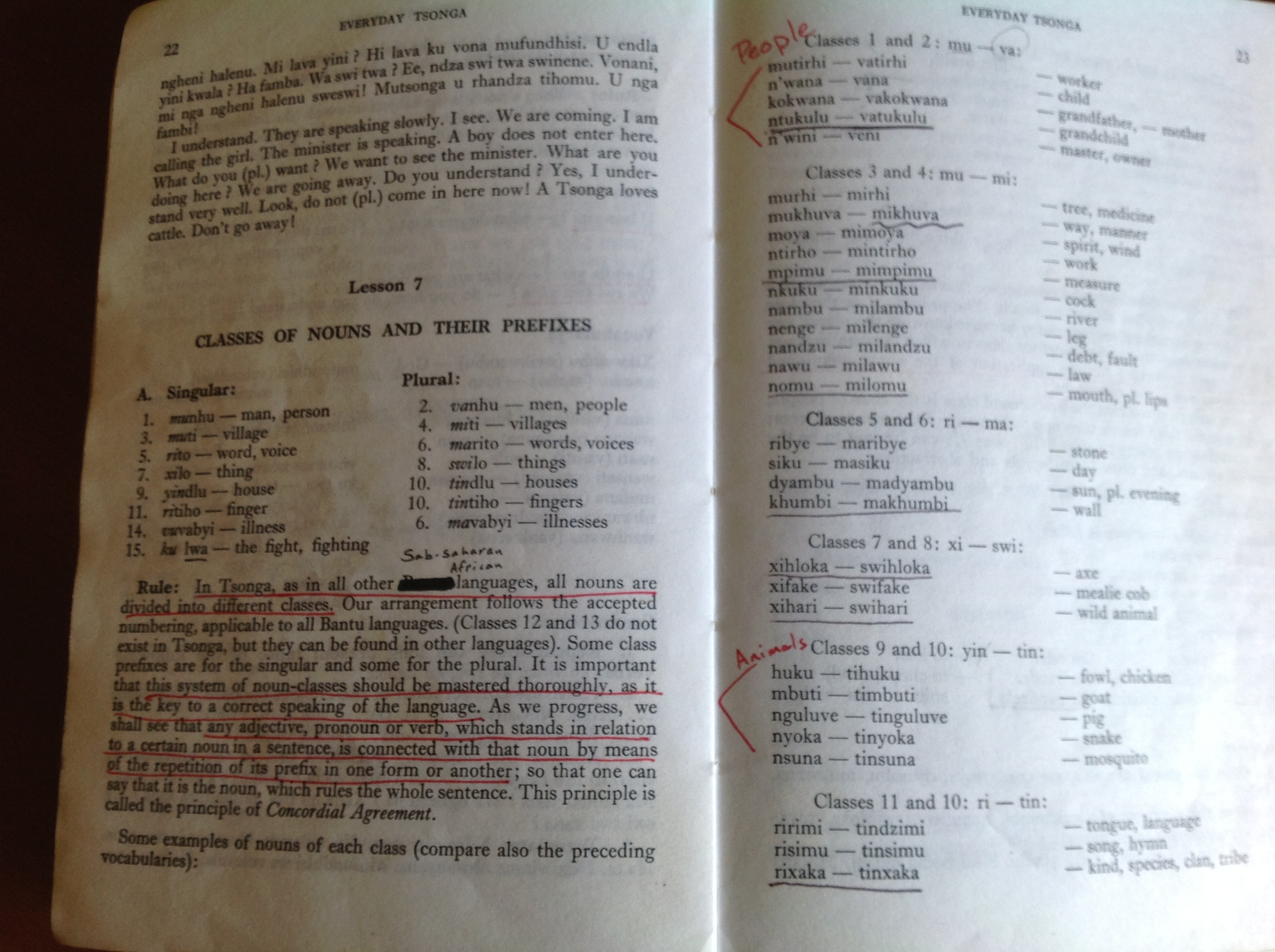
This was the game-changer. In order to learn the language, we often need help from those who have already done it! This man told Seth of a little grammar book that the old Swiss missionaries had written called Everyday Tsonga, which Seth could purchase at a little Indian shop in a nearby town.

IMG_1411

Seth did that immediately, and it opened up to him the structure of the sub-Saharan languages--the African languages south of the Saharan desert. Lesson 7--oh how we praise God for it! It's called "Classes of Nouns and Their Prefixes." Exciting, huh? :)

IMG_1413Each lesson had a grammatical term with a "rule" listed underneath. Yes. Every language has rules. :) Here's how lesson 7's rule began: "In Tsonga...all nouns are divided into different classes....It is important that this system of noun-classes should be mastered thoroughly, as it is the key to a correct speaking of the language. As we progress, we shall see that any adjective, pronoun, or verb, which stands in relation to a certain noun in a sentence, is connected with that noun by means of the repetition of its prefix in one form or another; so that one can say that it is the noun, which rules the whole sentence." The lesson goes on to give examples.

Oh, sweet relief! To our English minds, the verb really rules the sentence. We had no concept for nouns ruling the sentence. But African languages are riddled with tiny little words called "concords" that connect subjects to verbs, get attached to adjectives, and act as the pronoun. If you don't know the concordial system, you can't learn the language!

For example:
In English, we would say, "The bread is good." But in Tsonga, they say, "The bread it is good." And the "it" changes depending on what the subject is. "It" also changes for adjectives like "big" or "small."

Before this grammar book, Seth could not figure out the rhyme or reason for all of these little words throughout the Tsonga language. He would try one version of "it," only to be told that for "bread" it was "xi." So then he would apply "xi" to a person or a table, only to be told that it was "u" or "ri" respectively. He was constantly guessing wrong and didn't know what all those little words meant to the language. It was utterly confusing. Now it seems so obvious to us--now that we have the key!

Since then, we have both learned Tsonga (almost fluently) and bits of Venda (which I have forgotten, but Seth can speak passingly), and now Seth is trying to pick up bits of Shona in order to reach some of the Zimbabweans who have flooded our province of South Africa. Each succeeding African language is easier to learn after jumping the hurdle of the first one.

If you look back on your life, I'm sure you have your own stories of God's providence--literally, His "seeing before." How we learned Tsonga is one story in which we bless God for His providence--His "seeing before" in providing those clever Swiss missionaries to translate the Bible, publish a Tsonga grammar book (in English!), and guiding our steps to meet the people who would introduce us to the grammar.

And now we have begun on our journey to being a linguist--one of the most important jobs of a missionary!

How did you learn the language?

More to come...

Monday, February 24, 2014

The Many Jobs of a Missionary ~ Parent

A few years ago, a supporting pastor of our teammates came to visit their work. My teammate was teaching the women at our monthly ladies' group that month; and after finishing her theological lesson, commenced a mini-lesson on proper table manners. At one more slightly intrusive point, the supporting pastor's wife, who had come along to our ladies' meeting and was trying to get the gist of the mini-lesson, gave a surprised laugh with the side-whisper to me, "Wow, she's brave." I laughed with her, because my teammate is brave; but I defended my teammate with this comment:

"Well, sometimes, we take the role of a parent."
We love them like our own!
This again was an unforeseen role that I find myself taking often--never having been asked to, but often feeling shoved into the role--and I don't mean for my own children!

On any given day, if you came by our house in the afternoon, you would see anywhere from 10-30 village kids (mostly boys) playing here. They enjoy the grass and our garden, the possibility of a free ball, the novelty of white playmates--maybe just a change of pace, I'm not completely sure. But I am almost sure that their parents/guardians do not know where they are. For hours.

One time, several boys began to be in the bad habit of sneaking in without announcing themselves in their own traditionally respectful way, and hiding around the corner of the house. I would be sitting at the kitchen table homeschooling my eldest and see a shadow flit past the window. I, having recently been thinking again about Charlotte Mason's (a 20th-century educator) philosophy of training right habits, went out, and decided to take it upon myself to teach them the proper way of respecting others' property. I instructed them, made them repeat back to me what I'd said (since you never know if they understood otherwise), and then made them practice announcing themselves the right way (according to their cultural customs!) three times each. (I was easy on them; Charlotte Mason suggests 10 times, I believe.) :)

Recently, a boy, who did not remove himself from our garage when we'd warned him to, walked right into steel poles that we use for our church building project that some other boys were transporting into the garage at the time. His head wound bled profusely. Seth put on some gloves (HIV/AIDS is always a concern) and patched him up in the dim light of dusk. When we visited the home to explain, his guardian was unconcerned.
Seth frequently includes other boys on outings with our own. Here, enjoying a hike on a nearby tree farm.
If you saw how we handled some of the youth here, you may think we overstepped our bounds; but after time, we have become more bold, taking on more of a parent-teacher role than would be permissible in American culture. A few months ago, a boy (whom we didn't know well) became violently angry at another boy during their play in our yard. He went home and returned with a kitchen knife intending to harm the other children who had denied his desires. When Seth was told, he applied corporal punishment--more gently than if it were our own child. Yet the boy yelped and dodged and scurried away afterwards with his tail between his legs. We have not seen him back to play. I am sure he was embarrassed. Harsh, say you? But we must protect our children and the others playing here. And no one else will intervene to save his soul from the path he is now on.

Time would fail me to tell all the stories of our own, as well as of other missionaries who have, for all practical purposes acted as literal foster parents--taking children in, feeding them, clothing them, and paying for schooling.

We have frequently had to expel children from our yard (for the day or week) for lying, disobeying our authority, disregarding our garden and ruthlessly breaking plants or killing baby birds, or most recently, repeatedly stealing right out of our chest freezer in our garage.

Then when we come to the teens, the troubles become more severe. Many girls in our youth group have become pregnant or endangered themselves through reckless dating and disobedience of their parents. A handful of times when coming home after dark on the village roads, Seth (sometimes with our family in the car) has stopped to tell an immorally active teen couple by the side of the road to go home, and has rebuked them for immorality, and at the least, the possibility of contracting AIDS.

On a lighter note, we have supported teens by attending important functions where they were honored or gave a speech, but their parents didn't go. Or by attending an important soccer game. Or by funding them for an important field trip or school function.
Four of our children.
At least five different mothers of our church youth have come to us asking for help to get their teenagers to listen to them. I say mothers, because in our youth group, very few teens have ever even met their fathers (or know who they are). None have fathers at home.

Those who have fathers and know them live in a distance relationship with the father, seeing him 1-3 times a year at holidays when he comes home from his job in a far-away city. This fatherless-ness has completely destroyed the African understanding and placing of value on family. Fathers are unnecessary, mothers rule and support the home, and poverty is a can kicked down the road every time another teen mother gets pregnant in order to receive yet another governmental "child" grant.

The children are destitute of caring instruction and nurture, and yet few are even aware of the drought of true parental love parching the land. So the cycle continues. We are trying to break this generational sin and misunderstanding by example and by teaching the few Christians under our influence--and sometimes, by adopting the role of parent when it seems that no one else is.
A young Christian father with his daughter and wife at church.
Some of our youth have become men and women now. We enjoy the adult conversations, even though we also have tasted--before our children are of age--that youthful "wisdom" that comes back from university ready to instruct experienced wisdom on how to better change the world, mixed with youthful blindness at the differences between village and city ministry (for one example).

My mom always thought the 20s were harder to parent than the teens; and I'm seeing that in our "adopted" kids, as we wonder sometimes, how much to pick? How much to say? We hand out dating advice, try to match some pairs up so they are not ensnared by non-Christians, and Seth has pounded the pavement at a near town not a few hours to find jobs for some of the young men.
Seth instructed high school students to clean up their classroom before beginning an outreach economics course last week.
From teaching youth in our pick-up truck to say "Thank you" for the lift, and not to throw their trash out on the side of the road, to breaking up literal fights between teen boys duking it out in front of our gate, to mediating between shouting mothers and silent, rebellious daughters, we have seen the importance of God's plan for the family.

To have so many "children" is tiring and emotionally wearing, but it is a necessity. Christian parents, step it up! Change your world (and your kids' world)--by being a parent who follows Christ.

Monday, February 17, 2014

The Many Jobs of a Missionary ~ Shepherd

Jesus shepherd

"Beside those things that are without, that which cometh upon me daily, the care of all the churches." ~Paul


What minister cannot relate to this verse? We may not relate to all of Paul's list in the prior verses summarized in "beside those things that are without"; we may not relate to the word "all"; but the word "care"--that is a weight that those in the ministry know.

Last year I shared some of that weight in my meditation on the failings of one young person in our church. (I shared that here 2 weeks ago.) December to January for our ministries here seem fatal at times to the spiritual growth of many of our young people. We have few adults in the church, so we often concentrate our hopes and efforts on a number of teenagers in our church, who are faithful regardless of parents' lack of spiritual influence on their lives. We hope that "getting them young" will help them to be solid church members as they grow older. About now is the time when we should be seeing some of this glorious hoped-for fruit, as many of those who were teens when we began the church are now entering into adulthood.

But alas, as they get older, the temptations also get stronger--more adult-like. This last month, I might have written that meditation a few times over. Many of our youth have fallen into different sins--fornication, drunkenness, disrespect to parents, lying, having an unbelieving boyfriend or girlfriend.

In fact, at times I have to remind myself to still feel the "care" of the church, to not be weary in well-doing. I have to fight against the temptation to not care anymore about people's failures or to be cynical when I see spiritual growth, to not think when someone professes Christ, "Well, we'll see..." But after numerous failures, you feel protective for your heart against great excitement, because then the surprising plummet into discouragement can be long.

While writing this, I just received a text message from a former church member who recently had a baby out of wedlock, asking to restore her relationship (I'm not sure to what degree) to the church. Before that, I was meeting with a current teen church member to discuss lack of church attendance because of several issues of unsavory character over the Christmas school break. Before both of those cases, in the last two months, we had more than a handful of similar counseling sessions with other church members.

So for these latter two cases, I wanted to ignore them.

"Oh Lord, can't I please go hide in a book for a while and forget scraping my shins on dark, treacherous mountain passes trying to rescue another trapped lamb?"

"Lord, please, I already filled my quota for visitation this month! I'm trying to improve at reaching out to the women, but did you have to send five my way at once?"

"Lord, I already visited three others and sat in on sessions with others. I've already heard of the failings of too many this season. Can't I let this one go? I'm tired. I'm feeling lazy. (And they're willfully disobedient.) Can't I just let this one come back to church when she wants without having to be proactive to try to warn her from her way?"

And sometimes, you might even get the impression that the flock thinks, "What are you all worked up for? What are you hurt about? You chose this job. [especially missionaries] We didn't ask you to be here. And anyway, you're just a white person. You don't understand our culture."

So do we give up?

Of course not. What a futile question. Paul, who had the care of several churches, also said, "Therefore I endure all things for the elect's sakes, that they may also obtain the salvation which is in Christ Jesus with eternal glory."

And aren't you glad for the parable of Christ, the Good Shepherd, how he went seeking for the lost lamb and called others to rejoice with Him when He found it? Nowhere in that parable does He complain that He's had to do this before, in fact, too many times lately (99)! Will He always have to do this?

Yes. We will always have this job. Because we have been given a gift from our Heavenly Father: the opportunity to care for His church--the one He loved so much that He gave Himself for it to wash it clean.

Others have their weaknesses. We have ours. "Who is weak, and I am not weak?" And one weakness we shepherds need to watch out for is thinking too highly of ourselves, and thus, losing patience and care for others with their burdens.

"But let every man prove his own work, and then shall he have rejoicing in himself alone, and not in another."

And let us not be weary, fellow shepherds, brothers and sisters in Christ, in well doing: for in due season we shall reap, if we faint not. As we have therefore opportunity, let us do good unto all men, especially unto them who are of the household of faith.

Monday, January 27, 2014

The Many Jobs of a Missionary ~ Caterer

Several containers of food pulled out of the freezer to be transported to a conference.
Carson doesn't understand why he can't have any of the food!
Whenever I tell my mom of my latest mass cooking endeavor, she gets a glint of glee in her voice (I would say, in her eye, but I can't see her on the phone...) and asks triumphantly, "Oh, did they teach you that in college?" or some such variation.

I love that question. She's exactly right, and I laugh with her! Sometimes I am saddened by how little of my music degree I use on the field as a missionary's wife and a mother of small children; but most of the time, I'm too busy with said jobs to even think about it. I am so thankful for a mom who taught me to cook and plan in the kitchen. I wouldn't call myself a chef, but it's amazing how many events have utilized my what-I-would-deem "lowly," or at the most, quite ordinary culinary skills.
Lots of Christmas cookies baked to sell and for a party.
Lots of Christmas cookies baked to sell and to use for a party.
Now, I say "Caterer" in my title, because "Cook" will better describe a slight distinction in the many missionary job descriptions, a time when I care for my family or unexpected guests. But "Caterer" carries the idea of preparation for, and transport to, several guests. My teammate and I have cooked for church dinners, youth conferences, pastor's conferences, various parties and gatherings, a short term mission team (of men!), and college graduation luncheons.
Paptert (pronounced "poptart")--sort of like lasagna, only the layers are made with vuswa instead of pasta.
So what are some things we make? Well, that will depend on the function and the guests. Sometimes we cook according to the traditional food here-- "maize meal porridge" or "vuswa" in Tsonga, cornmeal cooked up thick enough to hold it in your fingers and eat. Add saucy side dishes to vuswa, and you have a feast: spinach, fried cabbage, beets, boiled tomatoes, butternut puree, cole slaw, beans, beef stew, and/or chicken.
Cooking for a crowd: their staple, vuswa (thick cornmeal).
My homemade tomato soup cooking in a large pot.
Sometimes we try to do more snack-y, handheld items like salads and sandwiches. For a recent African Pastor's Conference that we hosted, I happened to be the main cook, as we didn't have adult ladies from our churches available at the time to help, and my teammate was likewise unavailable. I made muffins days in advance and froze them for an easy breakfast when the men trickled in. Lunches were also easy--sandwiches, fruit, chips, and homemade brownies or cookies.

I got some help for the dinners. Ladies from a nearby national church made the staples in their big outdoor pots--vuswa one night, and rice the next. I made the meat side dish and tried to keep it cheap--one night was chicken in a slow cooker (plus an extra borrowed slow cooker), and the next night was chili on rice. I also made most of the vegetable side dishes, but got some help with some of them as well as a "pudding" for dessert each night. In the end, I did not even have to travel to the nearby town with my children in order to oversee the meals. A lady from the hosting church (very small, mostly elderly members) put the prepared food on the serving table and directed the clean-up. I stayed home and homeschooled my children.

So it takes quite a bit of planning, personal doing, and help from others to cater, but it's one of those things that either must be done in order for the function to exist, or it simply makes the function so much better. I enjoy it for the most part!

IMG_0803

Aren't you surprised sometimes at the jobs the Lord gave you to do? Yet He enables for each task. And likewise we, when we have done all those things that are commanded us, say, "We are unprofitable servants: we have done that which was our duty to do." 

Monday, December 9, 2013

The Many Jobs of a Missionary~ Historian

Yesterday after church a teen girl asked me, "Do missionaries have to finish grade 12?" She has expressed interest in being a missionary, and I got the impression that she was hoping I'd say, "No! Missionaries? What education do we need?? Just drop out of school in 10th grade and read your Bible!" ;)

Here in South Africa starting in 10th grade, the students have to choose which track they will take in school--one heavy on business and accounting or the sciences or history and social studies. If they do not choose the history track, they learn very little history in school.

But missionaries never stop learning history. Or they shouldn't. For one thing, we are in the middle of living history. Nelson Mandela died last week. This is such a huge, real moment to South Africans--and all blacks or those struggling with freedom from racism.

Who was Nelson Mandela? I had heard the name but didn't know him until I became a missionary to South Africa. I got world history a few times in school, but you know how you never seem to get to the final chapter or two of the history textbook in school? Not enough time. So Mandela was little more than a name to me.

nelson_mandela__my_heroIt is important for me as a missionary, though, not to show ignorance and apathy about a name that meant little to me, but is heroic to many of the people I live with. And therefore, he should have great significance to me. He (and the former white president of SA--F.W. de Klerk) did a great service for the blacks of SA. But even more, perhaps we could say he did a service for the whites. Because all of the hate and anger and injustice served to a people group for decades could have rolled back in a tidal wave of revenge on whites who did not begin the system yet kept it going and lived in it.

And then maybe we would not be so welcome here as (white) missionaries. Maybe SA would have gone the way of Zimbabwe with a dictator who cannot give up power, chases the whites off their farms, and impoverishes his people through corruption and fear tactics.

Mandela's example of peace and forgiveness protected many whites and blacks from what could have been a messy civil war. He and de Klerk truly deserved the Nobel Peace Prize they received together in 1993 (unlike America's president now, who apparently got it simply for his color, not for any actions associated with it?)

And then unlike many African politicians, he freely gave up his presidency after one 5-year term. His people loved him. They would have voted him in forever if he had chosen to change the laws and preserve his power and fame. But he didn't. And that in itself is praiseworthy in a continent full of politicians who give lip-service to democracy until their inability to allow themselves to be voted out or serviced out shows that they never really gave up their tribal monarchy ideals.
"The history of liberation heroes shows that when they come into office they interact with powerful groups: they can easily forget that they've been put in power by the poorest of the poor. They often lose their common touch, and turn against their own people."--Mandela as president, 1996
Was he perfect? Well, not by American standards. And that's another reason missionaries need to learn history, specifically national history of their country of service. There are those troubling connections with terrorists and Communists who supported him financially, in training, and with weapons and other promised aid.

So when one church member this week emotionally told me that Mandela was the greatest statesman who ever lived, and then slightly shocked and embittered said, "America called him a terrorist!" I had to think fast. I have never read a biography of Mandela, and my grasp of modern history is only so-so. I did come up with enough to hopefully explain America's lack of support for Mandela in the situation.

No, we weren't supporting racism. America has almost always stood as a bastion for freedom. There was that pesky Cold War we had just gone through where we were *this* close to blowing up Russia and vice versa, so maybe we didn't take that well when Mandela and Co. went to get training and weapons from them. ??? Uhh...same thing with support from Cuba. Yeah, that wouldn't be seen as a good thing by the US of A.

Isn't it funny how history can lead to ethics though? Here is this beloved politician who can do no wrong to South Africans, and this church member says to me, "But he had to take money from wherever he could! If I were in his situation, I would do it for freedom! America should have supported him anyway, at least verbally!" Hmmm. Oh boy, what to say? Do I plead the 5th, since my knowledge of to what extent America supported Mandela or apartheid is admittedly lacking (and I suspect my friend's was as well...)? Do I realize that what he's really seeking is affirmation that yes, Mandela was great, and therefore your culture and race can do really great things? Do I stick with an old adage? "It's never right to do wrong to make something right."

Probably the worst thing to do in that situation is to take umbrage that no matter how many billions of dollars in aid America sends every year to Africa we can still do no right in the eyes of Africans: always, we should have given more, or taken up this or that war--and then when we do (Iraq), they say we interfered under false pretenses. Sigh. I'm afraid I didn't pass that test so well. Ah, well, live and learn. At least, that's what we're supposed to do from history--learn!

Maybe I should learn from Mandela how to better be a peacemaker.

So all that to say, missionaries, that once again, our job is not as easy as "A-B-C, 1-2-3, Pray with me." There is a whole history behind the worldview of the people we minister amongst, and it is our duty (and pleasure) to learn it.