Showing posts with label ministry. Show all posts

Friday, July 6, 2018

Gospel Centered Ministry and the Missionary Woman


It happens to all of us probably more often than we’d like to admit: we lose sight of the main thing—the gospel—while exhausting ourselves with peripheral activities.  How can missionary women keep the gospel central to our lives and ministries, especially if others have alternative ideas?

We know that the definition of the gospel is the death, burial, and resurrection of Jesus Christ. The Good News is that Jesus died for the sins of people—personally—and that putting one’s faith in His propitiation will save a person. Because of the resurrection, there’s the promise of eternal life with Jesus. It doesn’t get better than that!

There are so many tugs on us! Can you do this? Can you help me with this? You’re an expert; add this to your duties. Can you serve on this committee, begin a Bible club in a new area, organize this function? And, unfortunately, most of us feel that adding to our ministry is always good, so we take this on and that on, and we begin to overwhelm our lives with good things—which become bad things. It’s so easy to say yes and later stumble under the burden.

How can we change our ministry perspective? How can we be more discerning when a thousand ministry-related things are tugging at us?

Let me offer some ideas that might help:

1. Take about a half hour to analyze what you’re presently doing. (If you don’t have a free half hour, you know you have a problem! Take a half hour off, anyhow.) Write out a list of your regular activities. You can include them all: cooking, cleaning, meetings, personal  and car care, ministry activities, work commutes, teaching, etc. Mention any deadlines you might routinely have (financial reports, blog posts, book writing, business deadlines, etc.). Assess what’s going on in your life right now.

2. Review your ministry description. I like to use the Great Commission (Matthew 28:18-20), but you can use a sentence or quote you’ve written out or another verse. What is your purpose in your ministry? Make sure this is very clear in your mind.

3. Now, decide:
  • Which of the activities or deadlines that you wrote down overwhelm you (if any)?
  • Which of your normal activities do nothing to further the spread of the gospel?
  • Do you need to revise any activity’s focus, so that it’s more effective in actually furthering the gospel?
  • Do your normal activities speak Truth into other lives? (Yes, your husband and children count!) Analyze if you have regular contact with unsaved people and how your contact might open up opportunities to share the gospel with them. 
  • Are you so activity/service oriented you’ve lost a gospel focus? (It’s easy to do!)
  • Do you have room to add anything? If so, what kinds of ministries and activities do you think you could add?
  • Do you need to cut back? (I’ve done this, and I need to do it again.) If so, where are your priorities? Which activities are more important?
  • Ask for help. Ask your husband or team leader’s opinion. You’ll doubtless be surprised at the answers they give you. Be humble enough to seriously listen and consider what they say.

Many years ago, people would ask a dear missionary friend about what his wife did on the field. His answer? “She’s my wife.” This lady homeschooled their kids, made all kinds of connections with neighbors, and was constantly sharing the gospel. But, her main ministry was being there for her husband, cooking, cleaning, mothering, and being a wife. That is a valuable calling.

If you’re not married, I believe it’s harder in some ways, because everyone wants a piece of you. You are “free,” which often means you don’t even have time to breathe.

Whatever kind of ministry you’re a part of, make sure your own life is gospel propelled and gospel centered. If you need to say no, do so. If you need to be more evangelistic, do so. If you can add or subtract, make wise decisions. Ask the Lord to guide your thinking and your steps. If any of you lack wisdom, let him ask of God, that giveth to all (missionary women) liberally, and upbraideth not; and it shall be given (James 1:5, my application).

Consider these Bible passages:
  • The steps of a (missionary woman) are ordered by the LORD: and He delighteth in (her) way (Psalm 37:23, applied).
  • NUN. Thy word is a lamp unto my feet, and a light unto my path (Psalm 119:105).
  • Trust in the LORD with all thine heart; and lean not unto thine own understanding. In all thy ways acknowledge him, and he shall direct thy paths (Proverbs 3:5-6).
  • But the path of the just is as the shining light, that shineth more and more unto the perfect day (Proverbs 4:18).
The next time someone asks you to add something to your plate, pause to pray for wisdom, analyze the request in the light of the gospel, and then make a wise decision.

God bless you!


by Lou Ann Keiser, in Basque Spain since 1984

Friday, March 6, 2015

When We Get Stretched

Photo: Ambro


I don’t know about you gals, but it seems that many of the things I’m asked to do—stretch, stretch—aren’t exactly in my line of expertise. For example, I’m not a public speaker. I love doing things behind the scenes, even coaching others, but public speaking? S-C-A-R-Y! I get physically ill when I have to speak to a group of people. (Literally ill, emotionally wimpy. Think dying inside and you’ll have it about right.) I’m not a soloist, pianist, or actor. (That’s putting it mildly!) I’m just not naturally gifted in those areas. Of course, a missionary woman is supposed to be able to do all those things—and well!

Are you ever asked to:
  • Supervise 50 children for two hours each night for four nights in a row?
  • Provide food for the 150 people expected to attend the banquet?
  • Organize crafts for vacation Bible school?
  • Plan special music for the upcoming evangelistic meetings?
  • Draw the backdrop for the church Christmas play?
  • Design literature on your computer?
  • Keep the nursery—with five infants and six toddlers, and only one helper?
  • Write a new gospel tract—in Swahili, Urdu, Italian, or Cantonese?
  • Give the keynote address at a ladies’ meeting with six area churches attending?
  • Bake and decorate sheet cakes for the church’s anniversary celebration?
You get the idea. We’re often asked to do things—or we need to do them because there’s no one else—that are totally outside our “talent zone.”

We respond, “Okay. I’ll be glad to,” while shooting a prayer heavenward, “HELP!”

And, that’s exactly where God wants us.

He wants us to have to depend on Him, because that way, He gets the glory. If everything we did in ministry were right up our alley, then we’d just charge ahead and do it. There’d be no prayer for help. We might not go to God at all.

So, the Good Lord stretches us. He presents us with challenges that keep us looking to Him.

Sometimes, we’re afraid.
  • What time I am afraid, I will trust in thee (Psalm 56:3).
  • When Jeremiah was afraid, the Lord told him, Say not, I am a child: for thou shalt go to all that I shall send thee, and whatsoever I command thee thou shalt speak. Be not afraid of their faces: for I am with thee to deliver thee, saith the LORD. Then the LORD put forth his hand, and touched my mouth. And the LORD said unto me, Behold, I have put my words in thy mouth (Jeremiah 1:7-9).
Sometimes, we need to be reminded of God’s faithfulness.
  • God is faithful, by whom ye were called unto the fellowship of his Son Jesus Christ our Lord (1 Corinthians 1:9).
  • Faithful is he that calleth you, who also will do it (1 Thessalonians 5:24).
Sometimes, we need to find joy in serving God all over again.
  • Serve the LORD with gladness: come before his presence with singing (Psalm 100:2).
  • And whatsoever ye do, do it heartily, as to the Lord, and not unto men; Knowing that of the Lord ye shall receive the reward of the inheritance: for ye serve the Lord Christ (Colossians 3:23-24).
We need to remember that our help comes from an infinite God. He never asks us to do what we can’t do relying on Him.
  • My help cometh from the LORD, which made heaven and earth (Psalm 121:2).
  • Call unto me, and I will answer thee, and shew thee great and mighty things, which thou knowest not (Jeremiah 33:3).
Whatever we end up doing, it’s through Him and for Him. All glory and credit goes to God.
  • He that glorieth, let him glory in the Lord (1 Corinthians 1:31b).
  • That the name of our Lord Jesus Christ may be glorified in you, and ye in him, according to the grace of our God and the Lord Jesus Christ (2 Thessalonians1:12).

________________________

So, what about when we flop?
I don’t know why, but sometimes our best efforts are met with some pretty whopping failures.

  • The cake you were supposed to decorate breaks into six ugly pieces when you flip it.
  • The backdrop for the Christmas play falls over, right in the middle of the play, and the crowd howls with laughter and claps.
  • The craft you’d planned to take three nights actually was done in one session—by seven-year-olds.
  • Your gospel tract in Swahili doesn’t exactly make sense to Swahili speakers.


We’ve all had our flops. (Some of mine have been soooo bad you can’t imagine!) So, what do we do when our best efforts fail?
  • Go to the Word and pour your tears and heart out to God. Get comfort for your soul. Listen to what God has to say to you. Be silent. Take time. God is our refuge and strength, a very present help in trouble. . . . Be still, and know that I am God: I will be exalted among the heathen, I will be exalted in the earth (Psalm 46:1, 10).
  • Ask God to examine your heart and motives. If you have any sin of pride, confess it and forsake it. Search me, O God, and know my heart: try me, and know my thoughts: And see if there be any wicked way in me, and lead me in the way everlasting (Psalm 139:23-24).
  • Remember, even if it looks like a failure to you, it might be okay after all. Your guests may never have guessed that the parfaits started out as a broken cake. The Christmas playgoers may have needed a laugh—and they might never forget that play. It might actually have had more of an impact (pun intended) with the falling scenery than without. Who cares how long it took to do the Bible club craft? And, you’ll learn from your Swahili mistakes. Every year, your language skills get better. It’s all okay. But God hath chosen the foolish things of the world to confound the wise; and God hath chosen the weak things of the world to confound the things which are mighty (1 Corinthians 1:27).

For it is God which worketh in you
both to will and to do of his good pleasure.
(Philippians 2:13)

God bless you, dear sister, as you watch Him do great things through you!
  

Wednesday, March 5, 2014

Wednesday's Wonderings...


How do you balance your ministry responsibilities along with homeschooling?  How do you handle visits, etc... during the school day?

Monday, February 3, 2014

I Repent

My heart is breaking today. Another soldier of Jesus Christ has fallen in his daily battle against sin, mortally wounded; and I, a fellow soldier, was petitioned to be the first medical aid response. I didn’t see it coming.

And yet I did. And that’s another reason my heart is breaking—that I’m getting accustomed to horrifying injuries. That soul tragedies become more commonplace, more quickly accepted, more believable, with each occurrence.

I fear for this soldier. Will he heal? If he does, how great will his scars be? He’s too important to lose!

Yet I felt that my heart didn’t respond to an emergency with crisis level of emotion. More like, “Oh! Oh no. [Hurt sigh.] Not you too…[mind-scrambling pause]…now what?” Like the Tsonga people who hear of a death every week or two, summoning a halfhearted, “Eish,” upon one more report of a funeral that weekend.

My eyes were wet after praying with this hurt soldier; but they weren’t overflowing, as they did last year about this time upon hearing of a different soldier’s injuries. I fear for the time they will cease to even moisten.

I fear for my heart, reacting against the hurt of yet another soldier going down, that it will harden, become bitter and cynical, as another missionary whom I won’t soon forget saying with resigned tone soon after I got here, “You can never trust them. Never.” Other comments something along the line of, You put your life into them, thinking you got a man who will faithfully serve Christ as a shepherd of the flock you raised, and he’ll let you down. Even after 10 years, he could be a rice Christian yet, and you will never really know for sure.

But that he went down on the battlefield this week is a reminder that I’m also in the line of fire. Just last week he was standing beside me, both of us fighting against the fiery darts of the enemy. Take heed! You’re standing, but you could fall too. You could fall next. Now that enemy is slinging darts my way, thoughts of discouragement, encouragement to cynicism—

“Not one. Is there no one who has character?”

“You’re wasting your time. You’ll be here your whole life, and the best potential candidates you can raise up even from their youth, will disqualify themselves just when you put your most hope in them. You’ll never leave. You’ll never get out. You’ll never start another church. What are you thinking? You haven’t even started this one!”

You haven’t even started this one. 

Ah. All things work together for good to those who love and are fighting for their Commander. The Commander-Comforter takes the enemy’s lies and reminds me of truth in the midst of wanting to lash out and protect myself from more disappointment, frustration, and hurt—YOU didn’t start THIS ONE.

I did. And you didn’t start yourself either—the reason you’re standing and fighting, the reason you have character, the reason you weren’t born in the same position as every single person you live amongst is all because of MY grace.

And I hang my head and say with shame, “I am an unworthy servant; for I have only done what was my duty.”

I grappled with it alone today as Seth was away preaching at our teammate’s church, knowing I wouldn’t have his comfort until after our own service was concluded several hours later, and even then, I’d have to wait for time and the Spirit to do its healing work on his heart as well.

As I watched this young man walk down the road towards his house, leaving our house as he’s done over a hundred times in the last 5 years, watching his familiar walk, hurting for and loving him, I walked to the piano for solace as I have done so often in the past, and played this song.

I played it for him, and I played it for myself. I played it for all my fellow-soldiers, hurting, in shame before our bloodied and risen Christ, whom we daily betray with our idol-loving choices, often not even realizing that we’ve yet again drifted far from the battlefield, our eyes dazzled by useless baubles from Vanity Fair—

“I repent.”

I regret the hours I have wasted
And the pleasures I have tasted
That you were never in.
And I confess that though your love is in me,
It doesn't always win me
When competing with my sin.

And I repent, making no excuses.
I repent no one else to blame.
And I return to fall in love with Jesus.
I bow down on my knees,
and I repent.

I lament the idols I've accepted,
The commandments I've rejected
To pursue my selfish end.
And I confess I need you to revive me,
Put selfishness behind me
And take up my cross again.


Monday, January 27, 2014

The Many Jobs of a Missionary ~ Caterer

Several containers of food pulled out of the freezer to be transported to a conference.
Carson doesn't understand why he can't have any of the food!
Whenever I tell my mom of my latest mass cooking endeavor, she gets a glint of glee in her voice (I would say, in her eye, but I can't see her on the phone...) and asks triumphantly, "Oh, did they teach you that in college?" or some such variation.

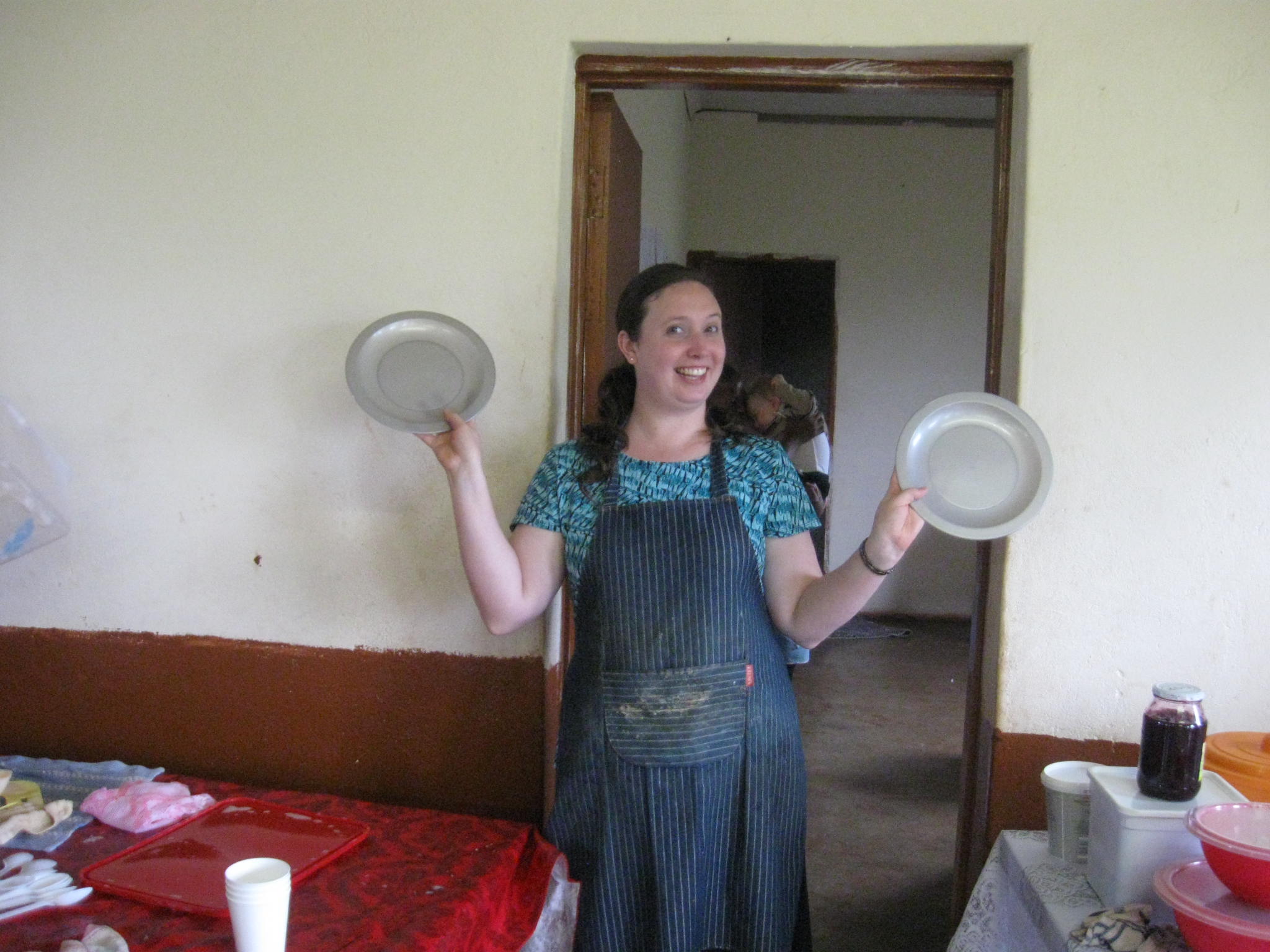
I love that question. She's exactly right, and I laugh with her! Sometimes I am saddened by how little of my music degree I use on the field as a missionary's wife and a mother of small children; but most of the time, I'm too busy with said jobs to even think about it. I am so thankful for a mom who taught me to cook and plan in the kitchen. I wouldn't call myself a chef, but it's amazing how many events have utilized my what-I-would-deem "lowly," or at the most, quite ordinary culinary skills.
Lots of Christmas cookies baked to sell and for a party.
Lots of Christmas cookies baked to sell and to use for a party.
Now, I say "Caterer" in my title, because "Cook" will better describe a slight distinction in the many missionary job descriptions, a time when I care for my family or unexpected guests. But "Caterer" carries the idea of preparation for, and transport to, several guests. My teammate and I have cooked for church dinners, youth conferences, pastor's conferences, various parties and gatherings, a short term mission team (of men!), and college graduation luncheons.
Paptert (pronounced "poptart")--sort of like lasagna, only the layers are made with vuswa instead of pasta.
So what are some things we make? Well, that will depend on the function and the guests. Sometimes we cook according to the traditional food here-- "maize meal porridge" or "vuswa" in Tsonga, cornmeal cooked up thick enough to hold it in your fingers and eat. Add saucy side dishes to vuswa, and you have a feast: spinach, fried cabbage, beets, boiled tomatoes, butternut puree, cole slaw, beans, beef stew, and/or chicken.
Cooking for a crowd: their staple, vuswa (thick cornmeal).
My homemade tomato soup cooking in a large pot.
Sometimes we try to do more snack-y, handheld items like salads and sandwiches. For a recent African Pastor's Conference that we hosted, I happened to be the main cook, as we didn't have adult ladies from our churches available at the time to help, and my teammate was likewise unavailable. I made muffins days in advance and froze them for an easy breakfast when the men trickled in. Lunches were also easy--sandwiches, fruit, chips, and homemade brownies or cookies.

I got some help for the dinners. Ladies from a nearby national church made the staples in their big outdoor pots--vuswa one night, and rice the next. I made the meat side dish and tried to keep it cheap--one night was chicken in a slow cooker (plus an extra borrowed slow cooker), and the next night was chili on rice. I also made most of the vegetable side dishes, but got some help with some of them as well as a "pudding" for dessert each night. In the end, I did not even have to travel to the nearby town with my children in order to oversee the meals. A lady from the hosting church (very small, mostly elderly members) put the prepared food on the serving table and directed the clean-up. I stayed home and homeschooled my children.

So it takes quite a bit of planning, personal doing, and help from others to cater, but it's one of those things that either must be done in order for the function to exist, or it simply makes the function so much better. I enjoy it for the most part!

IMG_0803

Aren't you surprised sometimes at the jobs the Lord gave you to do? Yet He enables for each task. And likewise we, when we have done all those things that are commanded us, say, "We are unprofitable servants: we have done that which was our duty to do." 

Monday, January 6, 2014

The Bride-Price

One of the most-viewed posts on my personal blog is my explanation of how a typical African engagement/wedding happens, or at least the ceremony in which the bridegroom pays for his bride.

The daughter of a local pastor was “lovoriwa” last year about this time, and we were invited to the party. Our ministry began with this pastor, surname Ngomane, learning Xitsonga and preaching in his church to practice that Tsonga, before we started a church another village in 2007. Through the years we have maintained a relationship between our church and theirs; so we were excited that he thought of inviting us to this familial party.

It is a sad commentary on African life and culture that in the nine years we’ve been here, we have attended countless funerals, but this was our first ever “lovola” ceremony to get to see. It was a tiny window into old African culture—the background that still shows itself even in this modern day of cell phones and store-bought cornmeal powder.

We weren’t sure how to dress, but since this is the equivalent of a wedding for many Africans, we dressed in Sunday or almost-Sunday dress. We also weren’t sure what time to go, since there was no official start-time. Ngomane gave us a 2-hour range, so we chose a time and we ended up guessing fairly well, arriving about 30 minutes before the bridegroom’s family. Maybe we’re getting better at reading between the lines and figuring out the unspoken in their culture. :)

Here’s a breakdown of what this cultural practice looks like—from our eyes:
IMG_0487 IMG_0488
Elise--Mashamba Baptist church member; notice the large jar of mayo.
Ngomane's church member; notice the large jar of mayo.
The grandmas all dressed up in their beads and head coverings, sitting together.
We arrived at 10:30. Several women were cooking outdoors. Their food preparations were almost complete. Each member of Pastor Ngomane’s family made their way to us in the next half hour and cheerfully greeted us. We sat under the tent, raised especially for the occasion, with several other family members and waited.

IMG_0479
And waited some more.

And more. By now, the kids have been oohed and aahed over, and we’re actually having to come up with “real” conversation. ;) My husband has a great knack for this. I’m so glad I’m married to this guy! He got these gray heads shaking their heads and commiserating about the youth these days—you know, how they change the Tsonga language, and they’re not doing this or that right (like the old days).
IMG_0480

Thankfully I had some paper and pen from the last church service in the diaper bag, as well as some cars. The cars kept the kids busy for the next few hours. I tried not to think about the chicken doo mixed in the sand they were driving the cars through. I have ceased to worry about their clothes getting dirty. (Notice the perfect color of Callie’s jumper—brown.)
Kids' only toys--paper, pen, and cars.


Things perked up when a full taxi (15-passenger van) arrived. The guests filed in, singing, “We are coming into the Ngomane’s,” wearing matching shirts saying, “Kubayi Ngomane Clan.” Shortly thereafter, Seth was called to sit in on the DISCUSSION over the bride-price.
Singing They Come
Singing They Come
Several Ngomane family members filled a cleared-out bedroom, and Seth (my husband) was the drop of milk mixed in a sea of chocolate. Since neither Seth nor I knew exactly what he’d been called away for, I did not see him for the next two hours, which turned out to be a very taxing time period for a missionary mom with 4 kids 5 years old and under.

Of course, the bride's parents are there (not the bride herself—she sat outside, happy and nervous, the entire time), along with Pastor Ngomane's father, mother, and several of the aunts and uncles, men and women sitting together with their respective genders. The bridegroom’s family, surname Rihlampfu, filled out the sitting room.
Sweet Tintswalo (left), happy and nervous
Sweet bride (left), happy and nervous
Ngomane clan in their room
Two messengers were sent from the Rihlampfu family to the Ngomane’s with R4,100 (currency here). Seth stands up to give them his chair, but is quickly motioned down by the Ngomane’s and threatened with a fine if he does that again. (He didn’t know that they really do fine for bad behavior! But I’m sure they were kindly teasing him in this case—though serious that there was an image they’re trying to hold up, and Seth wasn’t helping it!)

They copiously lay the money out on the floor for all to see. The Ngomane family starts to warm up. But when they see what is offered, they respond, “What did you come here to do? Give us some kind of offer that will open our mouths. Give us a reason to talk. These cows can’t get the whole job done.” (You can guess—cows were the method of payment in the past.)

The messengers are sent back with a messenger from the Ngomane’s to relay this comment. The Rihlampfu clan returns with R5,000 following the same display ceremony as previously. Some uncles are chiming in now. “When you have cows, you send them here, you send them there to plow. They work for you. What is this? This gets no work done, this is hardly anything.”

Pastor Ngomane's family wanted hard liquor, snuff, and cigarettes as part of their payment. Pastor N. had warned Seth in the beginning that his relatives loved drinking. Rihlampfu comes back, carrying two cases of cold drink (pop). Since both the bride and her young man are Christians, I’m glad to see the way the request for liquor was handled.

The groom’s family comes back a few more times offering a new suit of clothes for the father and some money to buy a blanket for the mother. But the Ngomane family scoffs at this: “That’s not even half what you need to buy a blanket. She loses her daughter, and you can’t even buy her a blanket to keep warm?”

More money is brought in. Pastor N’s father: “Go. Go back home.” He now starts to reference the money he was hoping for—R50,000. Some more rhetoric: “We raised her. We fed her, we paid for her. Now you want to come and take her for nothing.” Ngomane relays this message to Rihlampfu. More money is brought in. Now it’s trickling in in the form of smaller bills and coins, no more large denominations. Rihlampfu is trying to communicate that they are running out. Total is up to almost R25,000.

Pastor N’s father is unhappy, clearly stating now that they must reach R50,000. Rihlampfu brings back the message, “Please we ask for mercy. We have no more. Please we ask for water (ease).” The Ngomane’s take a hard stance; but the bride’s parents intervene. Pastor N.:  “Look, we don’t want to hurt these people. Drop the price to R30,000, and let them owe us that small amount. I’m happy. Look at the suit, the cold drink, all the money. I’m fine with this.” Pastor N's wife adds, “I’m happy; I don’t want to hurt these people. This is enough.” She’s told in no uncertain terms by the patriarch of the family (Pastor's father) that she has no say as a woman in the house. She’s not cowed and continues to calmly state that she doesn’t want anymore.
Pastor Godfrey (left)
Pastor Ngomane (left)
Martha, Tintswalo's mother, on left.
The bride's mother, on left.
Charity is one thing; bad manners are another. Ngomane decides that Rihlampfu must be fined R200 each for eight cultural misdemeanors that day. For one, when they all arrived, the groom’s family didn’t greet the bride’s family in the proper manner. Another—they hooted their horns on arrival, signaling that they had “already won the game before they’d even played.” Also the young men in their party did not take off their hats.
Rihlampfu messenger lays out the money.
Is it enough? Ngomane clan counts.
Rihlampfu returns with thanks for the R20,000 discount, and then displays a stack of bills to cover the last R5,000 or so. The Ngomane’s had added up exactly what Rihlampfu’s owe them. Pastor N. reminds them to add in the costs of the suit and cold drink in the payment amount. Calculators are pulled out. Seth, having kept a total in his mind throughout the process, announces the number, receiving a wide-eyed look. A family member checks his math on the calculator and announces that Seth was right. Pastor’s father, surprised, says, “White people!”

The final amount settled for the bride price is R30,000 (@$4,400, depending on the exchange rate). The families are moderately pleased with the exchange, and you hear a specifically Tsonga cheer all the way outdoors, signaling that the two will get married.

Seth was asked if he had to pay lovola for his wife? “No,” he responded, “people gave me gifts at our wedding.” ;) They rejoin, “No, but you had to get her a ring.” His answer: “Yes, but she gets to keep that!” They agreed that he should therefore be living with his in-laws because they are the ones who paid (meaning he can’t take care of his wife himself). Seth ended with, “Yeah, white people are nuts.” He was cheered by all in attendance.

A very tired mama and kids went home with Daddy right after this point, so I don’t know how they ended the party. Perhaps there were a couple of speeches and songs, but if nothing else, there was feasting and music with a DJ to run the computers and 4-foot high speakers. I admit that I had hoped to see more for myself, but instead had a discouraging couple of hours trying to handle the children in that scenario. I’m sure missionary mommy moments like these will only get easier when my kids are older. They have to!

Friday, October 4, 2013

Belonging


We came to Spain in 1984 with a ten-month-old baby in our arms. We hadn’t made a survey trip. We knew no Spanish—not one word—and no one besides our co-workers and the Spanish pastor’s family. When we arrived in the Madrid airport in the early morning, we had lost almost two nights of sleep. Our co-workers met us in a very strange looking, Siata van, something like a squarish tin can on wheels. We piled in along with their family, and one of the first things the lady said was, “Husband, we need to find a bar.”

I was suffering from jet lag and from wrestling with a very active baby the whole trip. And this wonderful Christian lady was looking for a bar? (I had never set foot in a bar in my life!)

Several miles down the road, we pulled into a spacious parking lot outside a lovely cafeteria where we got breakfast rolls and coffee—or in my husband’s case, hot chocolate. Lesson Number One: a bar in Spain is not the same thing as a bar in America.

Lessons Number Two and Three soon followed. Two: there are different kinds of bars—those for men, and those for families with children. Always look before entering. Three: bars always have public restrooms. It’s a very helpful thing to know.

I would say that our whole first term—five years—we felt like strangers in a strange land. We got to be fairly fluent in Spanish, but people still stared at us like we came from another planet. (I was clueless about dressing to blend in, and there weren’t many non-Spanish/Basque people living in the Basque region in those days. Plus, those were the Reagan years, and the sentiment was very anti-American.)

After our first furlough, when we returned to Spain, we felt oddly “at home.” Oh yes, there were still some big challenges and many learning experiences, but we knew that God had called and we were where He wanted us to be.

Fast-forward sixteen years from our arrival. Our daughter called home from college in the States. “Mama and Daddy,” she began, “should I say the Pledge of Allegiance?” Our eyes were opened to the reality of third culture kids. Our daughter wanted to know if it was honest to pledge allegiance to a country she had never lived in. Oh yes, she was a U.S. citizen from birth, but . . . .

Are there days when you feel like you don’t belong? (After twenty-nine years in Spain, we still have them.) Do you wake up sometimes, look out the window, and want to turn over and pull the covers over your head? Do you long for the things you had back in the States? Do you miss ________________? (doughnuts, Starbucks, Wal-Mart, creature comforts, people looking up to you as a missionary; you fill in the blank.) Do your kids struggle with being in between? Or do they already feel so much a part of their adopted country that they think America is the foreign country?

Belonging . . .

Let me share some important concepts and Scriptures with you.
  • To the new missionary: hang in there. Eventually, this crazy foreign place will feel like home. It is very important to go back for that second term. Give yourself time to learn and adapt. It won’t happen in one or two years. Be patient. Moses said, Lord, thou hast been our dwelling place in all generations (Psalm 90:1). Home is where God is.
  • To the single missionary: We admire you. 1 Corinthians 7:34 tells us how important single women are to God’s work: The unmarried woman careth for the things of the Lord, that she may be holy both in body and in spirit. Serve the Lord and keep yourself pure. Make friends of everyone—male, female, all ages, and complete families. You will find your “family” in the people to whom you minister.
  • To the mother of little ones, who would like to be more involved in the ministry, but you’re barely keeping your head above water: there are seasons in every life. Your ministry now is to your family and what you can do in the church. Ask your husband what he would like you to do. (You’ll probably be surprised by his answer.) Follow his leadership. She that is married careth for the things of the world, how she may please her husband (1 Corinthians 7:34b). Be sweet. Depend on God’s strength daily, and make sure you have a regular quiet time. Your impact is greater than you think.
  • To the homeschooling missionary: your children are an important part of your ministry—the most important part, excepting your husband. When you homeschool, you are not only imparting knowledge and school subjects; you are also pouring your values into your children. Deuteronomy 6:5-7 is a good outline for homeschooling. And thou shalt love the LORD thy God with all thine heart, and with all thy soul, and with all thy might. And these words, which I command thee this day, shall be in thine heart: And thou shalt teach them diligently unto thy children, and shalt talk of them when thou sittest in thine house, and when thou walkest by the way, and when thou liest down, and when thou risest up. First, you love the Lord with all your being, and then you share the Word of God with your children—all day long and in every life context.
  • To the tired missionary: Jesus said, Come unto me all ye that labour and are heavy laden, and I will give you rest. Take my yoke upon you, and learn of me; for I am meek and lowly in heart: and ye shall find rest unto your souls. For my yoke is easy, and my burden is light (Matthew 11:28-30). Lean on the Lord. Leave your burden. Find soul rest in the Lord. 

You do belong.

You belong—right where you are, right in this moment. God has led you, and He will never leave you nor forsake you. You belong to Him. (Hebrews 13:5; Romans 14:8)

God bless you, dear sister.