Showing posts with label culture. Show all posts

Thursday, May 4, 2017

Just a Little Blunt

We call her Buddhi Ama (boody om muh). It is a respectful way to say old mother. She had been in the hospital for three weeks. My husband and I had visited her when we found out she was in the hospital, but now she had finally come home. Our sweet elderly neighbor wanted us to visit as soon as possible, so we did.

Her grandson led us to the room where she was in bed. When she saw us, her face lit up. She looked so much healthier than when we saw her in the hospital. We love this sweet lady. She is like a grandmother to us. (I wish I had a picture of her, but we try to be very respectful when taking pictures of our people. We don't want them to feel paraded like spectacles.)


We sat and chatted for a while. When speaking to the people here, you have to be ready for two things:

  1. The people here are... well... curious. Some may say nosy, but curious is a better term. You never know what they will ask. They ask about the cost of things you buy, how much money you make, what your weight is. Nothing is off limits.
  2. The people are blunt. If they think it, they will probably say it.

Sure enough, it happened. She chose option number two.

"I don't like the color of your house. It's too dark."

Then her grandson chimed in with, "Yes, quite frankly, I don't like it either."

Sigh...


I just let it roll off. I have learned to have a thick skin here. It used to be very difficult, though. I used to weigh 50 pounds more than I weigh now. Frequently I would have people say, "You are so fat." Some would follow that statement with advice of how I could lose weight. It made it quite clear that being called fat was not considered a compliment like in some cultures. Even Buddhi Ama has told me before how fat I was. What was I to say? It was true! But now that I have lost so much weight, I haven't heard anything about being fat. Instead I hear about how thin I have become, and they ask how I did it.

So, in dealing with a blunt culture, when do you let it slide as part of the culture... and when do you confront the people for not being kind? If what they are saying isn't edifying, should I overlook it? Should I just have a thick skin or should I speak up?


Ephesians 4:29-32 "Let no corrupt communication proceed out of your mouth, but that which is good to the use of edifying, that it may minister grace unto the hearers. And grieve not the holy Spirit of God, whereby ye are sealed unto the day of redemption. Let all bitterness, and wrath, and anger, and clamour, and evil speaking, be put away from you, with all malice: And be ye kind one to another, tenderhearted, forgiving one another, even as God for Christ's sake hath forgiven you."

I am sure there are varying opinions on this subject, but here are a few deciding factors that determine how I respond.

Are they Christian?

This is always my first thought. If the person I am dealing with is not a Christian, the Bible is not the basis of their behavioral standard. Buddhi Ama is Hindu. There are bigger fish to fry than her stating she doesn't like the color of my house or that she thought I was fat. She needs a Saviour!

As Christians, corrupt communication should never come from our mouths, but sometimes the corruptness of communication is determined by culture. I would never tell someone in America that they are fat. Americans are pretty sensitive about that. But in some cultures, calling someone fat is a compliment. Even here in certain areas and certain people groups it is considered a compliment. Culture can impact what is appropriate and what is not.

If the person is a Christian and what they said was Biblically or culturally inappropriate, yes, I would correct or instruct them how God wants us to use edifying words. Gossip is one of those things that is inappropriate communication in any culture because it is Biblically wrong. The book of Proverbs makes that clear. Calling someone fat? That would depend on the culture. The people here do not realize how offensive it is in American culture.

Was their comment intended to be vicious?

Christian or not, I like to also to think about why they may have said what they did. In a blunt culture, sometimes they say things simply because it is true. The sky is blue, the day is hot, you are fat, I don't like your food, and your house is ugly. To them, these statements are all similar. To them, there is nothing to cause offense. It is conversation. If you want to be friends or good neighbors, their opinion should matter.

But... there are some here who say blunt things because of pride. They want to tear a person down because they feel inferior. They cannot afford something. They cannot do something. They cannot be something. In order to compensate, they say something hurtful to injure the "offending" party. This happened with my other neighbor. She is familiar with American culture. She knows being called fat is offensive. She lived in America for a while. 

One day, after I had lost some weight, she said, "Wow. You look like you have put on some weight." (She is also a little overweight.) That wasn't the only time she said something intentionally to "humble" me. What did she think of the house?

"That is a Christian color. We don't paint our houses that color. You only chose that color because you are Christian." We were all totally confused by her statement, but it was clear she didn't approve. She is not a Christian.

What was Buddhi Ama's intent? Just after telling us she didn't like the color, she said, "When you were back in America I couldn't even look at your house because I knew you were not there. It made me sad. I missed you." She held my hand and squeezed. It was a sign of affection. The people rarely have physical contact here, so it made her intent clear.

Buddhi Ama's intent was just conversation among friends. She wanted us to value her input. She had no desire to hurt us.

Is my cultural perspective the reason I am offended?

As an American, I have to understand my own culture, too. The things that may offend me may be culturally based. Americans (by culture) are easily offended. We have pushed political correctness over the past few decades until we can hardly speak without someone getting offended... even if the intent is pure. In American culture, what can be inferred is more important that what is intended. That's why so many public figures have to backtrack and apologize for so many innocent statements that had no ill intent behind them.


In this country, the bigger concern in most situations is intent.

Why would Buddhi Ama call me fat? Well, because she wants me to be healthy! Now, that isn't the intent of everyone who called me fat, but knowing her made it easy to determine her motive.


Is there a way to turn it into a teachable moment that brings the relationship to a new level?

One of the aspects of this culture that is dangerous is the concern of "what will my neighbors think?" With a culture that so freely shares their opinions has also come a great snare... the fear of man.


Proverbs 29:25 "The fear of man bringeth a snare: but whoso putteth his trust in the LORD shall be safe."


I have had many people reject the Gospel because they were afraid of what their neighbors would think. We struggled finding a building to rent for church because people were afraid of what the neighbors would think.

Is my house color a teachable moment even for unbelievers? Absolutely! I can demonstrate the freedom that comes from pleasing God rather than worrying what people will think.

What did I tell Buddhi Ama about our house color?

"I'm sorry you do not like the color. We chose it because it is a common color in America. It hides dirtiness well so the house will look nicer longer. It also matches the stone colors in the railing. Also, we do not want to be like all the other houses. They are all that peach color. We wanted to choose something different. We almost chose the same color of your house, but then we wanted green because I like green."

I showed her that I respected her opinion, but that it was more important to us to choose colors that were practical. It was also important for us not to do things just like everyone else to please everyone else.

Her grandson agreed, and said their house was also kind of dark... unlike all the other houses around our house. Then they offered us tea and said how happy they were that of all the neighbors, we chose to visit with them even though we were so busy.


Monday, November 23, 2015

The Racist Missionary

Jonah is an anomaly.

His book is unique among the prophets because it is entirely autobiographical. He did not desire the incredible ministry successes he experienced. God took the initiative to show His grace to the Assyrians by sending them a missionary. Jonah was not merely apathetic about this, he was antipathetic--he did not want that ethnic group to be converted. They were a different skin color, language group, and geography from him; and their culture was vastly different. He wasn't interested in their conversion.

And after ten years on the mission field, I can see that Jonah was not the only missionary to struggle with racist feelings.

What, a racist missionary? Isn't that an oxymoron? How could a racist be a missionary? Well, emotions of bitterness and cynicism towards the people on your field don't come all at once. Missionaries don't ever go to the field thinking that they could even become close to being racist! After all, they've given up everything because of their love for another people group, right? Nevertheless, negative emotions towards the very people you want to love can creep in over time after many adverse culture-shocking experiences. (Look at the results of "culture stress.")

jonah gourd
Jonah is a good bad example of NOT loving the people to whom you are sent. Thus Jonah's story is a great starting-place in a biblical discussion of racism. Jonah was "very angry" when God showed mercy to the Ninevites. So God used an object lesson of a quick-growing, then quick-dying gourd, with some gentle questions, followed up with a gentle, insightful rebuke to show Jonah that his hatred towards the Ninevites was wrong.


And God said to Jonah, Doest thou well to be angry for the gourd?

And he said, I do well to be angry, even unto death.

Then said the LORD, Thou hast had pity on the gourd, for the which thou hast not laboured, neither madest it grow; which came up in a night, and perished in a night:  And should not I spare Nineveh, that great city, wherein are more than sixscore thousand persons that cannot discern between their right hand and their left hand; and also much cattle?

~Jonah 4:9-11
Who are these persons that God is talking about? Who cannot tell the difference between their right and left hands? Isn't it the children? In other words, some litmus tests of whether you are racist or not are the following:
  • if you are unable to show love towards people from another ethnicity
  • if you wish for genocide including the children
  • if you believe that a person from that race cannot be converted, or
  • if you believe that all the people in that culture are only bad, thus even the children have no good potential.
I still remember a defining moment for Seth and me as new missionaries. We had just moved to a rural village in South Africa and were visiting neighbors in an attempt to meet them and learn their culture. We came across an old man who had been almost raised by Swiss Presbyterian missionaries who pioneered missions to the Tsonga people. They had sent him to school abroad, and his English was excellent.

Trying to answer his wife's questions as to why we were there, we began evangelizing, assuming that they knew basic ideas of salvation and the Gospel because of their background as staunch Presbyterians. Imagine our surprise when his wife inquired what we meant by "salvation." She queried, "You mean, baptism?" Startled, Seth began expounding the Gospel. Her husband cut us off with an eye-opening statement: "Oh, you'll never get them to understand details like that. These people will never get the details."

The Gospel? Details? Sadly this man was a living example of his own stereotype.

I remember another shocking scene in my first year here. Our landlord came over drunk one night to visit with us. I will never forget him pouring beer on the hood of our pick-up truck for his pet monkey to lap up, while saying, "This chimp is smarter than any of those * blacks."

After years of ministering to a pagan culture, missionaries can get very discouraged from witnessing repeated sinful behaviors. They can get bitter from attacks or disappointments by untrustworthy people. They can become cynical, wondering if fruit is real or how long it'll last this time. Harmful generalizations are made: "These people are all like that. They will never get better."

Missionaries to less civilized people groups eventually have to deal with the question, "Why are these people like that?" When a missionary hits that disillusioned stage of being so frustrated, it seems that two paths lie before him. He can explain the deficiencies he sees in another culture in one of two ways:

He could say that those people are like that because they are inherently inferior. They are simply unable to become an enlightened, Christian culture. He could become like our landlord, bitterly saying that the people have no more hope than animals. In other words, he could become a racist.

We have decided to take the second path, however, which explains stereotypical problems of another race with this answer: The Devil has blinded their culture for so many thousands of centuries and they have had so little common grace given to them, that they need a lot more time and work of the Holy Spirit to reflect Christianity in their culture. (2 Cor. 4:4) In other words, it is Satan we are fighting, not people.

Missionaries need to guard their hearts and thinking about pagan cultures. If you don't believe that cultural sins and deficiencies are strongholds of Satan, and that these are spiritual issues deserving of your empathy, you will become a racist missionary, constantly embittered and frustrated instead of responding with compassion. Because if the answer is not that the Devil has a stronghold in that culture, then the answer is that those people are just inferior, inherently, for centuries. And that is racist.


Thursday, July 10, 2014

Skip to the Loo, My Darling

Some of you love a "fly on the wall" glimpse into the lives of missionaries. This glimpse gets pretty personal. It's real. It's... well... Weird! But nevertheless, it is our lives. So sit back and get ready to chuckle. Get ready to be shocked. Don't worry... just go with the flow. And get ready to pray more fervently for us. Some of these lessons we have had to learn on our own the hard way!

**********************************

It wasn’t taught in Missions class in Bible College.

It wasn’t taught in candidate school at the mission board.

One of the most elementary needs of any human being has been totally neglected in the training of new missionaries for the foreign field. (How can this be overlooked year after year?!)

But don’t worry. With the help of a few missionary friends, I am about to help teach this vital class. We will flush this problem away in one post. So grab a cup of coffee and a bottle of hand sanitizer...

Monday, July 7, 2014

Not Much to Show for All That

10

Last week was the 10th anniversary of the day Seth began his work in South Africa.

10 years! That seems like a respectable amount of time to dedicate to a people not your own. I think we can officially be counted out of the "newbie" crowd now. :) We have completed a full decade of missionary service. (Well, actually, if you deduct furloughs, all of those 10 years haven't been here. It's actually more like 9 years.)

Now the pressure is on.

10a "10 years! And that's all you've got to show for it?" If we were better missionaries, wouldn't we have planted two churches by now? Or at least one? I mean--that's our job, right?

10 years...

You know, the first two terms people can excuse you mentally for your failure to produce a self-supporting church. It's your first term! Everyone knows that the first term is kind of a wash in the end. Hopefully in your first term, you accomplished that huge job summarized in an inadequate phrase called "learning the language and culture." Ha. After ten years, you know that although you can get a good start on those things in your first term, you never stop learning in those areas. So if you've got nothing really tangible after your first term to show for the furlough pictures except for a few converts and the pronouncement that you've "learned the language and culture," then that's pretty much all that can be expected from the first term.

And even your second term failure to produce an independent church can be excused because you're still just getting going. Your church is just beginning. Your work is still in the baby stages.

10b But after 10 years, no more excuses. We should start hearing pretty soon that you've got a church standing on its own two feet, and you're already starting your next one or two church plants. At least that's how I feel. No one from the States really makes me feel that way. I make me feel that way.

Missionary work can be the most humbling job on earth. Every day, you receive new little reminders of how you're not that great; or even if you think you really are, how no one else seems to see it. :) (Why?! haha) Every day you make language or cultural bloopers; people in your host culture don't know about or appreciate the gifts you had that were appreciated in America. They're not only not grateful that you've given your life to them, but also seem everlastingly stymied at your purpose for being there. (And we haven't even begun to explain homeschooling yet.)

And your churches in America have changed so much. People who cheered when their church took you on for support have moved or grown up or fallen away or died, and you've been forgotten by some. People who stroked your ego in the past about how gifted you were and how you would change the world are now quiet, outside of a soft question--"How's it going? How's the church?"

1oeHow to answer? It's really the same...or a little better...maybe worse right now. Please don't think we don't like to be asked about our church. We do. We know you care if you ask! But we're thinking, and wondering if our old supporter and friend is thinking, "After 10 years...how's the church? When will it be done? Accomplished?" That's what we'd all like to know, right?

Seth and I joke that we're the Discount Missionaries. We are able to live in this area for 50-60% of the usual costs of missionaries in other areas. But sometimes we wonder if our churches feel the other way--like we're the Discount Missionaries in output. You get what you pay for, you know!

When we first came here, we had a 5-year, 10-year, and 20-year plan. Oh, the wonderful things we were going to do according to that plan. (Did anyone else have a Dr. Suess deja vu moment there? "Oh, the wonderful things Mr. Brown can do!")

Sometimes your disappointments can cause you to be disappointed in God Himself.
"God, I gave up my life for You. Now YOU'RE supposed to make me successful! I don't have the power to save, to convict, to draw men to myself!" What can we do when His hand does not save? And how we long to see true change, revival in people's hearts--the kind we've read about: the drunkard who sobered instantly and became a provider for his household; the seekers walking five miles to hear the Word. So when we aren't seeing those things, whose fault is it? Ours, God's, or the cultures? Or all of the above?
10d
All this can be summarized in the question: Why is it so slow? Why is missionary work so slow?

I've got a few thoughts on why that is so.

First, why would we think that it would be quick? We come from a culture that increased its wealth and power over centuries because of a Biblical worldview. Why would we think that anything of value would come quickly without hard work? Our culture has become hasty with all of its technology and time-saving devices. We expect quick, well-done work.

But even in the States, you don't see too many churches experiencing explosive growth and revival. Most churches struggle to stay at about the same membership rate, fighting against attrition rates and love of this present world, trying to keep the youth, trying to encourage members to have a heart for evangelism--to get beyond needing marriage counseling and be able to have an outward focus.

Most church plants in the States take several years before they are self-supporting, even with all of the helps they receive through other Christian Americans who join their church to help start their membership or who help with advertising or come over to fill the pews or do music for a big-impressive kickoff Sunday service. Why would we expect things to move quicker in a place where there were no Christians whatsoever to hop over from a former church, where there is no Biblical worldview at all, and where literacy and education is lacking or under-valued?

If in the States, we're bemoaning the lack of passion for Christ and godliness in our youth groups, why would we think a church built on youth in Africa, youth who have no Christian parents and none of the advantages of those youth in American churches, would be doing better, just for one example?

Secondly, think of the nature of growth. Trees and men take twenty years to grow strong. The Bible describes our Christian life with pictures of growth: babies desire milk, so you should desire the Word; but when you grow strong, you are able to eat meat. A church will be similar, because a church is made up of all those people busy growing in the way the Bible describes. It takes time to grow.

In the States there are many godly men who serve the church as laymen without feeling called to the ministry. But on the mission field, it seems like you should grab the first male church member you get and throw him into the pastorate. "Lay hands suddenly on no man." On the mission field, in our eagerness to declare a church successfully planted, we put people into the ministry who would probably not have been considered worthy in the States. That doesn't necessarily mean they are unworthy. But even seminary training in the States takes 3-6 years, with the already-laid foundation of church background or at least a more Biblical worldview in the culture.

Think about how many youth recently left your church to go study at seminary in order to enter the ministry? If the percentage of people desiring the office of a pastor is small in the strongest Christian nation in the world, shouldn't we expect it to be MUCH harder to find a man fitting the qualifications of a pastor in a heathen culture? And that it would take MUCH more time to train him to be fit to lead a church in a very dark culture?

10cWhen I read of Paul's missionary journeys, I admit that I am baffled. He planted a church in three weeks (Thessalonica, Acts 17:1-2)?! How? But when I think about what the typical missionary in a pagan culture is up against, really, we should be amazed and encouraged at the evidence of the Holy Spirit's work. There have been true conversions, and it is those conversions that give us special strength and encouragement.

Brethren, pray for us. Satan's forces are strong, and the warriors for our side are few. In the next few weeks, I will share with you some of the verses that have been the most encouraging to us to persevere in the ministry--for 10 years! Praise Him.

Monday, April 21, 2014

Giving Up Fun for Good Friday

Holidays remind the far-flung family member of home, tradition, and making memories with family. I still feel disappointment at the lack of Christmas "spirit" over here. But after having several years to adjust the lens of my worldview a bit, I am able to see parts of our own culture a little more objectively, though I’m sure I’m still biased.

I remember our first couple of years being asked by new believers whether we were having a Good Friday service (or a Christmas service, depending on the holiday). We almost laughed at them, replying, “No…” (“Or course not!” we thought. “Who goes to church on those days?”)

The next couple of years I felt a sense of frustration at the question. Perhaps I was fighting the Holy Spirit’s nudging to introspect about the matter. My attitude: “Humph. That’s old-fashioned. They only ask that because that’s what the state church did for years.” South Africa’s state church during apartheid was the Dutch Reformed church. Other denominations did not have as many rights as the attendees of the state church. The Dutch Reformed had a Christmas and Good Friday service. Naturally new believers in our ministry asked if we were having one.

And now we’ve completed the circle, having both a Christmas and Good Friday service in our little Baptist church. We often combine with the other two Baptist churches in our region for these special services and sometimes have a meal or snack afterwards.

A year or two ago, a blogger asked missionaries what negative aspects they noticed about America and American culture when they return to the States after living abroad. From my perspective, I have come to realize how saturated Americans are with fun. Fun, fun, fun. I catch myself telling my kids to “go have fun” when they play and judging a whole occasion’s worth by whether it was fun or not. Homeschool reviewers call this or that curriculum “fun.” It’s become a right—especially on the holidays!

Americans don’t go to church on the religious holidays, unless they happen to fall on a Sunday in which case we all feel gypped out of our full holiday anyways, because that would ruin our fun. I was frustrated to “give up” my already much-lessened holiday to a day of ministry, which is most definitely in the work category, not the day-off category.

If you have to go to church on Christmas and Good Friday, well…all those rosy pictures you had in your mind of fuzzy-wuzzy family traditions? You can chuck those out. Cinnamon roll brunch after opening presents in our jammies in front of the Christmas tree (after reading the Christmas story, of course)—replace that with getting up early, dressing up the kids to go to church on a muddy, rainy day. And the fancy meal Mom was going to make while the kids all attempt to break their brand-new toys in record time this year? She can’t make it, since she’s at church. You’ll have to do that on Christmas Eve. Oh, but that’s not our tradition, comes the outcry!

On Good Friday if you go to church, you’ll have to replace “fun” with serious sitting still to meditate on Christ’s suffering. That nice long weekend off of work and school when the kids stay home in play clothes and decorate eggs together and then have an Easter egg hunt? That’s out. (at least on Good Friday) Even though of course eggs have nothing to do with Easter, as we all know. “New life!” we call it, trying to make Easter “fun” by mixing a celebration of spring in with Christ’s resurrection, all the while shaking our heads and wagging our fingers at those “syncretistic Africans.”

I have felt angry before at the Africans on Easter weekend: they take days that were made holidays in South Africa solely for worship and observing their religious importance, and use them for drunken parties with constant cacophonous music playing 24 hours all Easter weekend. But how much better are Americans when we say that Jesus is the Reason for the Season, yet feel frustrated at having to go to church to actually worship Him corporately with other believers?

I’m not trying to be too harsh on Americans. I’m not glorifying the natives and saying that African culture is better. Actually their going to church on Good Friday and Christmas isn’t even their own culture; it’s the Afrikaners’. I still think American Christianity is the best expression of Christianity in the modern world. And I like a hard-boiled egg as well as anybody, though did anyone ever think of what an oxymoron it is to eat “deviled” eggs on Easter?

I don’t have all the answers yet for how exactly to observe these holidays. But I am thankful for being put in this position that is forcing me to think more about our traditions. I think we’re one step closer to “rightness” in our feelings when we worship Christ with other believers those two extra days a year—on Christmas and Good Friday. It might not be fun; but that’s not what those days are about, right?

Monday, March 24, 2014

When Words That Do Not Exist Communicate ~ The Many Jobs of a Missionary, Linguist, Part 2

A missionary must learn the language of the people to whom he is ministering.

This really should go "without saying"; but unfortunately, some missionaries rely on translators for years, making little attempt to apply themselves to the language of the people around them. I have little to say in return to such a missionary. There are so many reasons why it is important for a missionary not only to get by in the language of his people, but also to be a linguist--to study the language in an attempt at eventual fluency. (This job never really ends.)

Why should missionaries be linguists?

Well, probably most obviously, attempting to learn the language communicates love--and humility. When people see a "smart" person (and some Africans think you are smart simply because you do speak English) humbling himself by stuttering out concepts in their home language, it makes you a real, accessible person. So many Africans have been delightedly surprised to hear us greet them in their language. And for some, their delight is unbounded when they hear us converse with them even beyond the greetings. Our first male convert came about because Seth stuck out his hand to shake hands with a security guard at a grocery store and greeted him in Tsonga, "Mi njhani?"
Our first adult male convert--and he helped us learn the language and culture quite a bit, too!
Next, learning the language forestalls errors in translation or miscommunication. Take out the middle man, the translator; and although yes, there are certain concepts the translator will be able to say better than you, once you have learned the language, you may find that there are certain concepts the translator himself didn't understand the way you meant them; and you may be chagrined to find out how he was translating it.

But finally and most importantly, there is a vital connection between language and culture. Learning the two go together. There is a debate about which came first--the chicken or the egg? Or in this case, the culture or the language? When you learn the language, you are gleaning eye-opening information about how those people think. What is important to them, and what isn't? In this case, words that they do not have may communicate just as much as the ones they do have.

Here's how an expert says it:
Ethnolinguistics, the study of the relationship between language and culture, has shown that languages provide categories through which people think. Languages mirror culture at every point. They emphasize and systematize what is important to the culture and filter out what is not important. For example, Eskimo tribes have as many as seven distinct labels to distinguish between types of snow ("falling snow, snow on the ground, fluffy snow, wet snow, and so forth"), while English has one all-inclusive word for the concept. Equatorial African languages have no term at all for snow but typically expand the word hail to include the idea of snow....

As missionaries evangelize in animistic contexts, they must realize that as outsiders to the cultures they must learn the categories of animistic thought as formulated by cultural insiders....These categories must be understood by the missionary if he is to effectively communicate God's eternal message in contexts where animistic worldviews are present.  pg. 45-46, 48 Communicating Christ in Animistic Contexts by Gailyn Van Rheenen
The Tsonga language is much less complex and much more limited, especially in words for propositions, than English. We are stymied at times to find ways to communicate important Biblical truths in words that don't exist in Tsonga! Here are some examples, some of which we can communicate through a phrase or approximation, but some of which are simply not there:

Words Tsonga Does Not Have
  1. Affect
  2. Eternity, eternal, everlasting
  3. Condition
  4. Priority
  5. Right, wrong
  6. Moral, immoral
  7. Valid, invalid
  8. True, false
  9. Temporary, permanent
  10. Proportion
  11. Mental, doctrinal, intellectual
  12. Certain, definite
  13. Specific, particular
  14. Limit
  15. Naturally, by nature
  16. Early
Distinctions for which Tsonga has only a single word
  1. Law / principle / rule / guideline / direction / standard
  2. Job / task / role / occupation / work
  3. Late / prolonged
  4. Want / need
  5. Must / might / can / could / should
  6. Justice / righteousness
  7. Mercy / grace
  8. Old / elderly
  9. Trouble / danger
  10. Good / great
  11. Better / best
  12. Consequences / payment
  13. Speak / say / mean / communicate
  14. Worthy / Deserving
  15. Love / will / like / desire
You can see the importance of some of those words to communicate the Gospel or other important Biblical truths. What does it say about a culture when they have no words for "right" or "wrong"? We have to say instead that a thing was good or not good, or that it was beautiful or ugly. When a culture has no words for justice or retribution, how do you carefully explain those concepts as applied from God towards us? Or from the government towards its citizens?

A culture may be just fine missing some words or distinctions, as in the above quoted example of snow; but when a culture is missing certain words, it shows the spiritual state they are in--even their spiritual degradation and danger. Please pray for our dear people and for us as we use with our limited abilities a limited language to explain an unlimited, worthy God.

I am interested to hear from my missionary friends if they have found the same things true in the language in which they minister?

Monday, March 3, 2014

Repaid Generosity

It is not possible to out-give God.

My husband has been an example of generosity to me for years; and I have seen God be generous to us in return--just when I thought maybe we'd tipped the scales our way, God would surprise me again.

Over Christmas, when we were slogged with several interruptions daily in the ministry, a Zimbabwean family came during a busy day, the day after Christmas, and with English even poorer than their standard of living, requested Seth's help in moving them to another shack. They had just moved to our village at the recommendation of another Zimbabwean man living here, but life in South Africa was not going as well as they had hoped or been led to believe. They had no jobs, and the one-room shack they were staying in leaked terribly. After three days of chilly rain, they'd had enough, and found another shack nearby. Would Seth move their things for them with our truck?

Have I ever mentioned that I don't like surprises? I am a very traditional sort of gal, and it takes me some time to warm up to change. Well, this request wasn't fitting into my plans for the day, or even week, and beyond that, they hadn't asked very nicely. (Don't you feel bad for these poor Africans having to try to communicate in a tough language to a cranky missionary?)

We had been interrupted and had had to shuffle our plans so often in December and January's flexible, plan-changing Christmas break that I'd about had enough too, of changing dinner plans, and adjusting, well, everything!

And we had just helped their Zimbabwean friends twice right before them, and had gotten rude requests for handouts afterwards instead of gratitude. I'm afraid I thought this was more of the same treatment.

But again, Seth was a rebuke to my stingy Stooge-iness. He left right after lunch, and when he came back from moving them, he said, "I'm glad I helped them. They have so little!" He went on to explain more of their situation--a man and his sister, wife, and two-year old.

Over the next few weeks, we took them a stash of food, including some Coke :) for Christmas. (You need to know that this was Seth's idea!) They attended church a few times, in spite of our conducting the services solely in Tsonga, which they don't understand. One service, their friends came as well, and we had 8 Shona-speaking Zimbabweans in a Tsonga service!

Meanwhile, our church building project was still going on. We were getting to the point where we would actually need to start putting bricks one on top of the other, after having dug and laid the foundation. Seth and I were wondering what we would do for a builder. Should Seth do it himself? He could probably do it, but he'd be much slower than an experienced man, and it would eat so much time out of his other duties. Should we hire? But that would cost so much more money.

That's when God once again surprised us by repaying more than we would have thought. Seth helped those Zimbabweans not expecting anything in return, simply because God gave him compassion for them. But God worked in the Zimbabwean man's heart to help us in return!

It so happened that he is a professional builder! He built hundreds of toilets for a government project in Zimbabwe, not counting other building projects he has been a part of. He has given his time freely (and we have paid him here and there as we could, but not all the time) to help build the outdoor toilets for our church. When Seth offered to pay, with the disclaimer that we may not always be able to do that, he replied, "No, no, it's for the church! We must do this for God." This is an almost unheard-of sentiment amongst the Tsonga people.

IMG_1665

His sister also popped in one day at our house to "help" me. I was surprised. I haven't had "house help," as missionaries call it, for a few years. I am reticent to hire people to come into my house. But I definitely "needed," in one sense of the word, some help. Now I pay her to come part of two mornings a week. She hangs up my laundry for me, which with a family of 6, was seriously eating into my homeschooling time; washes dishes; and cleans. I don't know how long it will last, but I am grateful for the help right now. (See now, right there, Seth would tell me not to write such a pessimistic line.) :)

So what if God moved those Zimbabweans down here just at the time when we needed them, knowing we would have a need before we had even asked? And what if He made them needy just at the time and place when we could help them, and thus they would be in a position to repay us in the ways they were able?

I think that's just what He did. And maybe more, but I don't have eyes to see all of His purposes.

And I'm grateful and humbled and amazed at God's goodness.

Monday, January 6, 2014

The Bride-Price

One of the most-viewed posts on my personal blog is my explanation of how a typical African engagement/wedding happens, or at least the ceremony in which the bridegroom pays for his bride.

The daughter of a local pastor was “lovoriwa” last year about this time, and we were invited to the party. Our ministry began with this pastor, surname Ngomane, learning Xitsonga and preaching in his church to practice that Tsonga, before we started a church another village in 2007. Through the years we have maintained a relationship between our church and theirs; so we were excited that he thought of inviting us to this familial party.

It is a sad commentary on African life and culture that in the nine years we’ve been here, we have attended countless funerals, but this was our first ever “lovola” ceremony to get to see. It was a tiny window into old African culture—the background that still shows itself even in this modern day of cell phones and store-bought cornmeal powder.

We weren’t sure how to dress, but since this is the equivalent of a wedding for many Africans, we dressed in Sunday or almost-Sunday dress. We also weren’t sure what time to go, since there was no official start-time. Ngomane gave us a 2-hour range, so we chose a time and we ended up guessing fairly well, arriving about 30 minutes before the bridegroom’s family. Maybe we’re getting better at reading between the lines and figuring out the unspoken in their culture. :)

Here’s a breakdown of what this cultural practice looks like—from our eyes:
IMG_0487 IMG_0488
Elise--Mashamba Baptist church member; notice the large jar of mayo.
Ngomane's church member; notice the large jar of mayo.
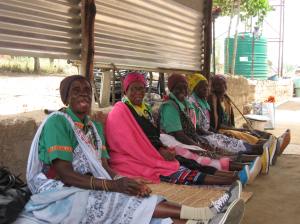
The grandmas all dressed up in their beads and head coverings, sitting together.
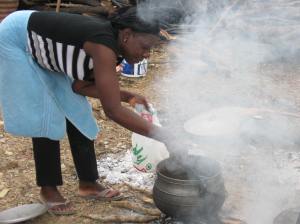
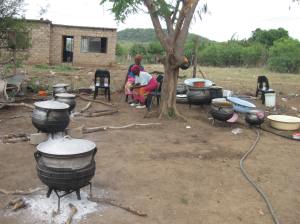
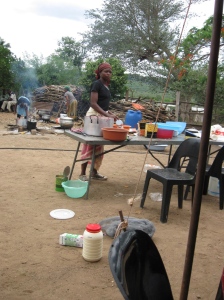
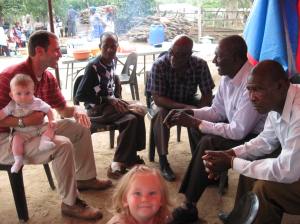
We arrived at 10:30. Several women were cooking outdoors. Their food preparations were almost complete. Each member of Pastor Ngomane’s family made their way to us in the next half hour and cheerfully greeted us. We sat under the tent, raised especially for the occasion, with several other family members and waited.

IMG_0479
And waited some more.

And more. By now, the kids have been oohed and aahed over, and we’re actually having to come up with “real” conversation. ;) My husband has a great knack for this. I’m so glad I’m married to this guy! He got these gray heads shaking their heads and commiserating about the youth these days—you know, how they change the Tsonga language, and they’re not doing this or that right (like the old days).
IMG_0480

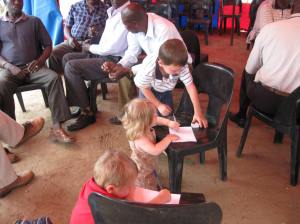
Thankfully I had some paper and pen from the last church service in the diaper bag, as well as some cars. The cars kept the kids busy for the next few hours. I tried not to think about the chicken doo mixed in the sand they were driving the cars through. I have ceased to worry about their clothes getting dirty. (Notice the perfect color of Callie’s jumper—brown.)
Kids' only toys--paper, pen, and cars.


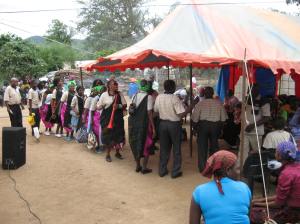
Things perked up when a full taxi (15-passenger van) arrived. The guests filed in, singing, “We are coming into the Ngomane’s,” wearing matching shirts saying, “Kubayi Ngomane Clan.” Shortly thereafter, Seth was called to sit in on the DISCUSSION over the bride-price.
Singing They Come
Singing They Come
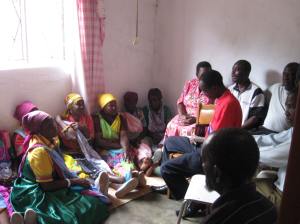
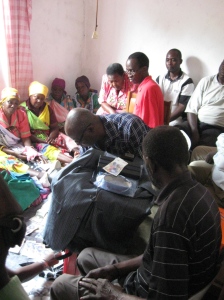
Several Ngomane family members filled a cleared-out bedroom, and Seth (my husband) was the drop of milk mixed in a sea of chocolate. Since neither Seth nor I knew exactly what he’d been called away for, I did not see him for the next two hours, which turned out to be a very taxing time period for a missionary mom with 4 kids 5 years old and under.

Of course, the bride's parents are there (not the bride herself—she sat outside, happy and nervous, the entire time), along with Pastor Ngomane's father, mother, and several of the aunts and uncles, men and women sitting together with their respective genders. The bridegroom’s family, surname Rihlampfu, filled out the sitting room.
Sweet Tintswalo (left), happy and nervous
Sweet bride (left), happy and nervous
Ngomane clan in their room
Two messengers were sent from the Rihlampfu family to the Ngomane’s with R4,100 (currency here). Seth stands up to give them his chair, but is quickly motioned down by the Ngomane’s and threatened with a fine if he does that again. (He didn’t know that they really do fine for bad behavior! But I’m sure they were kindly teasing him in this case—though serious that there was an image they’re trying to hold up, and Seth wasn’t helping it!)

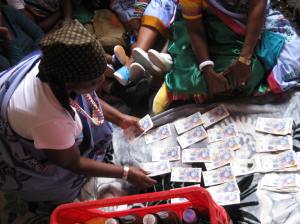
They copiously lay the money out on the floor for all to see. The Ngomane family starts to warm up. But when they see what is offered, they respond, “What did you come here to do? Give us some kind of offer that will open our mouths. Give us a reason to talk. These cows can’t get the whole job done.” (You can guess—cows were the method of payment in the past.)

The messengers are sent back with a messenger from the Ngomane’s to relay this comment. The Rihlampfu clan returns with R5,000 following the same display ceremony as previously. Some uncles are chiming in now. “When you have cows, you send them here, you send them there to plow. They work for you. What is this? This gets no work done, this is hardly anything.”

Pastor Ngomane's family wanted hard liquor, snuff, and cigarettes as part of their payment. Pastor N. had warned Seth in the beginning that his relatives loved drinking. Rihlampfu comes back, carrying two cases of cold drink (pop). Since both the bride and her young man are Christians, I’m glad to see the way the request for liquor was handled.

The groom’s family comes back a few more times offering a new suit of clothes for the father and some money to buy a blanket for the mother. But the Ngomane family scoffs at this: “That’s not even half what you need to buy a blanket. She loses her daughter, and you can’t even buy her a blanket to keep warm?”

More money is brought in. Pastor N’s father: “Go. Go back home.” He now starts to reference the money he was hoping for—R50,000. Some more rhetoric: “We raised her. We fed her, we paid for her. Now you want to come and take her for nothing.” Ngomane relays this message to Rihlampfu. More money is brought in. Now it’s trickling in in the form of smaller bills and coins, no more large denominations. Rihlampfu is trying to communicate that they are running out. Total is up to almost R25,000.

Pastor N’s father is unhappy, clearly stating now that they must reach R50,000. Rihlampfu brings back the message, “Please we ask for mercy. We have no more. Please we ask for water (ease).” The Ngomane’s take a hard stance; but the bride’s parents intervene. Pastor N.:  “Look, we don’t want to hurt these people. Drop the price to R30,000, and let them owe us that small amount. I’m happy. Look at the suit, the cold drink, all the money. I’m fine with this.” Pastor N's wife adds, “I’m happy; I don’t want to hurt these people. This is enough.” She’s told in no uncertain terms by the patriarch of the family (Pastor's father) that she has no say as a woman in the house. She’s not cowed and continues to calmly state that she doesn’t want anymore.
Pastor Godfrey (left)
Pastor Ngomane (left)
Martha, Tintswalo's mother, on left.
The bride's mother, on left.
Charity is one thing; bad manners are another. Ngomane decides that Rihlampfu must be fined R200 each for eight cultural misdemeanors that day. For one, when they all arrived, the groom’s family didn’t greet the bride’s family in the proper manner. Another—they hooted their horns on arrival, signaling that they had “already won the game before they’d even played.” Also the young men in their party did not take off their hats.
Rihlampfu messenger lays out the money.
Is it enough? Ngomane clan counts.
Rihlampfu returns with thanks for the R20,000 discount, and then displays a stack of bills to cover the last R5,000 or so. The Ngomane’s had added up exactly what Rihlampfu’s owe them. Pastor N. reminds them to add in the costs of the suit and cold drink in the payment amount. Calculators are pulled out. Seth, having kept a total in his mind throughout the process, announces the number, receiving a wide-eyed look. A family member checks his math on the calculator and announces that Seth was right. Pastor’s father, surprised, says, “White people!”

The final amount settled for the bride price is R30,000 (@$4,400, depending on the exchange rate). The families are moderately pleased with the exchange, and you hear a specifically Tsonga cheer all the way outdoors, signaling that the two will get married.

Seth was asked if he had to pay lovola for his wife? “No,” he responded, “people gave me gifts at our wedding.” ;) They rejoin, “No, but you had to get her a ring.” His answer: “Yes, but she gets to keep that!” They agreed that he should therefore be living with his in-laws because they are the ones who paid (meaning he can’t take care of his wife himself). Seth ended with, “Yeah, white people are nuts.” He was cheered by all in attendance.

A very tired mama and kids went home with Daddy right after this point, so I don’t know how they ended the party. Perhaps there were a couple of speeches and songs, but if nothing else, there was feasting and music with a DJ to run the computers and 4-foot high speakers. I admit that I had hoped to see more for myself, but instead had a discouraging couple of hours trying to handle the children in that scenario. I’m sure missionary mommy moments like these will only get easier when my kids are older. They have to!

Monday, December 30, 2013

Vertical Running

My daughter, for the longest time, ran forward, up-and-down, if that makes sense. Seth and I often mentioned how it seemed like her little toddler body bobbled up and down while running, which slowed down her forward motion. She still went forward, but a lot of energy was going into a different direction at the same time. Now she is learning to lengthen her stride, lean forward and move more horizontally than vertically.

IMG_1226

Every year around this time I feel an air of malaise that slows down or discourages my efforts. I'm still running forward, generally doing the same work; but I feel like my joints are creaky and slow, my steps bobbled, and I'm not moving forward like I was.

Missionaries, especially newer missionaries, may feel homesickness over the holidays. A break from homeschooling, welcome though it is, may also contribute to a low moment. The missionary mom stops running full speed ahead and has to watch out that the low moment doesn't become a full-blown crash! I know for me personally, I school according to the calendar year, in conjunction with the national school year here. So by Christmas we're done for the year. I'm planning for next year, my feet are unwillingly moving forward; but I'm tired, and subconsciously my body is taking a more vertical pattern trying not to get into next year yet. :)

Do you relate to those moments of low spiritual and physical energy? How do you lengthen your stride and pick up the pace again?

Today Callie invited me to "Look, Mommy, come see!!" a "pider" outside (I just love those invitations to see bugs...) As she ran ahead of me, I noticed that she was running more like a child now, less like a toddler. Aw! Her legs stretched farther apart, she leaned more forward than up, and she moved faster.

I think an important motivation for me to run forward again is my New Year's Goals. Every year, taking stock of how I did with last year's goals helps me to see how much I really did get done! Planning next year's goals gives me the impetus to tentatively peek at how much God still wants me to do.

Exhaustion, discouragement, or homesickness can cause a temporary vertical scope to my running, a moving forward while still remembering what's behind. But setting those goals for the New Year in every category--personal, spiritual, homeschooling, ministry--reminds me to keep "pressing toward the mark"! I'm not perfect, and I'll never be; but the point is that I keep pressing, I keep pursuing, forgetting what is behind, and reaching forward to those things which are before.

What goals have you made for your New Year? What keeps you going in a "vertical running" moment?

IMG_1235

Monday, December 23, 2013

An Unfair Sacrifice

IMG_1085

On the hottest two days of the year, I kept my oven running for seven hours making five batches of Christmas cut-out cookies and gingerbread men and caramel corn. Next the cookies had to be iced and then arranged and wrapped on individual take-out styrofoam trays. This was my latest brainchild for our church to make money (itself!) for our church building project.

Unfortunately, the next four days were rainy, which was the first strike against my new business idea. One day during a more dry but still drizzly spell, four teen girls walked around the strip mall nearby and tried to sell them. This actually was the second strike--they are very timid. (Yet I am happy and proud of their efforts!) But the final strike came when careless potential buyers broke several cookies, and of course, never bought them. How could I sell broken cookies? We made a total of $2, which wouldn't pay off the investment. I had hoped to make between $20-$30, which would have bought about three more bags of cement for our foundation.

My high hopes crashed. I had really thought it might work to capitalize on Christmas cash with pretty cookies around here, but it didn't. Sigh. I could write a whole article on the worldview that doesn't value other people's work or personal responsibility. That my labors were ruined on top of the failed venture was really hard to swallow. This was a low missionary moment for me, I'll admit. All sorts of not-so-nice names came to mind for these crumblers-of-cookies (and therefore profit).

And it's not like I had anything else to do, right? I had sacrificed Christmas baking for the family, homeschooling time, personal hobbies, and sleep for this endeavor.

Well, I was advised by a friend to make lemonade with my lemons (or should I say, ice cream topping from my crushed cookies?), and I did manage to salvage enough un-crumbed cookies and caramel corn for Christmas presents for neighbors and for an adult Christmas party Sunday afternoon.

But I felt discomfited--because of the situation, as well as my response to it. I was frustrated. This was now my fifth idea for what to sell, and I was pretty optimistic that it would be a hit, especially at this time of year when they sometimes buy a little extra for Christmas.

"What in the world will they buy?" I wondered. I had thought the eye-candy of something related to Christmas would appeal to them. I should have known that "new-to-them" would not be an easy sell to people who still call butter by the brand name of the original distributor of butter and pop by the brand name of the original distributor of pop (Coke), and whose lack of tradition regarding Christmas (outside of a day off of work, maybe some extra food, and a time to drink) would render cookies in the shapes and colors of Christmas meaningless.

But why did they have to break the cookies on top of not buying them? I had even anticipated this and warned the teen girls to be careful. That was the straw that broke this camel's back. (Not a pretty picture, I know, but neither were my hopes.) My mind started down the road to reviewing faults of the Tsonga culture related to their manhandling of my carefully prepared cookies. Unbidden, but too indulged, a memory arose of two people at the nearby bakery each gripping three loaves of bread in succession and leaving finger holes in the loaves, before taking the fourth loaf, which was no different in softness than the former three now-mangled loaves still sitting on the shelves.

Why did they do that? This was so unfair! Yet another unseen, unthanked sacrifice for the Tsonga people to add to my list--not that I was keeping a list, of course!

That night, the passage of time having lessened some of my angst, I sat with the family listening to my husband read our daily devotional for advent, from Psalm 22.
"I am poured out like water, and all my bones are out of joint: my heart is like wax; it is melted in the midst of my bowels. My strength is dried up like a potsherd; and my tongue cleaveth to my jaws; and thou hast brought me into the dust of death. For dogs have compassed me: the assembly of the wicked have enclosed me: they pierced my hands and my feet. I may tell all my bones: they look and stare upon me. They part my garments among them, and cast lots upon my vesture."
The commentary said,
"Though he would be innocent, the Lamb of God would take the punishment for sin upon Himself. God gave His people a picture of how He would die--surrounded by scoffers and unbelievers, exhausted in body and soul. His hands and feet would be pierced as they hung Him up to die, and His killers would disrespect Him so much that they would gamble for His leftover clothes."
crossThe Holy Spirit used my overly-tuned sense of justice to enlighten me as to how frustrated I would have been in Jesus' situation--a truly unfair one! He took cruel punishment He did not deserve, with no thanks or understanding, even by those He was closest to. Not to mention the slights and humiliation offered by his enemies.

He left the continuously offered worship and glories of Heaven and came to a place where the "manners" and "culture" of the people must have felt very degraded indeed. He "made himself of no reputation, took upon him the form of a servant, humbled himself, and became obedient unto death, even the death of the cross." He was unthanked, persecuted, hurt, grievously misunderstood, blamed, and sullied; yet He loved us and gave Himself freely for us.

And what are some cookie crumbs in comparison to that? I lay my hand on my mouth and shed a thankful tear.

Monday, December 9, 2013

The Many Jobs of a Missionary~ Historian

Yesterday after church a teen girl asked me, "Do missionaries have to finish grade 12?" She has expressed interest in being a missionary, and I got the impression that she was hoping I'd say, "No! Missionaries? What education do we need?? Just drop out of school in 10th grade and read your Bible!" ;)

Here in South Africa starting in 10th grade, the students have to choose which track they will take in school--one heavy on business and accounting or the sciences or history and social studies. If they do not choose the history track, they learn very little history in school.

But missionaries never stop learning history. Or they shouldn't. For one thing, we are in the middle of living history. Nelson Mandela died last week. This is such a huge, real moment to South Africans--and all blacks or those struggling with freedom from racism.

Who was Nelson Mandela? I had heard the name but didn't know him until I became a missionary to South Africa. I got world history a few times in school, but you know how you never seem to get to the final chapter or two of the history textbook in school? Not enough time. So Mandela was little more than a name to me.

nelson_mandela__my_heroIt is important for me as a missionary, though, not to show ignorance and apathy about a name that meant little to me, but is heroic to many of the people I live with. And therefore, he should have great significance to me. He (and the former white president of SA--F.W. de Klerk) did a great service for the blacks of SA. But even more, perhaps we could say he did a service for the whites. Because all of the hate and anger and injustice served to a people group for decades could have rolled back in a tidal wave of revenge on whites who did not begin the system yet kept it going and lived in it.

And then maybe we would not be so welcome here as (white) missionaries. Maybe SA would have gone the way of Zimbabwe with a dictator who cannot give up power, chases the whites off their farms, and impoverishes his people through corruption and fear tactics.

Mandela's example of peace and forgiveness protected many whites and blacks from what could have been a messy civil war. He and de Klerk truly deserved the Nobel Peace Prize they received together in 1993 (unlike America's president now, who apparently got it simply for his color, not for any actions associated with it?)

And then unlike many African politicians, he freely gave up his presidency after one 5-year term. His people loved him. They would have voted him in forever if he had chosen to change the laws and preserve his power and fame. But he didn't. And that in itself is praiseworthy in a continent full of politicians who give lip-service to democracy until their inability to allow themselves to be voted out or serviced out shows that they never really gave up their tribal monarchy ideals.
"The history of liberation heroes shows that when they come into office they interact with powerful groups: they can easily forget that they've been put in power by the poorest of the poor. They often lose their common touch, and turn against their own people."--Mandela as president, 1996
Was he perfect? Well, not by American standards. And that's another reason missionaries need to learn history, specifically national history of their country of service. There are those troubling connections with terrorists and Communists who supported him financially, in training, and with weapons and other promised aid.

So when one church member this week emotionally told me that Mandela was the greatest statesman who ever lived, and then slightly shocked and embittered said, "America called him a terrorist!" I had to think fast. I have never read a biography of Mandela, and my grasp of modern history is only so-so. I did come up with enough to hopefully explain America's lack of support for Mandela in the situation.

No, we weren't supporting racism. America has almost always stood as a bastion for freedom. There was that pesky Cold War we had just gone through where we were *this* close to blowing up Russia and vice versa, so maybe we didn't take that well when Mandela and Co. went to get training and weapons from them. ??? Uhh...same thing with support from Cuba. Yeah, that wouldn't be seen as a good thing by the US of A.

Isn't it funny how history can lead to ethics though? Here is this beloved politician who can do no wrong to South Africans, and this church member says to me, "But he had to take money from wherever he could! If I were in his situation, I would do it for freedom! America should have supported him anyway, at least verbally!" Hmmm. Oh boy, what to say? Do I plead the 5th, since my knowledge of to what extent America supported Mandela or apartheid is admittedly lacking (and I suspect my friend's was as well...)? Do I realize that what he's really seeking is affirmation that yes, Mandela was great, and therefore your culture and race can do really great things? Do I stick with an old adage? "It's never right to do wrong to make something right."

Probably the worst thing to do in that situation is to take umbrage that no matter how many billions of dollars in aid America sends every year to Africa we can still do no right in the eyes of Africans: always, we should have given more, or taken up this or that war--and then when we do (Iraq), they say we interfered under false pretenses. Sigh. I'm afraid I didn't pass that test so well. Ah, well, live and learn. At least, that's what we're supposed to do from history--learn!

Maybe I should learn from Mandela how to better be a peacemaker.

So all that to say, missionaries, that once again, our job is not as easy as "A-B-C, 1-2-3, Pray with me." There is a whole history behind the worldview of the people we minister amongst, and it is our duty (and pleasure) to learn it.