Showing posts with label By Amy. Show all posts

Monday, November 23, 2015

The Racist Missionary

Jonah is an anomaly.

His book is unique among the prophets because it is entirely autobiographical. He did not desire the incredible ministry successes he experienced. God took the initiative to show His grace to the Assyrians by sending them a missionary. Jonah was not merely apathetic about this, he was antipathetic--he did not want that ethnic group to be converted. They were a different skin color, language group, and geography from him; and their culture was vastly different. He wasn't interested in their conversion.

And after ten years on the mission field, I can see that Jonah was not the only missionary to struggle with racist feelings.

What, a racist missionary? Isn't that an oxymoron? How could a racist be a missionary? Well, emotions of bitterness and cynicism towards the people on your field don't come all at once. Missionaries don't ever go to the field thinking that they could even become close to being racist! After all, they've given up everything because of their love for another people group, right? Nevertheless, negative emotions towards the very people you want to love can creep in over time after many adverse culture-shocking experiences. (Look at the results of "culture stress.")

jonah gourd
Jonah is a good bad example of NOT loving the people to whom you are sent. Thus Jonah's story is a great starting-place in a biblical discussion of racism. Jonah was "very angry" when God showed mercy to the Ninevites. So God used an object lesson of a quick-growing, then quick-dying gourd, with some gentle questions, followed up with a gentle, insightful rebuke to show Jonah that his hatred towards the Ninevites was wrong.


And God said to Jonah, Doest thou well to be angry for the gourd?

And he said, I do well to be angry, even unto death.

Then said the LORD, Thou hast had pity on the gourd, for the which thou hast not laboured, neither madest it grow; which came up in a night, and perished in a night:  And should not I spare Nineveh, that great city, wherein are more than sixscore thousand persons that cannot discern between their right hand and their left hand; and also much cattle?

~Jonah 4:9-11
Who are these persons that God is talking about? Who cannot tell the difference between their right and left hands? Isn't it the children? In other words, some litmus tests of whether you are racist or not are the following:
  • if you are unable to show love towards people from another ethnicity
  • if you wish for genocide including the children
  • if you believe that a person from that race cannot be converted, or
  • if you believe that all the people in that culture are only bad, thus even the children have no good potential.
I still remember a defining moment for Seth and me as new missionaries. We had just moved to a rural village in South Africa and were visiting neighbors in an attempt to meet them and learn their culture. We came across an old man who had been almost raised by Swiss Presbyterian missionaries who pioneered missions to the Tsonga people. They had sent him to school abroad, and his English was excellent.

Trying to answer his wife's questions as to why we were there, we began evangelizing, assuming that they knew basic ideas of salvation and the Gospel because of their background as staunch Presbyterians. Imagine our surprise when his wife inquired what we meant by "salvation." She queried, "You mean, baptism?" Startled, Seth began expounding the Gospel. Her husband cut us off with an eye-opening statement: "Oh, you'll never get them to understand details like that. These people will never get the details."

The Gospel? Details? Sadly this man was a living example of his own stereotype.

I remember another shocking scene in my first year here. Our landlord came over drunk one night to visit with us. I will never forget him pouring beer on the hood of our pick-up truck for his pet monkey to lap up, while saying, "This chimp is smarter than any of those * blacks."

After years of ministering to a pagan culture, missionaries can get very discouraged from witnessing repeated sinful behaviors. They can get bitter from attacks or disappointments by untrustworthy people. They can become cynical, wondering if fruit is real or how long it'll last this time. Harmful generalizations are made: "These people are all like that. They will never get better."

Missionaries to less civilized people groups eventually have to deal with the question, "Why are these people like that?" When a missionary hits that disillusioned stage of being so frustrated, it seems that two paths lie before him. He can explain the deficiencies he sees in another culture in one of two ways:

He could say that those people are like that because they are inherently inferior. They are simply unable to become an enlightened, Christian culture. He could become like our landlord, bitterly saying that the people have no more hope than animals. In other words, he could become a racist.

We have decided to take the second path, however, which explains stereotypical problems of another race with this answer: The Devil has blinded their culture for so many thousands of centuries and they have had so little common grace given to them, that they need a lot more time and work of the Holy Spirit to reflect Christianity in their culture. (2 Cor. 4:4) In other words, it is Satan we are fighting, not people.

Missionaries need to guard their hearts and thinking about pagan cultures. If you don't believe that cultural sins and deficiencies are strongholds of Satan, and that these are spiritual issues deserving of your empathy, you will become a racist missionary, constantly embittered and frustrated instead of responding with compassion. Because if the answer is not that the Devil has a stronghold in that culture, then the answer is that those people are just inferior, inherently, for centuries. And that is racist.



Monday, November 9, 2015

The Most Undesired Ministry Success Ever

Soon after thinking about a summary of Noah's ministry, I recalled a sermon my husband preached at a supporting church on the book of Jonah. We had fun contrasting the two "ministries."


Noah

jonah2
Mission field: the very wicked people of the world
Message: total destruction
Converts: only his family (eight people)
Reaction: a sacrifice of thanks

Jonah

Mission field: the very wicked people of the capital city of Israel's enemies
Message: total destruction
Converts: everyone, from the greatest to the least
Reaction: anger, wishes to die


What fantastic irony! Can you think of two more polar opposites in Scripture? Noah preaches and prepares an ark for salvation but sees no fruit from his efforts outside of his family. But he praises the Lord for their salvation, this little fruit that came from his long ministry.

Jonah, on the other hand, doesn't want to see the salvation of the Ninevites, even though he himself has been so miraculously saved from a watery death. His sermon is as short and perfunctory as can be (eight words in English), and yet he has incredible success in a mass revival that involves even the beasts fasting and wearing sackcloth!
Jonah by George Frederick Watts
His angry reaction is even more incredible. I mean--what missionary doesn't long to see a revival like that? We can't even tell if he made it the three days the Bible says it took to cross the city before repentance falls on the people. But he is angry at God's great mercy, at His goodness. His emotions are extreme: "It displeased Jonah exceedingly, and he was very angry."

He spits out his prayer, which with your permission, could be summarized in modern speech, "I knew you'd be like that! You know... GOOD. I'd rather die than see this!"

We can learn so much from the book of Jonah. But for now, what can we learn from a comparison of Noah's and Jonah's ministries? I think we can be encouraged by the answer to a natural question that might come up when comparing the two ministries.

Why was Jonah's ministry so successful, though so vehemently undesired, when Noah's ministry was dry as a desert? (That is, ahem, until the waters covered the earth.)

There is only one answer. I'll use Jonah's words:

SALVATION is OF THE LORD.

That is the only explanation for such vast differences between the two ministry results, especially when we consider that Jonah actually worked and prayed against the salvation of the Ninevites!

Look at all the actions the Lord does in the book of Jonah:
  • He calls Jonah. "The word of the Lord came unto Jonah..., saying, 'Arise, go.'"
  • ...the Lord sent out a great wind into the sea...
  • ...the Lord...which hath made the sea and the dry land...
  • ...the Lord had prepared a great fish to swallow up Jonah.
  • [according to Jonah] "He heard me...thou heardest my voice. For thou hadst cast me into the deep....Yet hast thou brought up my life from corruption, O Lord my God.
  • And the Lord spake unto the fish, and it vomited out Jonah upon the dry land.
  • And the word of the Lord came unto Jonah the second time, saying, "Arise, go...and preach unto it the preaching that I bid thee."
  • And God saw their works...
  • And God repented of the evil that He had said that He would do unto them; and He did it not.
  • He gently questions Jonah, "Doest thou well to be angry?"
  • ...the Lord God prepared a gourd, and made it to come up over Jonah, that it might be a shadow over his head, to deliver him from his grief.
  • But God prepared a worm...
  • ...God prepared a vehement east wind; and the sun...
After being attacked by criminals, a few pastors asked if I was struggling to believe in God's goodness. Honestly, at the beginning, I wasn't struggling very much on that point. I knew God was good, if for no other reason than that He saved our lives!

jonah gourdActually I admitted that where I struggled to believe in God's goodness and love towards us was in the extreme difficulty and scant results of our evangelism efforts. I am sure many missionaries can relate to struggling with a feeling of bitterness towards our Lord. "I gave up all ___ for You, and where are You? Why aren't You blessing our ministry? Where's the fruit?"

This is actually nothing but a feeling of entitlement that God owes us certain glories for what we've sacrificed for Him, an expectation of a certain minimum of results. But hasn't it been said so many times in the Bible, that God is the One responsible for our ministry successes?
  • "I will build my church; and the gates of hell shall not prevail against it."
  • "I have planted, Apollos watered; but God gave the increase. So then neither is he that planteth any thing, neither he that watereth; but God that giveth the increase."
  • Even the pagan sailors whom Jonah sailed with admitted, "...thou, O Lord, hast done as it pleased thee."
It is initially discouragingly humbling for us to realize that it is not our charisma or plans or goodwill or activities that effect revival. It is the wind of God blowing where it will.

But there is one thing that we can do, that we must do, in order to see God's hand at work. We must go. And we must preach.

jonah preachingWhy God, with all of His amazing power and mercy, has chosen to use such a weak tool as the foolishness of preaching, is a mystery to me. But He told us to go, and He said that the Gospel is the power of God unto salvation, and He said that they cannot believe unless they hear, and they cannot hear without a preacher. So...

...don't be discouraged by the truth that God is ultimately responsible for the salvation of souls on your field. Let that truth encourage you. He said He would do it. It may not be as immediate as it was with Jonah; in fact, it could take a long time, but He will go with you, and He will build His church.

And what should be our only response?

Definitely not anger:
"Why are You doing it this way?"

But gratitude and humility. Embrace humility:
"Who then is Paul, and who is Apollos, but ministers by whom ye believed, even as the Lord gave to every man?"

And gratitude:
"You saved me and included me in Your plan of salvation for the Tsonga people? Thank You, Lord. You, O Lord, have done as it pleased You."

Salvation is of the LORD.


Monday, November 2, 2015

The Most Successful Ministry Failure Ever

When Seth and I were seeking counsel on whether or not to return to our suddenly-shockingly dangerous mission field, one counselor made some pithy statements that stuck with me; and I've ruminated on them since.

That meeting was quite humbling, because the take-away main point had to do with how unnecessary we are. We really needed convincing on that point! :) When we contemplated leaving Africa, we couldn't get around the "need" for laborers in our field.

Ours is a pioneer mission field. Swiss Presbyterian missionaries laid a wonderful foundation in the last century by translating the entire Bible, translating hymns and inventing a musical notation system for a hymnal, starting schools and hospitals, and building Presbyterian churches. Unfortunately by the '50s,  they were going liberal in their theology and lost the Gospel; and by the '60s, the missionaries were gone.

We, along with our teammates, and a national pastor or possibly two, are the only true churches with a Gospel witness in about 2.2 million Tsonga people in South Africa, and 3.1 million more in Mozambique. Truly the laborers are few! Who else, we wondered, would go through the struggle to learn this African language that had no language school? Learning the language and culture was an investment we weren't going to easily give up.

And we hadn't been "successful" enough yet to leave! Our infant church needed us. It wasn't ready to stand on its own.

But this counselor wanted to make a point even more important than our need for humility (and yes, even he, I think, would concede that our field does "need" laborers), and that is, that our children also needed us--parents, alive and whole, whose eyes could focus on them, and not always be focused on the ministry--in fact, that our children needed us more than the ministry needed us.

I know, this isn't really rocking your world yet, is it? Duh, no brainer. We'd all say our family is more important than ministry. 

But then he mentioned a Scriptural example that gave me a new flash of understanding, that set that truth in a clearer light for me. Are you ready for some easy Bible trivia? See if you can answer this question, the question he posed to us when we were busy arguing for why we were needed in Africa:

Who did Noah take on the ark with him?
Noah's Sacrifice by Jacobo Bassano
The Bible is clear-- "Noah, the eighth person," it says.
By faith Noah, being warned of God of things not seen as yet, moved with fear, prepared an ark to the saving of his house; by the which he condemned the world, and became heir of the righteousness which is by faith. ~Heb. 11:7

Which sometime were disobedient, when once the longsuffering of God waited in the days of Noah, while the ark was a preparing, wherein few, that is, eight souls were saved by water. ~1 Pet. 3:20

And spared not the old world, but saved Noah the eighth person, a preacher of righteousness, bringing in the flood upon the world of the ungodly. ~2 Pet. 2:5

And the Lord said unto Noah, Come thou and all thy house into the ark; for thee have I seen righteous before me in this generation. ~Gen. 7:1

And Noah went in, and his sons, and his wife, and his sons' wives with him, into the ark... ~Gen. 7:7
The new, interesting thought to me was an analysis of Noah's "ministry" successes. Peter called him a "preacher." I've heard some sermons or children's presentations that mention him preaching to the ungodly for over 100 years. Dramatic recordings usually have Noah pausing in the middle of building the ark to preach a sermon to unbelievers in evangelistic 21-century style.

I'm not sure if that preaching was the same as what we think of today when we think of preaching. But at the least, we know that his righteous lifestyle was counter-cultural, and that preached. And his building of the ark, motivated by fear grounded on faith, spoke; that also was counter-cultural, and this "preaching" condemned the world.

And what does he have to show for his evangelistic efforts?

"Nothing," most of us would respond.

And there's the rub, the immediate rebuke: nothing??! Saving his family is nothing?

But I'm pretty sure that if Noah were reporting to supporting churches after twenty years of service, he'd have lost support. If he were trying to raise more support in his 87th year of service on his oh-so-very-needy field, he wouldn't get it! If ministry successes were based on numbers, and let's admit it, we all do assess our ministry successes this way to some extent, we wouldn't support Noah, the eighth person, today. Wow.
Noah's Ark Mural by David Jermann
So was he a failure, then?

Ezekiel implies he was one of the best, listing him in a group of three along with Daniel and Job. And what of Jeremiah, preaching for fifty years, with only three converts mentioned?

No, Noah the eighth person was righteous, and one of the most obvious marks of his righteousness is that his "house" got on the ark with him. In a day when evil abounded, and every imagination of the thoughts of man's heart was only evil continually, Noah saved his family. His family got on the ark with him.

What about you, dear missionaries and preachers of righteousness? Who are you gonna take on the ark with you? It can be so hard to balance the needs of ministry with the needs of family. My husband tried to think through the difficulties of obtaining this balance here.

For those all-out, die-hard missionaries who can sometimes run over people in their zeal, let's get this one point from Noah's example:

In the eyes of many, his "ministry" was a failure; but he saved his family. And God called him righteous. The eighth person was a hero of the faith.
Noah's Daughter-in-Law in the Dovecote by Mary Jane Q. Cross


Monday, October 26, 2015

BMW Talk Shop: What Sunday School Curriculum Do You Use?


Our Common Work

One of the most common jobs that Baptist Missionary Women do for their ministries would be teaching and managing Sunday School or children’s Bible clubs. We often have to be quite flexible about where we gather: the Sunday school classroom might be outside on mats on the ground under a tree or in a dark cramped room. Challenges also include having to translate all materials ourselves and having children of all ages in one class, from age 2 to 14!

Having spent years translating our own materials, I was curious as to what curriculum other BMW preferred. I wish I had asked long ago, but since I just spent years translating one curriculum, I have no desire now to switch to anything else! I took a poll of several BMW to find out what Sunday School curriculum materials they preferred.

Several responses came back, including recommendations for curricula I had never heard of; and I’m sure that there are many resources out there that aren’t included here. If you’re about to begin a children’s ministry on your field, maybe these tips and explanations will help you think through where best to invest your money.

Our Common Preferences

The top three choices were Betty Lukens flannel graph, A BekaBook’s Flash-A-Card series (ABB), and Child Evangelism Fellowship’s materials (CEF), in that order. But before I compare and contrast these three, let me first mention some general comments that kept popping up.

First, even if BMW voted for a certain curriculum, many did not use the lesson plans but wrote their own. Most desired a curriculum that was straightforward Bible, not adding much conjecture. Secondly, most BMW when describing why they chose ABB or CEF mentioned their preference for flashcards over the flannel graph. So if you add together the votes for those two to reflect this desire, flashcards won out over flannel graph.

Betty Lukens’ felt curriculum was praised for being colorful and durable, holding up well in humid climates, versus paper cards which can stick or mildew. BMW like its CD with activities and coloring pages, and that it comes in Spanish. Kids enjoy adding pieces to the board themselves. Negatives include what I mention above—not being purely biblical and complaints about the hassle of transporting felt pieces, losing pieces, distracting transitional times while adding pieces, being locked into one location while telling the story, and dealing with pieces in the outdoors (do you tote an easel with you to prop up the felt board? And what do you do when the wind blows off your pieces?)

Other negatives have to do with the art: characters are too white-skinned, or one woman mentioned that the figures didn’t seem to be all of one size, some being bigger than others. One point would really bother me: all the cutting! Death by cutting out pieces! If you get a used set or a gift that includes the cutting-out-of-pieces already done, that would be wonderful. (I was gifted a set with the smaller size of pieces, and while I prefer flashcards, I may use this with preschool someday, as it seemed that the stories were much shorter.)

Next with almost as many votes is A Beka’s Flash-A-Card series. This is not their newer Sunday School company but the elementary school curriculum. The art is excellent, especially Brian Jekel’s work. I love these, because they have several large, colorful, interesting pictures for each story, and you can easily transport them and move freely in your classroom or outdoors with just picture cards. Some are in Spanish. Negatives include occasional conjecture added to Scripture or incongruent applications. Another negative is the price. I do feel, however, that they are worth the price.

This was my favorite choice. I shortened or split some lessons, sometimes changing applications or cutting conjecture; but in general, I felt that the stories thoroughly covered and explained Scripture. They don't clutter the lesson books with lots of extra teacher notes and objectives. The pictures help keep the children’s interest, and a ministry in the States helped me to laminate several sets so that they would hopefully be indestructible by potentially careless future teachers. I cut costs by searching for several of them on used homeschool curriculum sale websites. (One BMW found several at a garage sale for $10 for all! Sweet deal!)

A man teaches a children's Bible club, using a CEF flashcard story.
 A lot of people appreciate Child Evangelism Fellowship’s materials, especially the Bible and missionary stories, the older materials, as the newer ones begin to lean more Pentecostal. They seem to be good for exposing kids to other cultures, missions, and are very evangelistic. They include several teacher helps on how to write lessons using symbols from the wordless book (gold circle, black heart, red cross, white heart, green leaf). They have the benefits of flashcards, and are easily stored. Some already come translated into Spanish. BMW praised them for great application.

Our Uncommon Preferences
Here are other choices that were appreciated. Some I had never heard of.

  • Calvary Curriculum
  • Regular Baptist Press (I was given several sets free, but found these not as practical or straightforward.)
  • Bible Centered Ministries--series Footsteps of Faith (four series in both the Old and New Testaments). Some are translated into French.
  • The Story of Hope by ABWE
  • New Tribes Mission Firm Foundations for children—(also in Spanish). We were also gifted this set, and I translated (and shortened) and used it. I loved how it gives a great overview of the Bible, clearly pointing to the Deliverer in the Old Testament. I did not love how it usually only had one picture per lesson. Now that I have it translated however, I can easily switch out ABB’s pictures when I want to teach these lessons.
  • Homemade--several BMW are quite clever and resourceful!
  • Bible Visuals International: I really want to talk this company up. They are non-profit and include downloads of several of their resources, and have pursued translation work for their materials in several languages. They approached me to translate into Tsonga, but I was exhausted from having just finished translating all of the ABB series, so I doubted that I would do theirs. I love that they have 5-day biographical stories as well (like the new release on George Mueller) or other missionary stories or works that would be great for a 5-day continuing story for VBS. They even have Holy War and Pilgrim’s Progress by Bunyan summarized into 5-day lessons, including a PowerPoint option for the visuals. The visuals aren’t that great in some cases, but the lessons I have seen are good. They use flashcards and plan to soon release other media as well.
A Final Tip

Don’t forget to search for curriculum already published in your specific country. Some countries have materials in their home language already, and can target their own cultures better, and you win on the shipping costs. For example, a friend mentioned a curriculum where I am in South Africa called iVangeli. The stories have South African situations and names of children, and worksheets come in three local languages. 

Monday, October 12, 2015

And Let One Interpret

I am so excited about something that won't be in my life anymore. Not because I don't like it, but because I've finished it! Last week I finished translating the last lesson of our Sunday School curriculum into Xitsonga. I started this project over six years ago and finally have finished 212 lessons from A Beka Book's elementary Bible curriculum. Earlier I had translated 32 lessons with Firm Foundations, a chronological approach from New Tribes Mission.

I usually spent three to four hours per week in translating a lesson plus review questions, then another hour or so picking out a memory verse for the week, making memory verse visuals, and practicing teaching the lesson. I am very excited to have some more time in my week now that this lengthy project is finished! I am also happy when I think about national teachers being able to use these materials in the future when we have hopefully moved on to another church plant.

Once at a college graduation I attended, a man was awarded an honorary doctorate for having written curriculum for eight semesters of a one-day-per-week seminar. I tickled my fancy, awarding myself with an honorary doctorate for finally finishing this accomplishment. :) Not tooting my own horn, just enjoying finishing this "chapter." Oh, the work missionary women do that will go unheard of, unsung, or unnoticed. (By the way, much of what I write could apply to pastor's wives as well.) So share with me, are you working on any projects on your field right now? Have you finished any projects that excited you? I'd love to hear about it!
Decorating Valentine's cookies at a Sunday School party


Monday, October 5, 2015

An Open Letter to the Missionary (Woman) Quitter

When criminals entered our home last December 2nd and attacked our family, our lives changed completely. The obvious, immediate question after the crisis was, "Do we quit being missionaries?"

It was an excruciating question to work through, partially because it was completely unexpected. We had had no thought of leaving the field. My husband's screen saver on his phone when we were dating said, "Go tribal!" Hadn't I known what I was getting into? No, actually! And yes. His heart for the Unreached has defined him, been his core, since I've known him. It seemed there was no avenue forward that didn't involve reconstructing either Seth's or Amy's make-up. We reached out for counsel.

As you may have guessed, especially if you already heard of our situation and were thinking "in our shoes," not many counselors had an easy answer. It would have been wonderful if God had spoken to us in a vision. Most counselors were unwilling and unable to give a certain "yea" or "nay." Understandably so.

What a blessing that most counselors were amazingly supportive. By "supportive," I mean that they understood and articulated that leaving our field was an obvious and valid option, and that we weren't bad Christians to be considering it--that godly Christians have chosen both paths, to leave or to stay.

But a few comments stuck with me memorably--in a negative way--that, in my opinion, made our decision even tougher. They hinted or outright stated that they viewed me as weak or wimpy to even go back to the States for an eight-week visit to think about our future, that I was holding back my husband (because his personality did not struggle with the decision to return to the field even a fraction as much as mine), thus I was unsubmissive and "wearing the pants in the family" (and therefore, my husband had blame for not "leading me" appropriately), that I was not obeying certain Scriptures that encourage risking all for Christ, and that I was not a strong person or missionary or Christian if I couldn't go back.

Well, comments like these (made by people who have not experienced even a quarter of what I have) were not accepted well by a traumatized woman concerned for her traumatized children! And there, in that sentence, may lie part of the answer. Some people cannot empathize fully with a wounded person until they themselves have experienced the humiliation of trials and suffering. I cringe when I remember my naive judgmentalism as a young missionary. Oh, how I've changed now, and eaten my words (rather, thoughts) a hundred times over.

It is true that many leave the field for wrong reasons at the wrong time. And it is true that we do not hear enough encouragement to risk all for Christ. I don't want to take the teeth out of Scriptures like these:
Whosoever will come after me, let him deny himself, and take up his cross, and follow me. For whosoever will save his life shall lose it; but whosoever shall lose his life for my sake and the gospel’s, the same shall save it. For what shall it profit a man, if he shall gain the whole world, and lose his own soul? Or what shall a man give in exchange for his soul? Whosoever therefore shall be ashamed of me and of my words in this adulterous and sinful generation; of him also shall the Son of man be ashamed, when he cometh in the glory of his Father with the holy angels.
But: Around the time when I was struggling with the fact that I knew that we would be going back to the field, I heard of a missionary woman who was likewise struggling, almost...despairing. And my heart went out to her. She had "put in her time," labored for years on the field, followed her husband to a difficult people, had children in inferior hospitals on the field, and after numerous trials, was beginning to crack under the pressure. I cried for her, someone I'd never met. Why should she, dear timid warrior that she is, be criticized if she needs to come home (America) for the sake of her sanity?

Honestly, I struggled to even word that last paragraph, because I know alpha male theologians who would respond that she shouldn't need that, that if she were responding biblically she could handle this, etc. But I think long-term missionaries understand what I mean, because They've Been There.

So while I truly don't aim to encourage anyone to leave the field, especially for wrong reasons, please understand my desire in this post. I desire simply to offer compassion to that lonely, spent missionary woman who so badly needs to hear compassion, not guilt trips, if she goes home for good or simply for a rest. At other times, I will take the opposing side and encourage perseverance. But for right now I want to simply offer compassion, only compassion, in an open letter to the few missionary women who may be in this situation.

IMG_0196
You dear woman,
You've been told so many hurtful things.

It is okay. It is okay to leave the field because you are cracking under the pressure.

Your hair is prematurely graying. You are beaten down by the degrading depravity of your field. Your health is failing. You have forgotten that you used to have an easy laugh and can't remember what it feels like to converse easily with another Christian without weighing every word and its possible miscommunications. And you struggle to list one positive item per every fifty negative things about your field.

You have fought on the front lines of the war for a long time, and you are coming home a wounded soldier. Yes, soldiers wounded in the war receive an honorable discharge. You deserve a medal. Indeed you are a hero! So few people want your job that you are irreplaceable.

God bless you! You tried. You gave your all. You gave beyond your all. You submitted to your husband and raised your children in challenging circumstances. Now channel what remaining energies you have into enduring yet more change, but hopefully a more restful change because of its familiarity. If your coming home allows you to gain the benefits that Jesus got when He "came apart to rest a while," and to continue being a helpmeet to your husband and to keep going in the ministry, though it be no longer foreign, then come. Come home, and continue to follow Christ as well as you can in the place where you are.

You will hear no word of condemnation from me. Only compassion.
Only compassion, dear missionary friend.


Love in Christ,

Amy

Monday, November 24, 2014

Saved by the Mud

I mentioned that rainy season was about to begin here, and last Sunday that was proven correct in classic style. It was raining hard for the second day in a row with a chilly wind. Rainy days are always low attendance days at church. Who likes to get out of bed to trudge somewhere through the rain and muddy roads? We always hope that our church members have grown enough in grace that mud and chilly wet will mean nothing in comparison to being with believers and submitting themselves once again to hear the Word, but every rainy Sunday is another test.

This Sunday we had especially hoped for good attendance, as we were hoping to try a new tactic in the war for souls. We have several regular visitors who haven't committed to following Christ, so we decided to start a 5-week prospective members class in the Sunday School hour just to target these folks and present salvation, baptism, and our church covenant in a clear manner. We had about ten people lined up for the first class, but our spirits were dampened by their apparent drowned attendance.
Really stuck!
Really stuck!
Then the other family (we only have one family besides our own in our church that includes husband, wife, and kids--and a car!) got their truck stuck in the mud on the road to church. It took an hour and a half to extract them. The situation became even stickier, or should I say muddier, when we noticed that they had brought first-time visitors with them on this rare Sunday. They were discouraged to have such a setback on the day their visitors came with them. We were worried to start a new class without all of our beloved prospects attending. And all the men were wet, cold, and muddy when we began the service.

Ita vita African. This truly could be an apt description of normal life in Africa. Some discouraging setbacks just when you were hoping to make a good impression; poor attendance for weeks at a time in the rainy season. But God was working all of those seemingly bad events to ordain a private evangelism meeting between me and one of the children in my Sunday School class.

When Mr. N__ got stuck in the mud and all the men and boys went to help, I (with my kids) was left alone with one sweet neighbor girl who has attended my S.S. class and Seth's neighborhood Bible club all year. As I fiddled around setting up church stuff, she came to me and asked shyly, "How does a person go to Hell or to God?"
Seth's Bible club: they learn verses and the catechism (yellow book). She's the girl in the blue tank top, back row, third from the left.
Because of the rain and the car stuck in the mud, I was given an uninterrupted fifteen minutes to show a tweenage girl The Great Exchange from 2 Corinthians 5:21. I love this verse. In English every word but one has one syllable. Yet it encompasses so much with those little words.
For he hath made Him to be sin for us, Who knew no sin; that we might be made the righteousness of God in Him.
Praise the Lamb slain for sinners! Praise the Creator of the rain and mud who kept distractions away from a child He was busy pulling from the filth of a life lived for sin, at the same time as Seth was pulling a truck out of the mud. She seemed to respond to the Word in faith.

Obviously the mud didn't save her. But in one sense, it did. God used it as a means to give this shy child one-on-one time with her teacher so that she could ask a very important question! Last Sunday, a child was saved by the blood, by the mud.

Seth and I also were saved by the mud in a sense. We were saved from discouragement and ingratitude over the lack of optimal conditions that day. We were reminded that God doesn't need dry roads to do His work and that His plans are wiser than ours.

Once I heard a sermon by R.C. Sproul on 2 Samuel 6 when God struck Uzzah dead for touching the Ark of the Covenant so that it wouldn't fall from the oxcart. I've never forgotten how Sproul mentioned that Uzzah's error was in thinking that his hands were cleaner than the dirt. He thought it would be better for him to touch the ark--he, a sinful creature--than for the ark to fall in the dirt. But the dirt was doing what God made it to do. I thought of that Sunday--the mud was doing what God made it to do. I couldn't be mad at the mud or at God for letting it rain on Sunday. He had a plan even for the mud; and it did what He made it to do, even being an instrument in God's plan of redemption for a child.

When Mr. N__ finally arrived at church, embarrassed and a bit careworn, I greeted him happily. "You may think this was a bad day," I said, "but I am glad you got stuck in the mud!"
My S.S. class quoting Psalm 1 for the church. She's first on the left, back row, of the girls' side.
Still happy, even after scrubbing our family's muddy clothes!

Monday, November 17, 2014

The Grass Is Greener on the Other Side of the Ocean

DSC_0172

We all tend to think that everyone else has it easier and better than we have. We've noticed this sentiment in some of our church members.
  • One young man says he wants to start a church (a noble idea), but not here in the village. He's going to plant a church in __ (some village near a city several hours away--that doesn't speak his mother tongue.) Why not a village closer to home that speaks Tsonga? Because there's such a need there, or it would just be better in some way.
  • Another young man decides to take a similar job with similar pay (to the current one) in another city. Why not stay close to his family, his village, and his home church? Oh, that job will be better somehow.
  • Another young man says that an internship with a church in the city will better prepare him for rural ministry than the local Bible college started specifically to prepare men for rural ministry. Why? The city has so many more attractions, including preaching in English, etc.
  • Young ladies think that getting a cleaning job in the city would be better than staying home and mothering their children.
DSC_0043

The grass is always greener on the other side. Change and newness help to make a different position seem better, and sometimes there is some truth to that. Sometimes the other situation genuinely is better.

I remember going back to America for a quick visit in 2011 during America's summertime. The grass was so green, the flowers so colorful! I kept exclaiming, "It's so beautiful! It's so beautiful!" Africa has a beauty of its own, but it is rugged, wild, and untamed; in the parts filled with bush grass and thorny overgrowth, you really have to search for the beauty.
Searching for a bird's nest
Beauty in thorns
Beauty in thorns
This temptation comes often to missionaries. Perhaps it comes to everyone in the ministry, but I can only speak for the missionary. I got to thinking about this because of a recent Facebook discussion in which a BMW asked whether being a missionary wife was essentially the same thing as being a pastor's wife (just in a different field--which obviously makes it totally different! But you get the idea of the question.)

Most BMW responders quickly and confidently pointed out the extra difficulties a missionary wife faces in ministry that a pastor's wife in America wouldn't. But one BMW noted that ministry was actually easier for her in many respects as a missionary wife than it had been as a pastor's wife. She mentioned the squabbles, criticisms, and cliques that she experienced in her American ministry; in contrast to the complete acceptance and love she experienced from the nationals in her host country.

In a difficult or disappointing stretch in ministry, which may occur more frequently than the encouraging times, a missionary may hear of friends ministering in America and think about how easy their ministry would be if they were there. If only I were there, my church would be bigger, better, more like Christ! I would be more appreciated, more respected, and the flock would actually follow my (husband's) advice. We wouldn't have to deal with all this ___ (immorality, apathy, drunkenness, laziness, etc.)

Missionaries can also fall into the foolish trap of comparing fields. If only we were in Missionary Z's field, our ministry would be more successful. They have it much easier because of... It is so much harder to serve here due to the burned-over territory from the prosperity gospel, or the idolatry, or the animism, or the atheism, or whatever, than it would be to serve in their country.

But remember that you don't have the whole picture! Perhaps they also wish to trade places because of their own silent trials.

Yes, some of that thinking may be valid, fair, and true. A few missionaries have shown no qualms in saying they "could never do what you do." I even included a question on this topic on my get-to-know-ya missionary questionnaire for the BMW blog: what makes your field difficult? (Because we all think that our field is the hardest for some reason, and some of those reasons are legitimate.)

But it's not good; it's not lovely; it's not of good report; it's not praise. 

DSC_0122

As Thanksgiving and Christmas approach--holidays when many missionaries, especially newbies, are homesick, this grass-is-greener syndrome may pop up. But let's just call it what it is. It's discontent. It's a failure to praise God "in everything." It is bitterness against God for putting you in a place so removed from the comforts of home and then apparently not making you successful there. It's pride, because you compare your successes and failures with another's and can only be content with your situation if you look the best at the end of the comparison.

The grass may truly be greener on the other side of the ocean. And yet it may not. But that's not where you are. And you are commanded to think on praiseworthy things and to praise God in everything--where you are.


DSC_0164 


Monday, November 10, 2014

Vacation? What Vacation?

Ladies, we don't live in a goldfish bowl...I'm afraid it's more like under the microscope.
This quote came from a thought-provoking, humorous discussion I was in recently with other BMWs (Baptist Missionary Women) when a lady shared the criticisms her family received over spending "missions money" unwisely to get away for a day. The irony is that the missionaries were given the day away for free! Many other women shared how they had lost support or been threatened with dropped support because of sharing pictures of a vacation they took while on the field. Honestly, I've not experienced criticisms of misused funds for our personal use before, and I feel sorry for missionaries who have supporters like that. Who needs enemies when you have "friends" like that, right?

Vacation?


It got me to thinking about how I have often struggled with, and never fully adjusted to, the lack of privacy here on the field. But I didn't take into account that we can also be closely watched from American supporters (at times--we would actually like more input and friendship from our supporters--an uplifting kind of friendship!)

How ironic that a lack of privacy would be a culprit on both ends of the matter: It can make you feel like you're dying to get away from the village for a break, but then deliver criticism from across the ocean if you do. (Again, thankfully, I've not experienced this!)

So in the spirit of solidarity with missionary women who have experienced this, I am posting pictures of an amazing vacation we just took to Durban (a coastal city thirteen hours south of us)!


Monday, October 27, 2014

If You Give a Pastor a Pickup

Cookie
As our rainy season approaches, I remembered a little yarn I wrote several years ago during our rainy season about my husband and how we couldn't seem to think of the perfect car for transporting people to church on the muddy, rainy roads. I based it off of Laura Numeroff's books, in the style of If You Give a Mouse a Cookie.
IMG_0885


IF YOU GIVE A PASTOR A PICKUP

If you give a pastor a pickup,

He'll want to pick up people for church in it.

You’ll let him pick up lots of people for church.
You'll let him pick up lots of people for church.
It’ll probably be raining on Sunday,

So he’ll be afraid the people will get all wet and muddy.

He’ll probably want to put the canopy on the truck bed to keep them dry.

He’ll ask you for some help Sunday morning to put the canopy on.

When he puts on the canopy, he’ll probably get very muddy and wet.
He'll probably get very muddy and wet.
He’ll ask you for a rag and a change of clothes.

You’ll get him some clothes, but this will make him late to pick the people up for church.

Then with the canopy on the pickup, he won’t be able to pick up as many people for church.

So he’ll want to get a Combi*.

Pulling out our teammate, on our way to church. Stuck in the river--even with a 4x4.
Pulling our teammate out of the river on the way to church. 
It’ll probably be raining on Sunday…

So the Combi* will get stuck in the mud.

Being stuck will remind him of 4WD.

He’ll probably ask you for a 4WD.

And chances are,

If he asks you for 4WD,

He’ll want a pickup to go with it.

*Combi--name for a 12- to 15-passenger van over here, used as taxis.


Monday, October 20, 2014

The Pastor's Paycheck ~ A Prayer Request

My husband has been preaching through 1 Corinthians this year, and yesterday he arrived at the first half of chapter nine in which the apostle Paul challenges the Corinthians over their lack of financial support for him. We deem this lesson crucial to our baby believers as well; yet we are reticent to preach on the topic unless it comes up naturally through the course of expositional preaching, as it did yesterday.

This passage of Scripture is crucial to a baby church plant because, as I explained to my son last night, "If we want to move on to plant other churches, we must make sure this church is strong first and able to stand on its own. And if we want this church to stand on its own, it must be able to pay its own pastor."

We are reticent to preach on this topic for two major reasons:
  • the prosperity gospel and
  • the people's poverty
The prosperity gospel has burned over much of southern Africa. False pastors, syncretistic churches, and money-making miracle crusades are everywhere in Africa--copying to the extreme the abuses they see on TBN. Every one of those pastors preaches weekly about the tithe or makes big ordeals out of the collection of the offerings and rewards big givers through promises or status symbols. The church is big business over here. In fact, so many of the other churches are like that that we and our church members  simply describe them as "money churches." Thus an obvious, major difference between our church and the prosperity churches is that we DON'T talk a lot about money.

So we feel we must avoid those topics so as to not be joined in a group we consider heretical and detrimental to the Gospel; and when we do address the giving of church members, we sometimes feel that we have to add a lot of disclaimers to enumerate the differences between what we're preaching and what they say.

Poverty is obviously another big problem. How can they be expected to support their pastors when they have barely enough to live on? Would we want to live on that much?

The issue of poverty is complicated by the centuries of vast amounts of aid Africa has received through the years. The Africans get so MUCH welfare and yet seem to feel that it's not enough. So it might not occur to them to live sacrificially and plan a budget in order to pay their pastor. After all, so many needs are met from outside them. Why would this need be met from within them?

So one of the questions Seth asked the church yesterday in his sermon was, "If a church can't support its pastor, is it sinning?" What do you think? Tough question. The answer could certainly be yes; but it could possibly be no as well, if the church were too poor to support its pastor yet tried wholeheartedly to support him more than they supported self-comforts.

There are so many other questions that can be included in this issue. For example, should our poor, small church try to support us with whatever finances they can? At first I said no, because we are church planting missionaries, which is not the same thing as a pastor. But my husband reminded me that the apostle Paul was also a missionary when he assumed the Corinthians should support him.

Please pray for your church planting missionaries around the world, because they cannot leave their churches and begin new works until the churches are selfish, meaning that they have the "Three Selfs":
  • Self-supporting
  • Self-governing
  • Self-propagating
and supporting their pastor includes two of those points. We need a change in their cultures and worldviews to allow for sacrificial giving to their pastor (and to missions). At times this seems like an impossible task indeed, but God can do what seems impossible!

IMG_0560


Monday, October 13, 2014

Laughter Is Really Serious


A long time ago when someone was interested in possibly joining our ministry here, our team compiled a list of what we thought were missionary "essentials" in order for our team to work well. If you wanted to join our team, we hoped that you would agree with these essentials and have them in your own life. Since then, I've sometimes thought of other "essentials," or at least, good-to-haves. I thought I'd share them with you when the mood strikes.

So what makes a good missionary?

One of the original points on the list was a sense of humor. We were not made to carry the gravity of the most serious task in the world without a break of merriment. Steel can only be stressed so long and so hard. Now this point does not require that you would be expected to perform extemporaneous stand-up comedian routines, but can you recognize humor and have an appropriate sense of humor?

This is actually an important issue in team ministry. What we laugh about says a lot about us. Likewise, what a culture in general finds funny communicates their worldview and character. So in a mission team, when there is only one other person or couple in your large area who understands both your home culture and your host culture, it can be extremely frustrating if the teammate laughs at things that you deem un-funny, or highly disappointing if they don't see the humor in something you find obviously hilarious. In fact, we can get very angry about what others laugh at or don't laugh at.

You won't be sorry if you read this very long quote that says this much better than I can:
...I propose to cut through it by considering one of the raw materials from which culture is built, namely laughter. All rational beings laugh--and maybe only rational beings laugh. And all rational beings benefit from laughing. As a result there has emerged a peculiar human institution--that of the joke, the repeatable performance in words or gestures that is designed as an object of laughter.
Now there is a great difficulty in saying exactly what laughter is. It is not just a sound....Nor is it just a thought, like the thought of some object as incongruous. It is a response to something, which also involves a judgment of that thing. Moreover, it is not an individual peculiarity....Laughter is an expression of amusement. Laughter begins as a collective condition, as when children giggle together over some absurdity. And in adulthood amusement remains one of the ways in which human beings enjoy each other's company, become reconciled to their differences, and accept their common lot. Laughter helps us to overcome our isolation and fortifies us against despair.
That does not mean that laughter is subjective in the sense that "anything goes," or that it is uncritical of its object. On the contrary, jokes are the object of fierce disputes, and many are dismissed as "not funny," "in bad taste," "offensive," and so on. The habit of laughing at things is not detachable from the habit of judging things to be worthy of laughter. Indeed, amusement, although a spontaneous outflow of social emotion, is also the most frequently practiced form of judgment. To laugh at something is already to judge it, and when we refrain from laughing at what someone nevertheless believes to be funny, we may thereby show our disapproval of that person's stance.
~Roger Scruton in Culture Counts, pgs. 6-7
When stressful events rain down all at once like it's trial monsoon season or it seems like your life is an all-too-frequent example of Murphy's Law (we had nine machines break in a short period of time one year--car, fridge, stove blew up, etc.), sometimes you have to crack a sarcastic joke about it.
When you're going nuts because of some element of the host culture that you're not used to or even think is rude, sometimes it is cathartic to laugh with your teammates until the tears come to your eyes at the unexpectedness of this or that happening. Just keeps you sane sometimes and helps to release the anger or bitterness that shouldn't be there.

Those are examples of how you might laugh at events out of your control, such as elements of your host culture. But being able to laugh at yourself is perhaps even more important. Isn't that really an element of humility? To be able to laugh at yourself when you make a language mistake or harmless cultural gaffe or have a most embarrassing moment on furlough, etc., is very important as well. Be humble, and laugh at yourself.
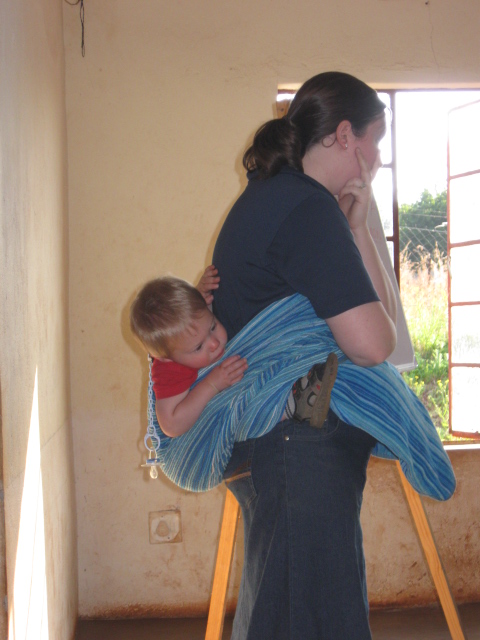
I was embarrassed to see this proof of my failure to tie my baby to my back African style that my teammates took of me while I was keeping score at a Bible Quiz tournament. But it WAS funny!
Seth has tried before to pin down what people may universally find funny, and he came up with this: "Connecting two things in an unexpected way." You weren't expecting those two ideas to be put together like that. Let me give you one example recently that our team found funny in our host culture because it was unexpected. There is danger in giving examples because someone may miss my main point in shooting down the example, but here goes:

Recently our team laughed until there were tears in our eyes over someone's account and imitation of a song blared at his house. Here is an event that frustrated the missionary couple: neighbors 20 meters away put up 4-foot high speakers and blared an inane, offensive song so loudly in the direction of their house that the speakers went staticky; and this continued for hours, including the kids' naptimes. (I'm sure this is a common issue for missionaries, not only in Africa.) Now, this is actually a very frustrating occurrence, and we began by expressing our sympathy for them. The funny part was when the narrator told us, and then imitated, what was in the song: belching.

Completely unexpected. Songs and belching don't go together. Add to that volume. These Africans liked this music so much, they wanted it to be heard loudly by everyone! Who produces this music??? It's just...funny.

Now some people at this point may object. "You're judging their culture. You're laughing at them!" Our politically correct culture doesn't like to laugh at other people's cultures. But as that quote above begins to express, we are making judgments all the time in what we laugh at. Every culture does this. Some things shouldn't or can't be laughed about. For example, when someone is hurt or when something is sinful, we shouldn't laugh at those things. Some people have a cutting sense of humor that only makes fun of others in a belittling or demeaning way. That's inappropriate. But some things can and should be laughed at.

And that brings me to the next objection: "Are you saying someone shouldn't be a missionary if they don't have a sense of humor? What if they just don't have the same sense of humor as you?" Exactly. This is the issue.

It isn't enough to say that the teammate must have a sense of humor. Even though we may judge another person with the statement, "He doesn't have a sense of humor," what we mean is, "He doesn't appreciate my sense of humor." Or "I don't appreciate his sense of humor." So that is the key. Can that teammate laugh at things that you deem important to laugh at? Can she laugh at herself? Can you laugh together over similar things without one squirming with discomfort or another blankly staring in misunderstanding?

Remember that excellent quote above: "And in adulthood amusement remains one of the ways in which human beings enjoy each other's company, become reconciled to their differences, and accept their common lot. Laughter helps us to overcome our isolation and fortifies us against despair."

Yes, some things shouldn't be laughed at. But on the other hand, "a merry heart doeth good like a medicine."


Monday, October 6, 2014

"And in Nothing Terrified"

A few months ago when we celebrated 10 years in Africa, I mentioned that I would share some verses that have encouraged us to keep going in ministry, even when outward results seem unimpressive. I have since shared one passage that encourages us that God will build His church.  Today I wanted to share a verse that strengthened me during one of our darkest trials.

I appreciated the advice given here to Baptist Missionary Women on how to handle persecution. One of the things I most appreciated in that article was that Lou Ann assumed that we will experience persecution. My life was fairly free from persecution in the States, so I have always felt cautious about claiming to be persecuted in any way. The word "persecution" seems like such a strong word for what most of us have experienced in comparison to what the early church experienced, or what some people in Communistic or Muslim countries experience today.

Nevertheless, when you enter a stronghold of Satan, where he has had free realm for centuries, you must expect that your adversary the Devil will seek to devour you, or at the least, to get you back out of his domain. Missionaries will certainly experience persecution, even if they didn't in the States, because of entering another area that might not be so friendly to Christianity (perhaps even one of those countries mentioned above). I also appreciated the balance of the writer in showing how some persecution can come about because of our own faults or stupidity!

Late in our first term, we experienced what seemed like a Satanic attack from one of our friends and church members. It almost numbed me with fright. I couldn't think clearly and was in panic mode. "Get me out of here!" was the dangerous reaction slamming through my brain.

By God's grace, He kept me here. I was reading through Philippians, and the verses at the end of chapter one, especially verses 28-30 returned some calm to my soul and helped me to persevere.
Only let your conversation be as it becometh the gospel of Christ: that whether I come and see you, or else be absent, I may hear of your affairs, that ye stand fast in one spirit, with one mind striving together for the faith of the gospel;

And in nothing terrified by your adversaries: which is to them an evident token of perdition, but to you of salvation, and that of God.

For unto you it is given in the behalf of Christ, not only to believe on him, but also to suffer for his sake;

Having the same conflict which ye saw in me, and now hear to be in me.
When you experience unexpected and "unreasonable" persecution that paralyzes you with fear, you are having the same conflict that Paul had, and you are sharing in Christ's sufferings. Paul admits here that you may be terrified. This is the conflict, or the struggle. We will be terrified, but instead should feel encouraged and joyful! We should view persecution as a confirmation that we are saved, that we are His. The apostles and early disciples counted themselves unworthy to suffer for Christ's sake. They felt joy to do so. The contrast between their attitude and mine illuminated my weakness.
The Christian Martyrs' Last Prayer by Jean-Leon Gerome
As with so many other issues in Christianity, this struggle comes down to right feelings (orthopathy). You can't control this kind of persecution, initiated by Satan and his followers; in fact, that's sometimes why it's so terrifying--it was completely unexpected! But you can in some ways control your feelings about it. It may seem impossible, but you must with the Holy Spirit's guidance, somehow change from the extremes on the feelings spectrum of terror to joy.

No longer terrified by your adversaries, but counting it all joy.