Thursday, August 14, 2014

Somewhere Between a Shack and a Palace

Cockroach.

Yes, that's the English meaning of the name of the village development area where we are planting a church. The name of the town is Sangla. Our church is the only church in the entire village area. It is the only Baptist church for an even larger area. The very few others that dot the region are charismatic.

The drive to Sangla is somewhat of an adventure. It's one of those drives where you need a four wheel drive vehicle, you feel like a milkshake, you don't eat too much before you go, and you can hear the vehicle scraping on the bottom several times as it rocks all around going over hills.

But there is something that catches my eye each time on the way to the new church building.


Monday, August 11, 2014

Y'All Look Alike!

Friday night, my husband was letting a church member out of our gate and locking it up for the night, when a man driving our teammate's pick-up truck drove up to our gate and repeatedly shouted in Tsonga, "Where's my canopy??"

Huh???

Once again, it was a case of mistaken identity. Though we've lived here a bit longer than our teammates in another less-central village 10 minutes down a tar road that connects a seemingly endless string of villages, our teammates are by far the better known family around here. Their house is in a much more visible place in their village on a main thoroughfare that leads to two other villages. We confused the Tsongas even more by each having four children in rapid succession, each having the same exact pick-up, and even looking somewhat similar. And of course, we both speak the language.

So our teammates recently bought a new car, sold their pick-up identical to ours, and the buyer wanted the canopy for the bed of the pick-up. He's from a whole 'nuther string of villages somewhere else, so he drove out here and asked someone where the white guy lived. He was directed to our house. Our bewilderment was visibly funny when he shouted at us for his canopy!

Anyway, it didn't take long for us to figure out what had happened. We're used to this confusion. People constantly shout our teammate's name at us as we pass in the truck, asking for lifts back to their (and his) village. Seth goes to the local hardware shop and gets called by our teammate's name. He rarely tries to correct them, as listening skills are not generally a strong point of this culture.

If they listen long enough to understand that there are, oddly enough, two white families in this sea of chocolate out here, they usually laugh a bit chagrined: "Oh, I thought you were him. There's another white person?"

"Yes," we respond. "Don't worry. We know: all white people look alike."

Outburst of laughter and quick agreement! "Yes," they agree, "White people all look alike." Then they might flick their nose to show the offending member which causes confusion. You know, we all have sharp-tipped noses...

We tease them back. "What? You only have to remember one or two white people. Look at all of you we have to keep straight!"
Can you tell these pretty girls apart?
I remember getting confused back when I was a teenager ministering on my church's bus route. Many of those little black girls with their adorable beaded braids looked the same to me. Now I can tell the Africans apart even if, for example, a woman wearing a hairpiece tells me her full name one day, and comes to church the next day without the hairpiece and uses her nickname. ;) I can kind-of tell when someone's from Zimbabwe versus South Africa, and it's even easier to pick an Ethiopian or Somalian out of a crowd. (There is a small Somalian community here.) Seth's better at that than me.

Anyway, I just wanted to share the funny thought that if you've ever looked at a people group (Africans, Koreans, whatever) and gotten mixed up because to you they all look the same--they think the same thing about you!


Saturday, August 9, 2014

Calling all Missionaries!


September 10 we are going to have a fun link-up day!

What's the theme?  - Your home!

Please write a blog post and share photos of your home (keep it real, folks!),
then come back here on September 10 and link up your post.
What fun to take a sneak people into the homes of missionaries all around the world!

Who's with me?!!

By the way, a few of you have commented here and on facebook that you are on deputation and don't have a  home.  Then feel free to post photos of your deputation vehicle!  That's your home at this season in your life.  As missionaries, we've all been there!


Friday, August 8, 2014

Just for fun!


We truly love where God has called us, but we do have our days!


Thursday, August 7, 2014

Furlough Whatchamacallit Focus


Furlough: [fur-loh] noun
a vacation or leave of absence granted to an enlisted person in the military.

That's the dictionary definition. But from what I have been told and what I have seen... vacation does not really describe it at all. It may describe a very short portion of the time, but the majority of the time isn't spent lounging in a hammock sipping ice tea while reading a book. "A leave of absence?" Well, it is a leave of absence from the main field of serve, but it certainly isn't a leave of absence from ministry. It is work!


Some people have pushed for a change of the term "furlough" to something like "home assignment" or "home ministry." But what if we see the field as our home? And "assignment????" No one calls us up and says, "Hey, you need to come back to the States to do some work now." Maybe we should call it Ministry to the Passport Issuing Country. Sigh...

Well, no matter what you choose to call it, the fact of the matter is that it is part of the ministry. Since our family hasn't taken our first furlough/home assignment/whatchamacallit, I was all ears when a veteran missionary began sharing how God was preparing her for her next trip back to the States. When she sent me the list, I just had to share. And I am tucking this away for future use! Our furlough... or whatever you want to call it... will be here before we know it. I want to be ready physically, emotionally, and spiritually.

Monday, August 4, 2014

Working to Build the Choir

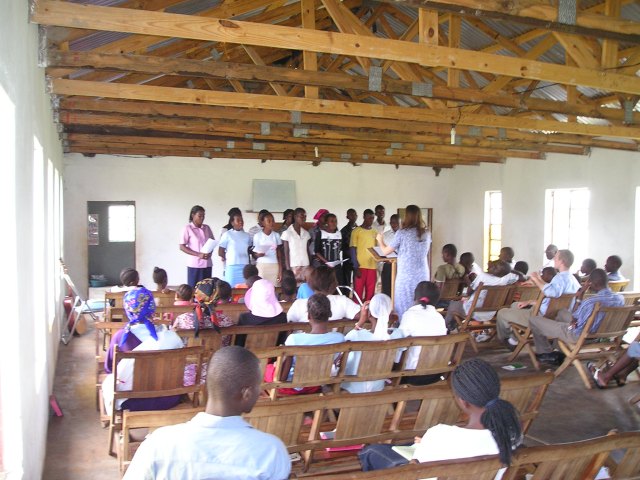
My first choir
My first choir
How can you improve a choir? There are two ways:
  1. Help one of the singers who is already in the choir.
  2. Add new singers.
We just celebrated 10 years of service in Africa, and I mentioned that I'd be sharing verses that have kept us persevering in spite of trials and slow growth. Revelation 5:9-10 tops the inspiration list.
And they sung a new song, saying, Thou art worthy to take the book, and to open the seals thereof: for thou wast slain, and hast redeemed us to God by thy blood out of every kindred, and tongue, and people, and nation; And has made us unto our God kings and priests: and we shall reign on the earth.
John Sees Heaven

Imagine this picture with me (or with John). John, overwhelmed with a vision of a beautiful, glittering heaven, records details in rapid-fire succession. So much grabs his eye that no one thing occupies too much space in chapters 4-5 (which form a complete unit). But the first thing that catches his eye is a throne and the One who sits on it.

He describes a heavenly scene using at least 12 different colors, sounds, and symbols. Some colors he describes with the word "like," implying that perhaps the actual colors are far more beautiful--like C.S. Lewis describing in The Last Battle how the fruit in Aslan's world were like strawberries, but SO much better.

Then chapter five changes focal points: the Lamb is introduced. There are no "minor" issues here--this is Christ and God. With this as the scenery, another sense takes over--John hears singing.

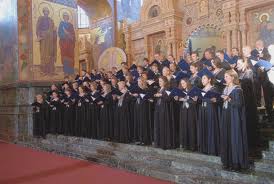
Byzantine church choir


John Hears Heaven

Examine this song of praise to Jesus with me for a moment.
  1. It is emotional. (The Christian life demands passion!)
  2. It is artistic. (Cathedral-builders in the medieval ages set figurines in stained glass high up in corners of the ceiling where no one could see. Why? "This art is for God.")
  3. It is doctrinal (covering the sovereignty of Christ, the atonement, redemption, the kingdom of God, and focuses on Christ, rather than secondary issues)
Okay, so John sees amazing sights and hears an even more wonderful song; but even more encouraging for us is the identification of who he sees and hears!

The Choir

Who is singing? Who is the "they"?

In verse 8, it's the 24 "elders." These singers are identified by their relationship to Christ. In verse 10, the singers are the "kings and priests of God on earth." In verse 9, it's "those who were redeemed"--all Christians from all time, "out of every kindred and tongue and people and nation."

Ethonologue catalogued 6,495 living languages as of 2005.
The Joshua Project catalogues 15, 967 ethnic groups.
The largest people group is Mandarin Chinese with 793,000,ooo speakers. India has the most amount of people groups with 2, 327. (350 languages) One people group in India (the Nai) has 70 alternate names.
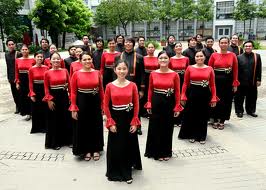
Asian choirSo think about this choir with me for a minute... How many people will be there?

Let's go back to the beginning of the church in Acts. In Acts we read about 3,000 saved on the Day of Pentecost, and at another time, 5,000; then it says "many" people were added the church "daily." Let's put that number at about 50,000 people. An average-ly large stadium today could hold that many people.

So imagine a football stadium full of people looking down on the field. One Man walks to the center, and the entire stadium rises to its feet and begins a glorious song of praise to that Man.

But there's more. From 100-300 A.D. we see clear evidence that Christians were affecting their society. Joshua Project gives a statistic that at least 2% of a people group is needed before it can impact its society. So if a group wants to advocate for the spotted owls of North America, there must be at least 2% of Americans advocating that cause to impact all of America on that issue. If this statistic is correct, then there were at least 200,000 Christians during the early church time period.  (And when you think of Constantine converting his entire army to Christianity at the end of this time period, it seems that there must have been more than just 2%.) = 4 stadiums

57 revivals are recorded by Brian Edwards in Revival. In some of those revivals tens of thousands
were converted. = 2 stadiums

Today 400 million people claim to be Protestant. If we assume that only 20% of them are actually born again, we have 80 million people. = 1,600 stadiums

Then we could talk about Old Testament believers or children who died before the age of accountability.

ireland choir


God will build this choir. It cannot fail. There cannot be a final day that does not have this choir. So, how can this encourage us today?
  1. Trust that God is working all things to produce this choir, for the good of this choir--the good and the bad things, the large and small things; that car accident that killed our only male church member, that man who shockingly fell out of the ministry; even Robert Mugabe's crazy leadership in Zimbabwe. He will build this choir, and it will include people from the people group to whom you are ministering!
  2. What are you doing to add new singers? When you stand at that final day, the only thing that will matter is Christ and His glory!
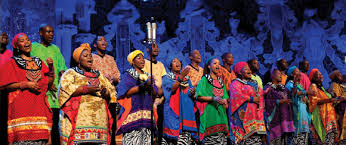
Capetown choirWhen I think about being a member of that choir made up of hundreds of millions of people, and I picture singing a song to Christ with my dearly beloved family members to my left, and my dearly beloved Tsonga church members to my right dressed up in national dress carrying their flag all to the glory of God...it shakes me back to the reality that the only thing that matters for me right now is what I'm doing to build that choir!

At that time, I won't think about the yard sales I couldn't go to in America because I was across the ocean. I won't remember the slights and accusations others slung our way, whether deserved or undeserved. I won't think about which singer brought the most other singers to the choir. I will think about Christ and what He did. And I will probably regret that more beloved Tsonga people did not become a part of this beautiful moment.

Are you leading anyone to "try out" for this choir? What are you doing to add new singers? What are you doing to help anyone to improve their voice for this choir? Let's get involved working for the grandest event in all of history--building the choir that will sing to the praise of His glorious grace. And never give up working for this!
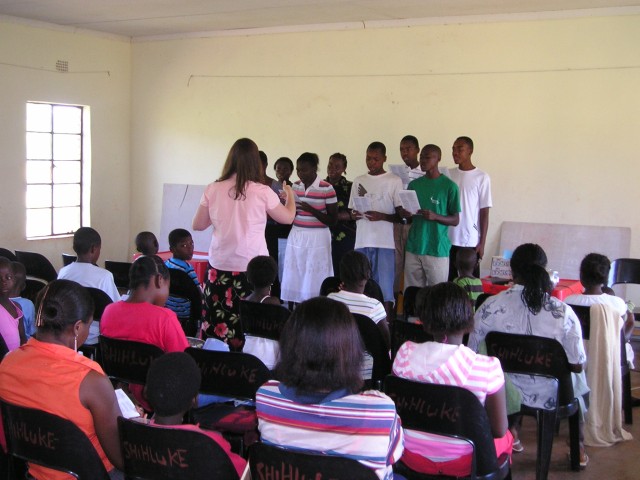
OLYMPUS DIGITAL CAMERA

Friday, August 1, 2014

It's Home!


Having lived in Spain for thirty years, sometimes I see uniqueness through my visitors’ eyes more clearly than my own. The differences in our field seem normal to us, now. Here are some examples:

When we first got here, I was shocked that people tucked a long loaf of bread—think French—under an arm. There was no wrapper, and lots of people avoided deodorant. Now, I buy bread and tuck it under my arm sometimes. (You’ll be glad to know I believe in using deodorant!)

Servers place chunks of bread on the tablecloth. Everyone uses both fork and knife the whole meal long. Both hands are at the table. Spanish people don’t switch hands after cutting meat. They just use the fork in the left hand to pop the food in their mouths. Now, when we go back to the States, people say to me, “We notice you eat European-style.” Yes, I simply cannot eat without a knife in one hand. It’s great; you don’t have to chase little pieces of food around the plate. You always have a solid pusher. Why didn’t Americans come up with this?

Another foodie thing—or maybe I should call it “drinkie.” Here in Spain, although many people drink wine with meals, a lot drink water. It’s plain ole water, usually served room temperature. No ice, ever, in water. So, we have guests, and we pour water for everyone. It’s normal for us; not so for our guests. We hosted a group, and the ladies made iced tea and Crystal Light. I only have two ice trays . . . .

Stateside with our two teenagers in the car, I was zipping around, driving my dad’s old Toyota Corolla in a 25 mph speed-limit residential area. One of my children was watching the speedometer and constantly saying, “Mama, you’re speeding . . . Mama, you’re speeding.” Well, technically, I guess I was. (Don’t report me, please. I was doing 30 mph, which to me was a snail’s pace.) In Spain, we enjoy faster, more aggressive driving and higher speed limits. I’ve since learned to watch it in both worlds, but I confess I like driving standard transmission and buzzing around.

I worked at a Christian magazine when I was (much) younger, and I would often catch misspellings the editors missed. After learning a second language, I am addicted to spell check, thankful for a dictionary, and I frequently look up whether a word is one or two and whether or not it’s hyphenated. All of that very good English and excellent spelling went down the tubes somewhere!

I used to feel like a foreigner. Now, when I see someone who’s obviously not from the Basque Country, I think, “I wonder where he’s/she’s from.” Then, I realize I’m a foreigner too, and others are probably thinking the same about me.

You see, it’s home.

We’ve lived longer here than we lived in our “home” country. We brought up our children here. We understand the lifestyle and have adapted. Truthfully, we are more at home here than at “home.” Our birth country will forever be the foundation of our lives, and we’re loyal citizens, but we’re at home here. Does that make sense?

“Where are you from?” gets a confused answer. “Ummm . . . do you mean in the States, originally, or where do we live?”

“Can you tell me why you don’t want to sign up for the store credit card and get a 40% discount on your purchase today?”

“Well, we live overseas, and we’d probably never use it again.”

“Oh yes? Where?”

“Spain.”

“Oh.” Pause. End of conversation.

Yes, we’ve been here way too long. It’s become home.

But . . .

“This world is not my home; I’m just a passing through.”* (In Spanish, the second line is translated “I’m a pilgrim here.”)

Our perfect home is somewhere else. Home is heaven! We have a whole different perspective.

We’re only pilgrims.

The heroes of faith in Hebrews 11 understood this: These all died in faith, not having received the promises, but having seen them afar off, and were persuaded of them, and embraced them, and confessed that they were strangers and pilgrims on the earth (Hebrews 11:13). Peter knew it, too. (1 Peter 2:11)

We haven’t yet seen our permanent home, but we will. Until then, God has given us the greatest message in the world to spread all over this world.
  • And he said unto them, Go ye into all the world, and preach the gospel to every creature (Mark 16:15).
  • For God sent not his Son into the world to condemn the world; but that the world through him might be saved (John 3:17).
Our task is before us. Our mission is clear.

When we feel like strangers at home or abroad, we remember we’re just pilgrims passing through. Our life is, after all, just a vapor. (James 4:14)

When we’re mind-boggled about what we need to be doing and are trying to decide priorities, our mission is always the same. Go . . . and teach all nations, baptizing them in the name of the Father, and of the Son, and of the Holy Ghost: Teaching them to observe all things whatsoever I have commanded you: and, lo, I am with you alway, even unto the end of the world. Amen (Matthew 28:19-20).

When I need a priority check, I go back to my simple mission statement, Matthew 28:19-20, along with 1 Corinthians 10:31, which says we’re to do everything to glorify God:
  • Does this activity actually glorify God?
  • Does this activity teach others about Christ and His salvation?
  • Does this activity lead people to obey God?
  • Does this activity teach holy precepts?
  • Am I evidencing through my life the Holy Spirit in me?
Am I a living testimony?

“This world is not (our) home. (We’re) just a passing through.”*


* “This World Is Not My Home” by Mary Reeves and Albert E. Brumley