Tuesday, March 11, 2014

Bacon Potato Salad


Everyone has a potato salad recipe passed down from their mother or their grandmother,
or their second cousin twice-removed, but somehow this phenomenon skipped me.
So, I made my own, though I've tweaked it over the years for my husband who hates
really any kind of "normal" potato salad.
And we do have one simple rule when creating in the kitchen--Everything is better with bacon!
Cook until crispy, drain, crumble, and set aside.
 
 In Brazil, the potatoes come pre-washed.  In fact, when I cook in the States again, I'm pretty sure that I will hesitate to eat those gritty, brown potatoes that I once knew as normal.  But I digress.  If you are comfortable with the level of cleanliness in your potatoes, please feel free to cook them with the skins on, or just peel them and be done with it.  Your choice.  Generally, I plan on a medium-sized potato per person. Throw the cubed potatoes in some salted water and boil until you can slide a fork into them easily.  Drain
 
For a recipe of 6 potatoes, 5-6 stalks of green onion will do.  I use the greens and the whites.  Chop and set aside.

This is where I stopped taking pictures of prep work, so you'll have to use your imagination.  Hold back some of your crumbled bacon and green onions for the top, but throw everything else in the bowl.  If you have access to sour cream, I like to use half sour cream, half real mayonnaise.  For 6 potatoes, you will only need about 2-3 tbsp. each, but you can add more or less depending on your families' texture preferences.  Because we don't have sour cream here, I use all mayo, but splash in a tablespoon of plain vinegar. 
 I prefer the taste of dill, but don't always have access, so you can add or leave it out.  Add salt, and refrigerate until serving.  This recipe keeps well, so make it the day before if needed.  Enjoy!
 
Bacon Potato Salad
 
serves 6
 
6 medium sized potatoes, washed, cubed
5-6 stalks of green onion, diced
1/2 pound of bacon, fried, drained and crumbled
2 Tbsp. Sour Cream
2 Tbsp. Mayonnaise (or omit Sour Cream, double mayo, and add 1 Tbsp. vinegar)
1 tsp. dill
Salt to taste
 
Boil potatoes in salted water until tender, and not quite to mashed potato stage.  Drain, and set aside.  Fry bacon, drain, and crumble.  Chop green onions, and set aside a small amount for garnish along with a small amount of the crumbled bacon.  Combine all remaining ingredients, adjusting the mayo/sour cream mixture to attain desired creaminess .  Can be served right away or up to a day ahead. 


Monday, March 10, 2014

The Many Jobs of a Missionary ~ Linguist, Part 1

This job goes without saying. Pun intended! :)

Missionaries must learn the language of the people they are ministering to!

When my husband arrived in South Africa in 2004 to work in the villages of the Tsonga people (before we were married), he knew no other missionaries working with the Tsonga people who could teach him the language. There was no language school or Rosetta Stone digital course.

Thankfully, South Africa's national language is English, so several of the nationals had a working grasp of English, some better than others. Seth asked a national pastor that was his sole link to the village to teach him Tsonga. This worked--like a broken wheel--bumpy and uncomfortable for both.

The national pastor, although fluent of course in his native tongue, did not know how to explain the rules and logic of Tsonga to a non-native learner. Would you know how to explain the logic of English to an ESL speaker? And Seth did not know at the time how to teach another person to teach him the language. (Now we have a much better idea of how to tutor someone to tutor us!) Eventually in frustration, the pastor explained that Tsonga was like Greek--no rules, see? Okay, so Seth was back on his own.

Again thankfully, those stronger and better than us had gone before. Swiss missionaries translated the entire Bible into Tsonga in 1907, and so Seth had a Bible and a dictionary in Tsonga, which helped immensely.

My favorite missionary heroes are those linguists who pull a language out of the air and put it into writing for the first time--who labor for years to put the Bible into someone else's language. How can we measure the worth of those who have gone before us making our work so much easier? My eyes teared up recently reading a book for children about missionary translation work called God Speaks Numanggang, by missionary-turned-homeschool-curriculum-provider David Hazell. Frontline missionaries who sweat to translate the Bible are heroes. Praise them with great praise!

So Seth read through Romans and other books of the Bible verse by verse with teen boys, trying to match his accent to their tone. But he still didn't understand the structure of the language.
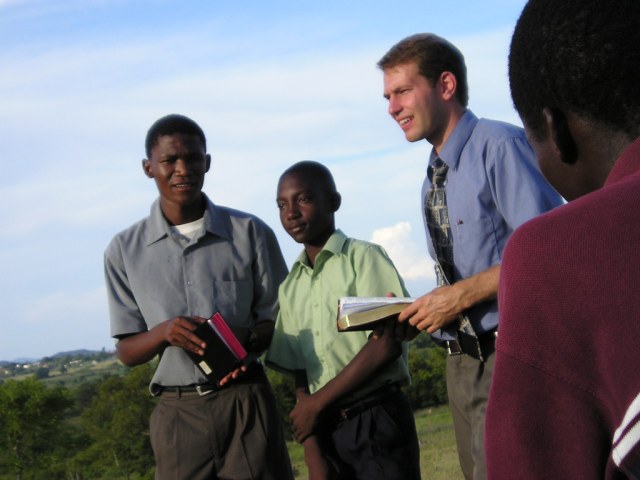
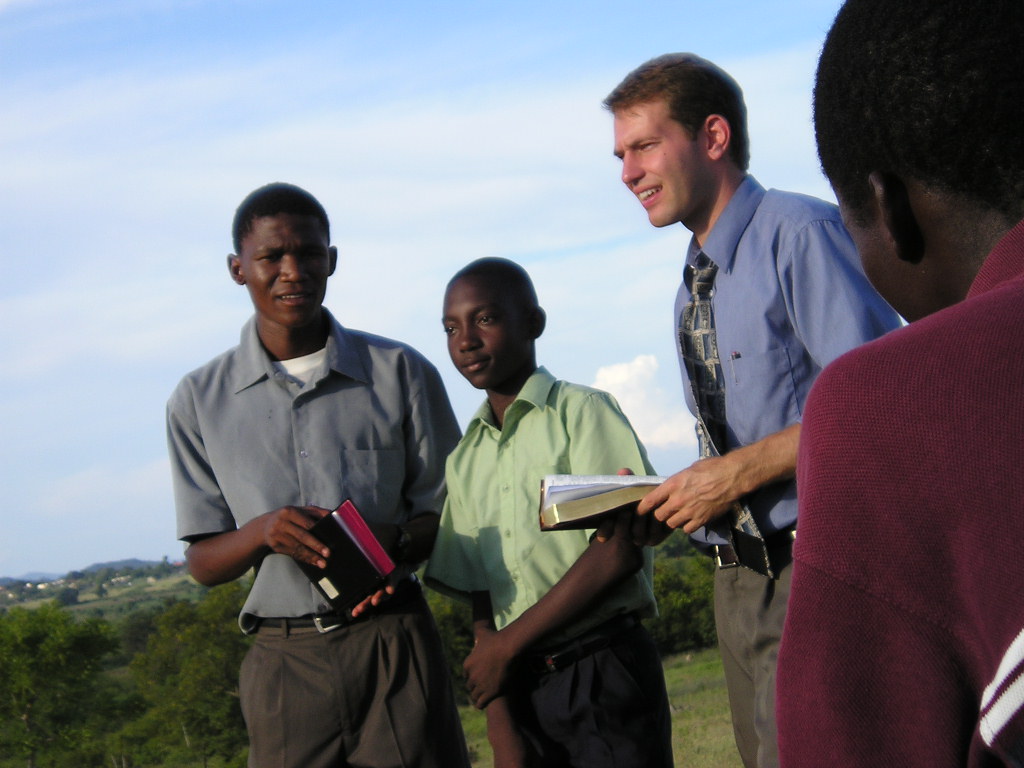
Early days: Two teen boys helping to translate into Venda and Tsonga--not ideal!
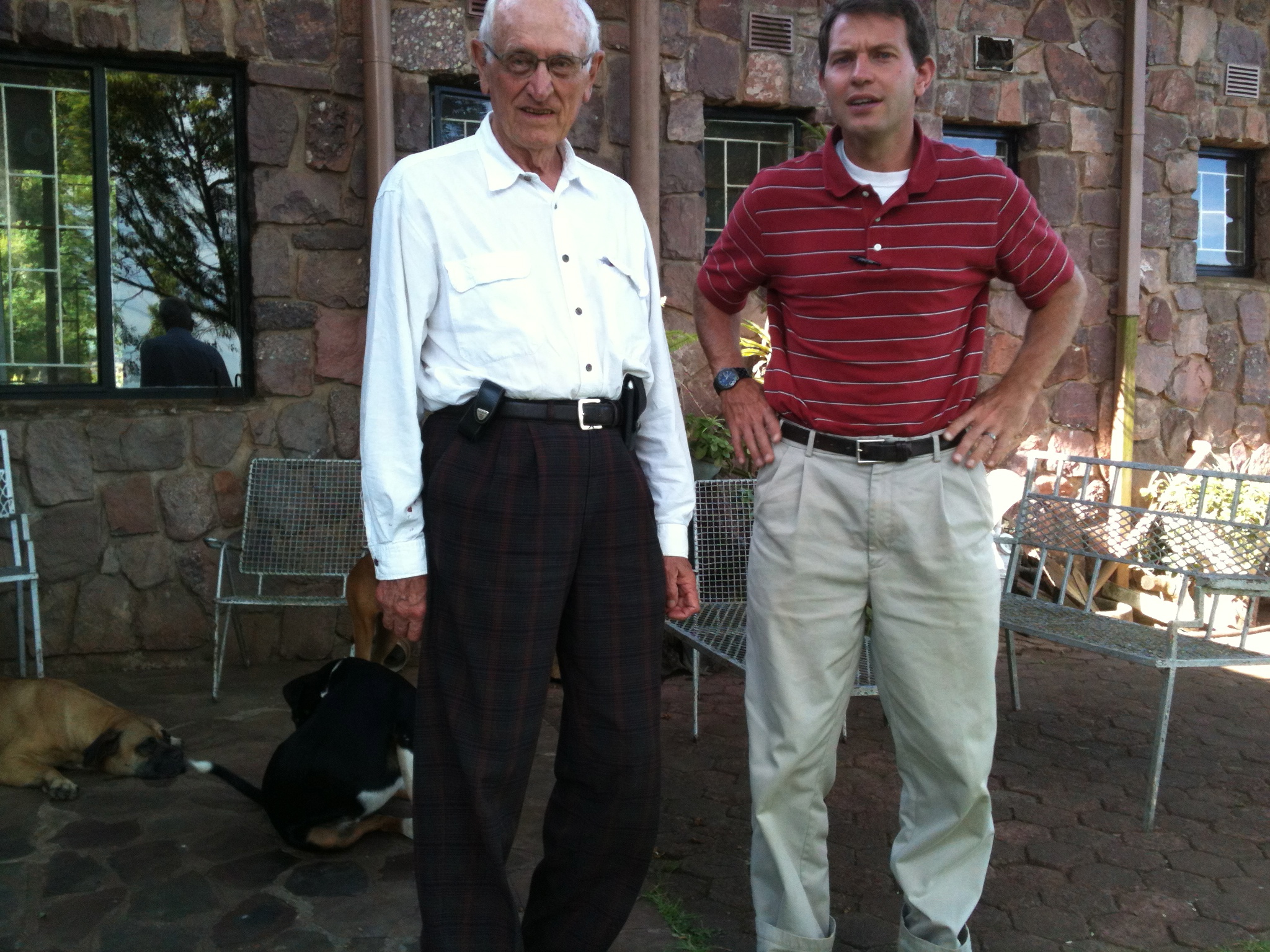
Well into his first year, he received a tip from an Afrikaner (white South Africans--another thing to be thankful for in this country!) about another Afrikaner who worked for the South African Bible Society for years, mainly in the Venda language, another language prevalent in the villages around us. This man helped to translate the second version of the Venda Bible. He could even preach in Venda. Seth got his contact details and went to visit him.
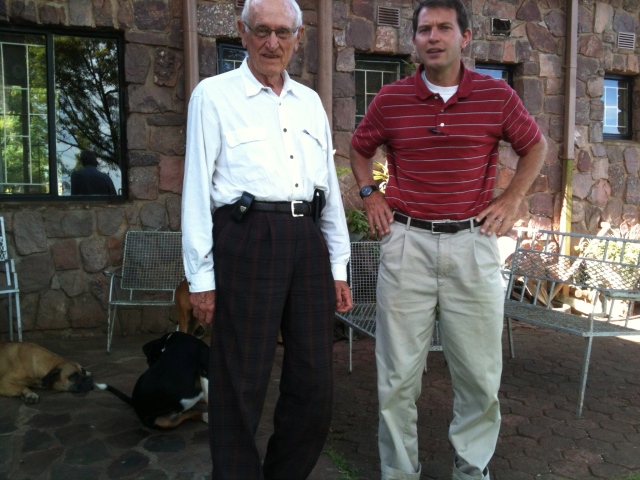
Here he is--a modern-day hero that the world does not know.
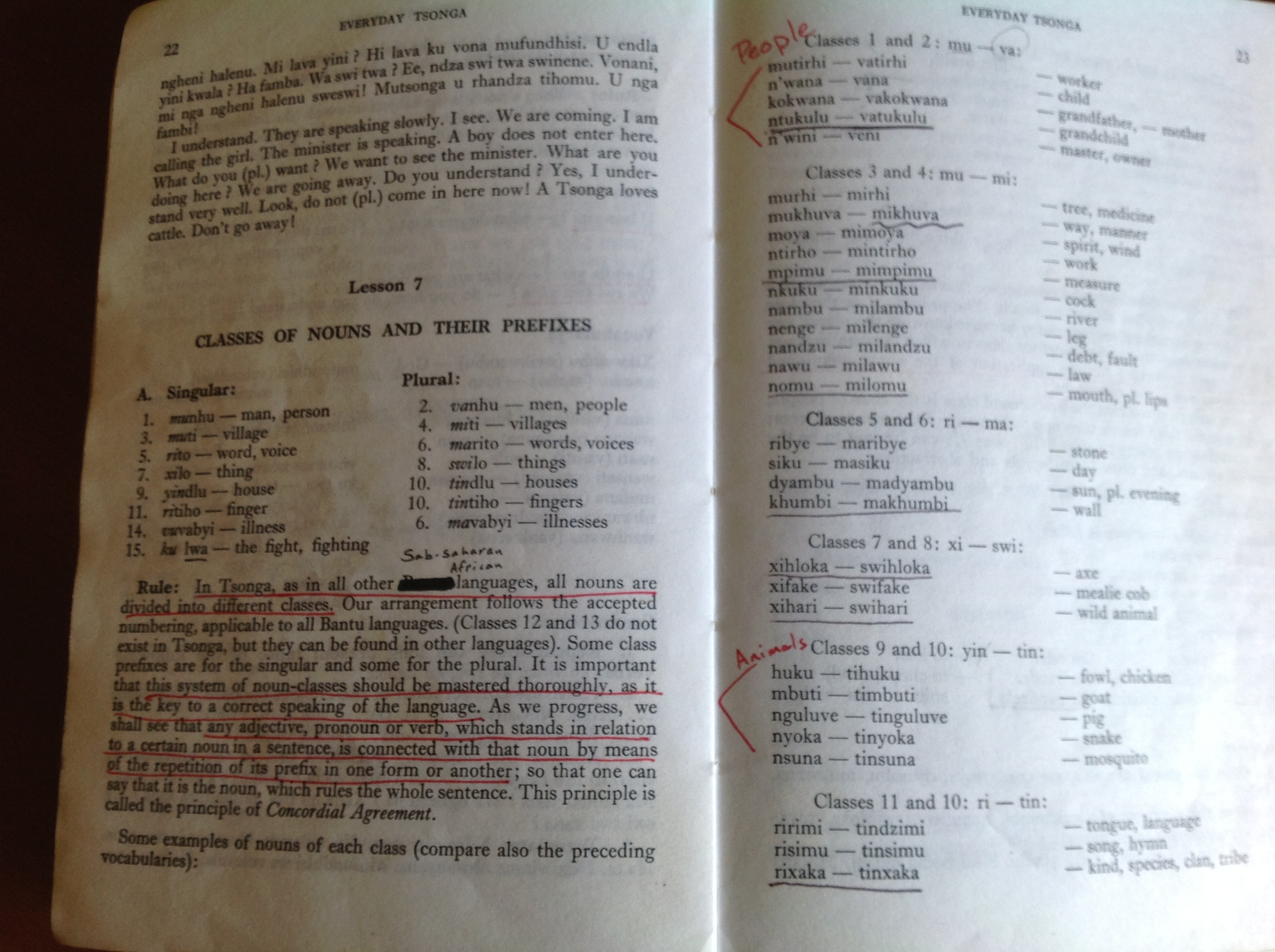
This was the game-changer. In order to learn the language, we often need help from those who have already done it! This man told Seth of a little grammar book that the old Swiss missionaries had written called Everyday Tsonga, which Seth could purchase at a little Indian shop in a nearby town.
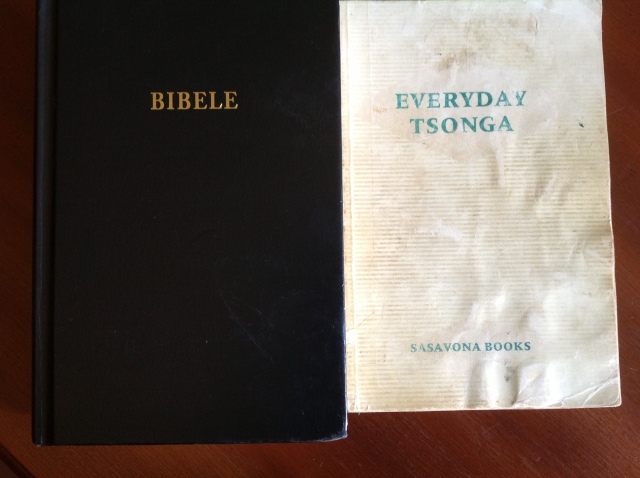
IMG_1411

Seth did that immediately, and it opened up to him the structure of the sub-Saharan languages--the African languages south of the Saharan desert. Lesson 7--oh how we praise God for it! It's called "Classes of Nouns and Their Prefixes." Exciting, huh? :)
IMG_1413Each lesson had a grammatical term with a "rule" listed underneath. Yes. Every language has rules. :) Here's how lesson 7's rule began: "In Tsonga...all nouns are divided into different classes....It is important that this system of noun-classes should be mastered thoroughly, as it is the key to a correct speaking of the language. As we progress, we shall see that any adjective, pronoun, or verb, which stands in relation to a certain noun in a sentence, is connected with that noun by means of the repetition of its prefix in one form or another; so that one can say that it is the noun, which rules the whole sentence." The lesson goes on to give examples.

Oh, sweet relief! To our English minds, the verb really rules the sentence. We had no concept for nouns ruling the sentence. But African languages are riddled with tiny little words called "concords" that connect subjects to verbs, get attached to adjectives, and act as the pronoun. If you don't know the concordial system, you can't learn the language!

For example:
In English, we would say, "The bread is good." But in Tsonga, they say, "The bread it is good." And the "it" changes depending on what the subject is. "It" also changes for adjectives like "big" or "small."

Before this grammar book, Seth could not figure out the rhyme or reason for all of these little words throughout the Tsonga language. He would try one version of "it," only to be told that for "bread" it was "xi." So then he would apply "xi" to a person or a table, only to be told that it was "u" or "ri" respectively. He was constantly guessing wrong and didn't know what all those little words meant to the language. It was utterly confusing. Now it seems so obvious to us--now that we have the key!

Since then, we have both learned Tsonga (almost fluently) and bits of Venda (which I have forgotten, but Seth can speak passingly), and now Seth is trying to pick up bits of Shona in order to reach some of the Zimbabweans who have flooded our province of South Africa. Each succeeding African language is easier to learn after jumping the hurdle of the first one.

If you look back on your life, I'm sure you have your own stories of God's providence--literally, His "seeing before." How we learned Tsonga is one story in which we bless God for His providence--His "seeing before" in providing those clever Swiss missionaries to translate the Bible, publish a Tsonga grammar book (in English!), and guiding our steps to meet the people who would introduce us to the grammar.

And now we have begun on our journey to being a linguist--one of the most important jobs of a missionary!

How did you learn the language?

More to come...

Friday, March 7, 2014

How The Parable of the Sower Encourages Missionary Wives

Christian Clip Art

Missionary X in the Squeegie Islands announces an evangelistic film. To his happy surprise, so many people show up that they have to show the film outdoors, rigging a makeshift screen and loudspeakers. Missionary X reports that almost everyone in the village attended, and even the little children were mesmerized by the gospel message. Twenty-seven people accepted Christ as Savior when the invitation was given.*

Missionary Y in Pulsovia gives out thousands of gospel tracts. He sometimes sees people reading them, but he never gets a response. In Pulsovia, the people are mostly antireligious. They would not even go to a native religious meeting, let alone to a foreign “sect.” When Missionary Y held special meetings, he couldn’t even get all of his saved church members to come, let alone those friends he personally invited. No one ever came from the neighborhood, even after the missionary gave out thousands of invitations.*

Missionary X and Missionary Y sent out prayer letters. They told what God was doing in their countries. Missionary Y eventually lost a few supporting churches because of his lack of “results.” His wife cried and prayed.
____________________________

And he spake many things unto them in parables, saying, Behold, a sower went forth to sow; And when he sowed, some seeds fell by the way side, and the fowls came and devoured them up: Some fell upon stony places, where they had not much earth: and forthwith they sprung up, because they had no deepness of earth: And when the sun was up, they were scorched; and because they had no root, they withered away. And some fell among thorns; and the thorns sprung up, and choked them: But other fell into good ground, and brought forth fruit, some an hundredfold, some sixtyfold, some thirtyfold (Matthew 13:3-8).

You know this passage. Jesus is talking to His disciples, and He’s teaching them about the kingdom of God. The seed is the Word of God, and the ground is the heart of the hearer.

There are four kinds of ground: 
  1. By the way side—The seed is snatched away. The hearer really never gets it. (verse 19)
  2. Stony places—Something registers but is quickly “scorched.” I don’t think this person is really saved, since the Bible says the Word doesn’t really take root. Whatever the case, at the beginning, he seems receptive and then gives up. (verses 20-21)
  3. Among thorns—This person hears, seems to grow some, but then the new plant gets “choked.” It’s debatable whether he is really saved or not. It seems he has some root, since he grows, but when the care of this world, and the deceitfulness of riches, choke the word . . . he becometh unfruitful (verse 22). Colossians 1:6 seems to indicate that all believers bring forth some fruit, so I have my doubts that this person really believed.
  4. Good ground—The gospel takes root, grows, flourishes, and the believer brings forth fruit in differing amounts. (verses 22-23) Notice the amounts here: one hundred, sixty, and thirty times.
_______________________________

The sower represents your husband, you, and any of your children old enough to sow along with you. You sow the Word of God, specifically the wonderful gospel. You spread the seed. It lands as it’s thrown. The seed is all good seed. But the kinds of ground are different.

Some husbands are Missionary Xes. They announce a special service, and the church is packed, so packed that some are standing in the back or sitting in the windows. Many people respond to the gospel and are genuinely saved.

Your church’s challenge is to disciple all of these people, to help them grow and bear fruit for the Lord, to train them to be mature Christians and to be in the Word for themselves. (For some of you, training them begins with teaching them to read, then to study.) You are seeing lots of results. Praise the Lord! But, you also have added challenges—many people to train and disciple, most of them with little background in the Bible and with little schooling. And, you, the missionary wife, feel overwhelmed, because the majority of these new believers are women and children.

Some husbands are Missionary Ys. They sow faithfully, preach faithfully, and pastor faithfully. They may lead someone to the Lord every two or three years. From time to time, they have the privilege to baptize a new believer. They teach, mentor, and disciple.

There still aren’t any men in your congregation who could take over a service. There are very few men who could be qualified for the pastoral ministry, due to their backstories. You’re the wife who cries and prays for your beloved Missionary Y, that he won’t get weary in well doing.

You’ve seen thorny Christians who gave up, unbelievers who listen, and some people who don’t. You’ve been there for those that disappoint you. You’ve been bad-mouthed by people you thought were friends. You have watched the Star Missionaries be praised and get all the publicity while the Plodding Missionaries weren’t recognized by anybody (but God). You’ve watched from the sidelines and cried and prayed.

Here’s some encouragement from the Parable of the Sower: 
  • Along every path, there’s some good ground. Whether it looks like you’re doing major reaping or not, there is some. And, it will, in God’s time, produce fruit.
  • If you’re Missionary X’s wife or Missionary Y’s wife (or someone in between), God is doing a work through your husband. You can get behind him because he’s doing God’s work. He’s sowing and he’s reaping. You are helping, even when you cry for him and pray for him—especially when you pray for him.
  • Pioneer works will usually look like Missionary Y’s. More mature works—second generation or third—will look like Missionary X’s.


I remember reading Valente Hernandez’ book about the pioneer missionaries in Mexico in the 1950s.** They had a hard time. They were persecuted, and some were martyred. Today, Mexico is a missionary-sending country. Oh yes, there are some areas that haven’t yet been reached, but overall, the gospel seed has taken root and had time to grow. There are mature churches and several excellent Bible colleges. Mexican missionaries are all over the world.

In other countries, the gospel seed is being sown for the first time. It will take years for saved people to grow and mature. Probably with their children, we’ll see church leadership, and if Jesus tarries, those churches will eventually send out missionaries.

Let’s make an effort to understand the ground where we minister. Trust the Lord for some good ground and some fruit. Let’s get behind our husbands, helping and encouraging them in sowing the Precious Seed.

Say not ye, There are yet four months, and then cometh harvest?
Behold, I say unto you, Lift up your eyes, and look on the fields;
for they are white already to harvest.
And he that reapeth receiveth wages, and gathereth fruit unto life eternal:
that both he that soweth and he that reapeth may rejoice together.
And herein is that saying true, One soweth, and another reapeth (John 4:35-37).

__________________________
*Completely made-up scenarios. Although representative, they do not depict anyone I know. The “countries” are also fictitious.
** Martyred in Mexico. (Spanish, Mártirizado en México.) The Christian film, No Greater Love, is based on Mr. Hernandez’ book. 

Thursday, March 6, 2014

The One-Way Two-Way Street: Learning to Support the Supporter

We all know them. We all have them. And sadly, we are probably all occasionally guilty of being one of them.

You know, that person who only calls when they want something. No "I was just calling just to check on you," or "I was just thinking of you and wanted to let you know I care." But, "I need..."

I do not like it when I realize I am playing that same role. It grieves me.

Our family has often declared that our supporting churches are our supporting church FAMILY, and they truly are. God really blessed us as He picked out the churches we would partner with in ministry. Recently, I began reflecting and inspecting how I treat this family. Am I the relative who only contacts when I need something? Am I expecting them to give or do what I am not willing to give or do myself for them?

Wednesday, March 5, 2014

Wednesday's Wonderings...


How do you balance your ministry responsibilities along with homeschooling?  How do you handle visits, etc... during the school day?

Tuesday, March 4, 2014

Bacon and Avocado Macaroni Salad


Bacon and Avocado Macaroni Salad


This simple macaroni salad of just three main ingredients comes together so beautifully as they get tossed in an incredibly creamy lemon-thyme dressing. It has such a wonderful burst of fresh flavors with just enough savoriness from the fatty, crisp, salty bacon. 


Ingredients

    • 12 ounces elbow pasta
    • 5 slices bacon, diced
    • 2 avocados, halved, seeded, peeled and diced
    • Kosher salt and freshly ground black pepper, to taste
    • 2 teaspoons fresh thyme leaves, for garnish
    • For the lemon thyme dressing:
    • 3/4 cup mayonnaise
    • 1/4 cup freshly squeezed lemon juice
    • 1 1/2 tablespoons lemon zest
    • 1 tablespoon sugar
    • 1 teaspoon fresh thyme leaves
    • Kosher salt and freshly ground black pepper, to taste
    • 1/3 cup olive oil

INSTRUCTIONS
  • To make the dressing, combine mayonnaise, lemon juice, lemon zest, sugar and thyme in the bowl of a food processor; season with salt and pepper, to taste. With the motor running, add the olive oil in a slow stream until emulsified; set aside.
  • In a large pot of boiling salted water, cook pasta according to package instructions; drain well.
  • Heat a large skillet over medium high heat. Add bacon and cook until brown and crispy, about 6-8 minutes. Transfer to a paper towel-lined plate.
  • In a large bowl, combine pasta, bacon, avocado, lemon-thyme dressing, salt and pepper to taste.
  • Serve immediately, garnished with thyme.


Preparation time: 15 minute(s)
Cooking time: 15 minute(s)
Number of servings (yield): 6


Monday, March 3, 2014

Repaid Generosity

It is not possible to out-give God.

My husband has been an example of generosity to me for years; and I have seen God be generous to us in return--just when I thought maybe we'd tipped the scales our way, God would surprise me again.

Over Christmas, when we were slogged with several interruptions daily in the ministry, a Zimbabwean family came during a busy day, the day after Christmas, and with English even poorer than their standard of living, requested Seth's help in moving them to another shack. They had just moved to our village at the recommendation of another Zimbabwean man living here, but life in South Africa was not going as well as they had hoped or been led to believe. They had no jobs, and the one-room shack they were staying in leaked terribly. After three days of chilly rain, they'd had enough, and found another shack nearby. Would Seth move their things for them with our truck?

Have I ever mentioned that I don't like surprises? I am a very traditional sort of gal, and it takes me some time to warm up to change. Well, this request wasn't fitting into my plans for the day, or even week, and beyond that, they hadn't asked very nicely. (Don't you feel bad for these poor Africans having to try to communicate in a tough language to a cranky missionary?)

We had been interrupted and had had to shuffle our plans so often in December and January's flexible, plan-changing Christmas break that I'd about had enough too, of changing dinner plans, and adjusting, well, everything!

And we had just helped their Zimbabwean friends twice right before them, and had gotten rude requests for handouts afterwards instead of gratitude. I'm afraid I thought this was more of the same treatment.

But again, Seth was a rebuke to my stingy Stooge-iness. He left right after lunch, and when he came back from moving them, he said, "I'm glad I helped them. They have so little!" He went on to explain more of their situation--a man and his sister, wife, and two-year old.

Over the next few weeks, we took them a stash of food, including some Coke :) for Christmas. (You need to know that this was Seth's idea!) They attended church a few times, in spite of our conducting the services solely in Tsonga, which they don't understand. One service, their friends came as well, and we had 8 Shona-speaking Zimbabweans in a Tsonga service!

Meanwhile, our church building project was still going on. We were getting to the point where we would actually need to start putting bricks one on top of the other, after having dug and laid the foundation. Seth and I were wondering what we would do for a builder. Should Seth do it himself? He could probably do it, but he'd be much slower than an experienced man, and it would eat so much time out of his other duties. Should we hire? But that would cost so much more money.

That's when God once again surprised us by repaying more than we would have thought. Seth helped those Zimbabweans not expecting anything in return, simply because God gave him compassion for them. But God worked in the Zimbabwean man's heart to help us in return!

It so happened that he is a professional builder! He built hundreds of toilets for a government project in Zimbabwe, not counting other building projects he has been a part of. He has given his time freely (and we have paid him here and there as we could, but not all the time) to help build the outdoor toilets for our church. When Seth offered to pay, with the disclaimer that we may not always be able to do that, he replied, "No, no, it's for the church! We must do this for God." This is an almost unheard-of sentiment amongst the Tsonga people.

IMG_1665

His sister also popped in one day at our house to "help" me. I was surprised. I haven't had "house help," as missionaries call it, for a few years. I am reticent to hire people to come into my house. But I definitely "needed," in one sense of the word, some help. Now I pay her to come part of two mornings a week. She hangs up my laundry for me, which with a family of 6, was seriously eating into my homeschooling time; washes dishes; and cleans. I don't know how long it will last, but I am grateful for the help right now. (See now, right there, Seth would tell me not to write such a pessimistic line.) :)

So what if God moved those Zimbabweans down here just at the time when we needed them, knowing we would have a need before we had even asked? And what if He made them needy just at the time and place when we could help them, and thus they would be in a position to repay us in the ways they were able?

I think that's just what He did. And maybe more, but I don't have eyes to see all of His purposes.

And I'm grateful and humbled and amazed at God's goodness.